
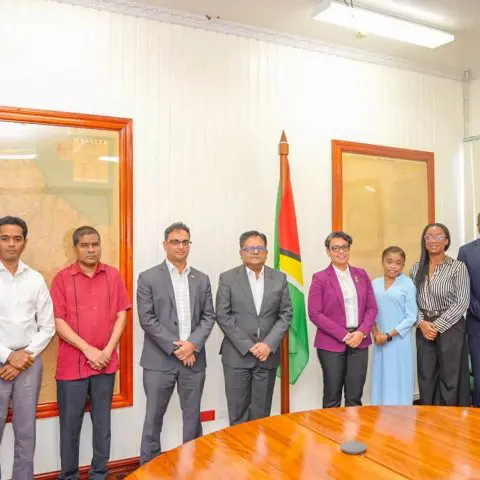
Media representatives on Saturday joined the government’s ongoing consultations on proposed measures to regulate social media and strengthen protections for children online, offering recommendations that are expected to form part of the final policy framework.
The engagement was led by Minister within the Office of the Prime Minister with responsibility for Public Affairs Kwame McCoy at the Office of the Prime Minister, Camp Street, Georgetown. It brought together representatives from various media houses who shared their views on the proposals under consideration as the government continues to solicit feedback from stakeholders across the country.
The latest meeting with media representatives forms part of the consultation on “Social Media and its Consequential Effects on Children” that President Irfaan Ali tasked the Ministry of Parliamentary Affairs and Governance with coordinating.
At the launch of the initiative on June 2 at the World Trade Centre in Kingston, Georgetown, Attorney General and Minister of Legal Affairs Anil Nandlall SC disclosed that the government had retained a United Kingdom firm to develop a practical and effective model to regulate cyberspace and protect children amid advancements of technology and social media.
According to Nandlall, the firm has already been instructed to examine models from around the world that have proven successful. “Regulating cyberspace is no longer an option in the world… it must be regulated…we will do everything to ensure we get a national output, and we will look at the best and most updated position for Guyana,” he said.
The June 2 consultation brought together stakeholders from various sectors to examine the impact of social media and related technologies on the well-being, development, safety and social interactions of children. Participants were invited to submit written recommendations that could inform the government’s final approach.
Minister of Parliamentary Affairs and Governance Gail Teixeira said Guyana now has more than one million registered cell phones, underscoring the widespread access to social media. She said the exercise is aimed at protecting those least able to protect themselves, particularly children, from threats such as harmful content, cyberbullying, exploitation, misinformation, excessive screen time and impaired cognitive and social development.
Among the proposals being considered under a National Child Online Safety and Ethical Technology Framework for Guyana is the introduction of a minimum age of 16 for social media use, while children between the ages of 13 and 15 would only be allowed access with parental consent. Educational, research and other approved platforms would be exempt from the restrictions.
The framework also proposes mandatory age verification for social media platforms, child-safe platform design measures, digital literacy education, national awareness campaigns for parents and guardians and the establishment of a Child Online Protection Authority to oversee child safety measures in the digital environment.
Teixeira, however, acknowledged that enforcement could be challenging, noting that online child protection remains a relatively new area for Guyana’s legal and judicial systems.







Discussion