
Part Two of Two: The commissioners and the failure of leadership
Business and Economic Commentary
Introduction
Last week, I examined GECOM’s history and its reported expenditure of G$46.53 billion over fifteen years. This concluding article examines whether its chairperson and commissioners have justified the authority, benefits and public confidence entrusted to them through their performance.
GECOM comprises Chairperson Justice (ret’d) Claudette Singh and six commissioners: three appointed by the President in his own judgement, and three on the advice of the Leader of the Opposition after consultation. Conceived for Guyana’s 1992 return to democratic elections, this political compromise has never guaranteed independent, professionally accountable electoral governance. As the Table below shows, the two longest-serving commissioners have collectively held office for more than 37 years, while another approaches twelve.
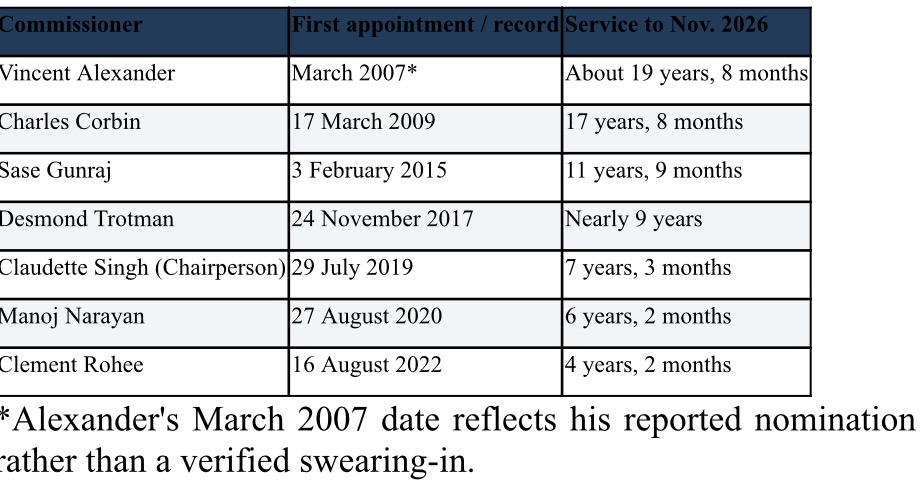
What measurable improvements to Guyana’s electoral system can any one of them demonstrate after so many years? GECOM is neither a pasture for political appointees nor a retirement home for those whose useful public service has run its course.
The 2025 elections gave WIN sixteen opposition seats, APNU twelve and Forward Guyana Movement one, yet the previous opposition nominees remain on GECOM. Dickens’ Mr. Bumble called the law “an ass – a idiot.” Must constitutional tenure in twenty-first-century Guyana excuse institutional paralysis? This looks more like staying on a lucrative payroll than public service. The honourable course was for all six commissioners to resign and offer themselves for reappointment. None did.
We learnt from a Commissioner that GECOM has not met since September 2025. That a constitutional body responsible for elections can remain inactive for over a year indicts its leadership. The Chairperson cites disputed opposition representation; incumbent nominees insist their appointments remain valid. The President and Opposition Leader share responsibility, but Local Government Elections remain in limbo. By what authority can Singh suspend meetings indefinitely? The Carter Center warned in August that the deadlock threatened the statutory timetable. Her withdrawal to a locked room during the 2020 election crisis compounds questions about her leadership.
The inevitable question is, what are commissioners being paid for? In March 2021, Minister Gail Teixeira disclosed ordinary commissioners’ basic monthly salaries of G$478,485, plus allowances and security provision capped at G$7.2 million annually per commissioner – not necessarily paid in cash. The Chairperson then received over G$2 million monthly, reportedly rising to G$2.7 million by 2025. What exactly are the Chairperson and commissioners being paid for -constitutional service, or paralysis, political pasturage, personal enrichment and loyalty to those who appointed them?
Justice Claudette Singh’s conduct and cowardice during the 2020 electoral crisis remains troubling. She told the Commission of Inquiry that she withdrew to a locked room during the controversy over Region Four Returning Officer Clairmont Mingo’s declaration, explaining that she was frightened and unwell. Although the Commission had met earlier that day, who was directing it when disputed figures were being declared? Her absence raises serious questions about leadership at a critical moment, and her capacity for continuing in that office.
The Carter Center and European Union acknowledged improvements in the September 2025 polls, reflecting credit on ordinary election officials. Those achievements cannot excuse failures of leadership in 2020 or the Commission’s present paralysis.
After decades of service, where are the commissioners’ substantive reform proposals, published agendas, minutes, voting records and implementation plans? The Carter Center reported in 2025 that Commission meetings were closed and such records unavailable. Commissioners should provide independent leadership, not merely occupy seats on behalf of political sponsors.
The reform agenda is familiar. The Carter Center has repeatedly urged reform of GECOM’s politicised structure, while the EU made eighteen recommendations in November 2025. Yet campaign-financing rules remain archaic, disclosure inadequate and oversight ineffective. Parliament must modernise the law, but why has GECOM not led the demand for reform or enforced existing requirements? In October 2025, the Carter Center was still urging political parties to submit their election expenditure returns. More fundamentally, how can elections be considered genuinely fair when campaign financing remains inadequately regulated and the governing party enjoys advantages from incumbency and state resources? Neither the Carter Center nor the EU can resolve that question merely by praising the administration of polling day.
Guyana must neither return to the manipulated elections of the past nor remain captive to a political compromise devised for 1992. The professional secretariat must be preserved, but the present governing arrangement requires fundamental change. Our oil wealth should encourage higher standards of constitutional propriety, efficiency and accountability, not subsidise institutional inertia and political privilege.
The Constitution Reform Commission, chaired by former Chancellor Carl Singh, should urgently address GECOM’s future. That Commission itself faces troubling questions about its pace of work, political composition, remuneration and institutional effectiveness. It should accelerate its work and publish a substantive Thought Paper examining GECOM’s structure, appointments, tenure, independence and accountability, together with practical alternatives. After more than two years in office, surely its members can offer the country something more substantial than an invitation to submit proposals.
In closing, I address Justice Claudette Singh and Commissioners Vincent Alexander, Charles Corbin, Desmond Trotman, Sase Gunraj, Manoj Narayan and Clement Rohee directly. Look into your consciences. Ask yourselves whether you have put country before party, constitutional duty before personal interest, and public service before financial reward. Vincent, after nearly twenty years, surely this is your opportunity to demonstrate that honour matters more than tenure. Sase and Manoj, as successful attorneys, you have professional reputations worth far more than any commissioner’s remuneration. Why risk those reputations for political appointments you do not need?
No question that Guyana needs an Elections Commission that serves democracy, not political sponsors. Public office is a sacred trust, not a pension plan. The time has come to put country before self.







Discussion