
By Prof C. Justin Robinson, Pro Vice Chancellor and Campus Principal, UWI Five Islands Campus
t’s as familiar a scene across the Caribbean as one of our stunning sunsets. The Central Bank Governor and the Minister of Finance proudly report that tourist arrivals set a record, the economy grew again, the economy is in the pink of health and commentators like me chime in confirming the glowing reports. A housewife goes to the supermarket the same evening, watches the cashier ring up the items, quietly puts some stuff back on the shelf and swears loudly that these damn people always trying to fool we with these economic reports.
Caribbean people are often stunned to read that their countries are classified as middle or high-income countries, while they and most people they know struggle to make ends meet.
As people discuss the gap between the news reports and their own pocket book you typically hear two reactions. Some conclude the numbers are lies while others conclude they must be missing something, the economy is a matter for experts, and their own struggle is a private failure. The reality is that both conclusions are wrong, and both are dangerous.
The numbers are usually not lies and people are not missing anything, the numbers being reported are asking and answering a different question from the one households are asking.
Two reasons the numbers and the kitchen table disagree
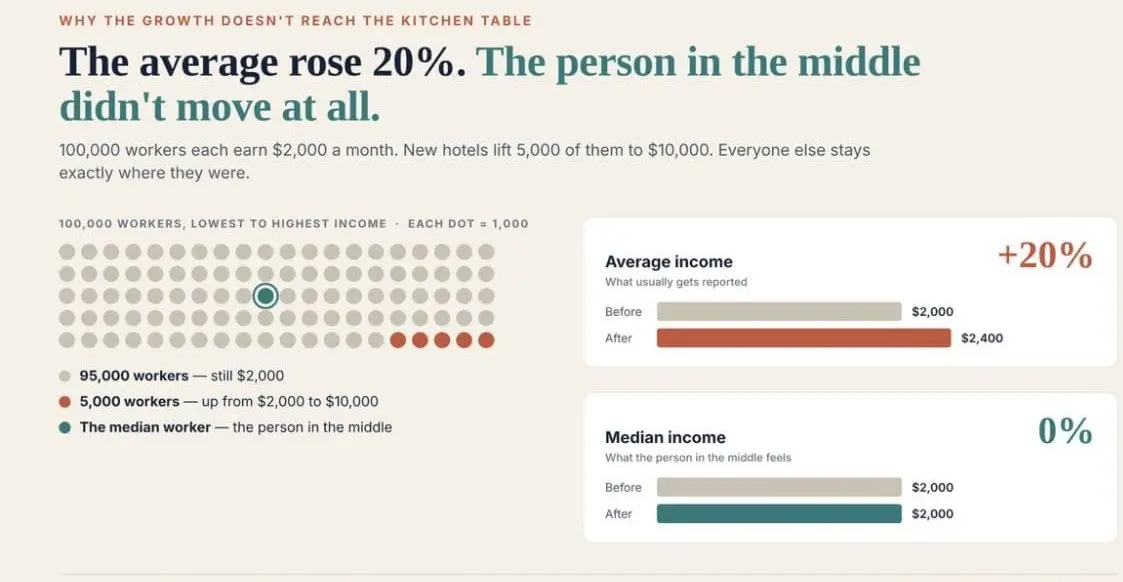
If there are 100,000 people working in the country with each person earning $2,000 a month, then the average income in the country is $2,000. Now suppose there are some major investments in the country with say several new hotels and 5,000 people see their incomes rise to $10,000 while the incomes of the other 95,000 workers stays exactly where it was. The average income in the country will jump to $2,400, the news would truthfully announce that average income has grown by 20% and 95,000 people would still be wondering how on earth they became better off.
If we used a different statistic, the median, where we line up the 100,000 workers from the lowest to highest income and look at the person in the middle we get a different picture. That person in the middle, still earns $2,000, the average has soared by 20% but the middle or the median has not moved.
The use of the average without reporting the median is a major cause of the disconnect between the official statistics and the experience of the average man or woman. Averages are pulled upward by the fortunate few while the median, the person in the middle, is not, and when we report only the average, we let the top speak for everyone.
The second source of the disconnect runs deeper and it lies in the use of Gross Domestic Product (GDP) and GDP per capita as the main indicator of economic performance. GDP measures the dollar value of what the economy produces and GDP per capita divides that by the population and is often interpreted as average income per person. The economy is not the household, and the simple fact is that GDP per capita is not anyone’s actual income. Part of GDP goes to profits, part goes to government and part is reinvested and what actually reaches households after taxes and including wages, pensions, remittances and transfers, can be very different. In tourism economies, much of the hotel and resort profit is repatriated abroad so it counts in GDP but never reaches a Caribbean household’s bank or credit union account.
A household prosperity statement
More is at stake here than an esoteric economic or statistical discussion. A central problem in the Caribbean is that official statistics repeatedly describe an economy that citizens do not recognize. As a result, people have stopped believing the statistics, they have stopped believing the institutions that publish them and the people who speak based on these official statistics, except maybe when it feeds the interests of their political tribe.
If we are to rebuild trust we must provide our people numbers they can test against their own kitchen tables.
I propose that Caricom, the Caribbean Development Bank, the Eastern Caribbean Central Bank and UWI partner to build an annual Household Prosperity Statement for Caricom member nations. The centerpiece of the statement would be an annual survey of Real median disposable household income and poverty measures. It is a challenging but necessary exercise but there are established and globally accepted methodologies and we don’t lack the expertise or regional and international partnerships to do this.
What happens when the question changes from GDP only?
The first change is that growth would stop justifying itself. At present, a year of strong GDP growth is treated as a good year by definition. However, alongside a Household Prosperity Statement, strong growth with flat Real median disposable household income and poverty numbers is a mixed year while modest growth with a rising middle and less poverty is a successful one.
A second change is the debate around national budgets and policies. Each budget can now be assessed according to how its measures are expected to affect real median disposable household income household purchasing power and poverty levels, and importantly the next year’s statement can report on the impact. Major investment initiatives should answer a question beyond output, what will they credibly contribute to local earnings, household security and public revenue?
The third change is subtler. For decades, our implicit model has been trickledown economics, grow the economy and trust that the benefits will reach people. A household measure forces us to ask how growth reaches average people and policy debates will shift to the handful of routes from a dollar of GDP output to a family’s kitchen table. These routes are typically:
• prices, through the cost of essentials;
• the state’s share, through taxes and transfers;
• wages and local linkages, through who is employed and who supplies;
• capital income, through who owns the assets.
My proposed Household Prosperity Statement should not be read as an argument against GDP or profitable business. What I am suggesting is that for decades the official statistics have been asking and answering whether Caribbean economies are getting bigger, which is an important, necessary and insufficient question. The Household Prosperity Statement will ask and answer whether the person in the middle, the teacher, the bus driver, the nurse, the vendor, is getting ahead.







Discussion