by Ray Kril
Nong Saeng Soi, Thailand
Ray Kril has produced documentaries in USA, Guyana, Suriname, Netherlands, Cuba, UK and recently Asia. Kril has done 12 productions in Guyana, including the award winning films “The Seawall: Tales of the Guyana Coast’ and with the Victor Jara Collective, “The Terror and the Time.” He was also founder, with Terry Roopanarine, of the environmental film organization, Guiana Shield Media Project (GSMP). As a cinema educator, he has held positions at the University of Iowa (USA), Saxion University (Netherlands), Cornell University (USA), University of California, Humboldt (USA) and Limkokwing University (Malaysia). Ray currently lives in Thailand, doing international film production and film project consultancies.
‘They come treading in the hoofmarks of the mule
Passing the ancient bridge
The grave of pride
The sudden flight
The terror and the time.’
– Martin Carter
I first met Eusi Kwayana in 1976 when I was in Guyana making a film with Rupert Roopnaraine, Lewanne Jones and Susumu Tokunow as a member of the Victor Jara Collective. We had formed the group in the USA at Cornell University. Rupert was Guyanese and was returning home after resigning from his position at Cornell. I had been at Cornell as the Cornell Cinema Coordinator.
As a filmmaker, I was always on the lookout for interesting social /political film projects. Rupert talked to me about the possibility of making a film in Guyana, thus the Victor Jara Collective was formed to go there. The film we made focused on the 1953 period of Guyanese history when there was the first election under universal suffrage in the colony. The film, as it developed, had three main characters as the documentary voices. The structure of the story would be told from the poetry of Guyanese poet Martin Carter, using his poems and his reading of the poems from his book published in 1953, Poems of Resistance. Carter is not seen in the film, only the reading of the poems which are illustrated with film images that we shot, as well as archive material.
Cheddi Jagan, of the People’s Progressive Party that won the election in 1953, tells the political history through interviews on camera as well as illustrations we filmed and archive material.
Eusi Kwayana, the third voice in the film, was also a part of the 1953 PPP Party. He began his political activities as a village organizer from the village of Buxton where he remained for most of his life. He was a teacher, writer, activist, and philosopher. His role was to discuss the importance of the poetry of Martin Carter to the struggle of the working people. We chose to be called the Victor Jara Collective, named after the Chilean poet, folk singer and politician whose work, music and art was about love, peace, and social justice. He was an inspiration to the people in Chile in 1970s who were being oppressed, and he became a “potent symbol of struggle for human rights and justice” through his art. Jara was arrested by the Chilean military the day after the 1973 coup led by Augusto Pinochet, which overthrew the elected Allende government. We wanted to identify our filmmaking as cultural workers as part of the struggle for social justice. Eusi Kwayana was a perfect choice to present the importance of the poetry and its significance to the people and their struggle at that time. I should mention that Kwayana, Jagan and Carter were arrested in 1953 after the British suspended the constitution, invaded Guyana and dismantled the PPP party government that had been elected; another interesting parallel to Victor Jara 20 years earlier.
I remember meeting Eusi Kwayana with Rupert when we went to Buxton to discuss the concept of the film and what Rupert thought he could contribute. I was impressed by the gentleness in Eusi’s voice and mannerisms. You immediately felt comfortable, and I could see and hear that he was a man of wisdom. As a white man from New Jersey, I felt comfortable and accepted as we were working together on a shared goal.
Many have written about Eusi Kwayana’s political and cultural achievements; for me, he was a teacher who could eloquently and simply dissect language and suggest a way to see and hear the meaning, in this case of poetry. This is what I discovered when we filmed his discussion about the importance of Martin Carter’s Poems of Resistance to the people at that time and their political significance.
The filming of Kwayana’s discussion for the film was done at the school in Buxton where he taught at one time. Here you see him to the left in discussion with Roopnaraine who is sitting in front of him under the camera lens. Ray Kril is on the right of the frame.
I have included two pages with frames from the film of Kwayana’s discussion of the poetry and the influence at that time. The frames follow the visualization we did of the poem ‘Cartman of Dayclean.’ There are five (5) more sequences in the film where Kwayana elaborates on the poetry and its significance as well as contribution to the anti-colonial struggle. I hope to publish these frames and discussion in the near future.
I met with Kwayana several more time during my various film projects I did in Guyana as well as while doing the political spots for TV for two of the Working People’s Alliance election campaigns. Several spots included discussions from Kwayana. During these times I had a greater insight into his political thinking. We were able to have many discussions when Rupert Roopnaraine and I drove him home to Buxton following the many late-night meetings.
We lost a truly remarkable human being who gave us much during his 101 years with us. A true giant.
You can see the film The Terror and The Time on my YouTube Channel at https://www.youtube.com/watch?v=F9T-FgZTLtE&t=193s
We are finalizing a 4K digital restoration of the film, hopefully by the end of 2026. At that time, the YouTube copies will be removed and there will be a new distribution for the film with some public screenings.
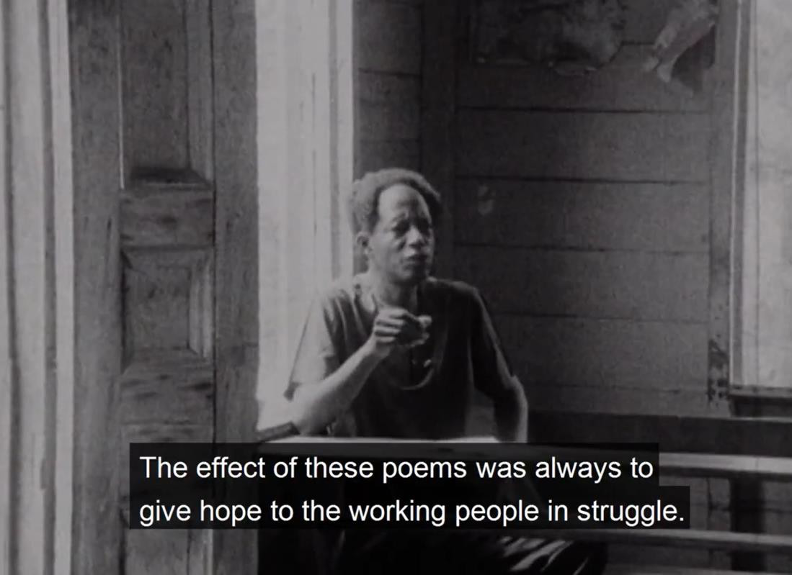
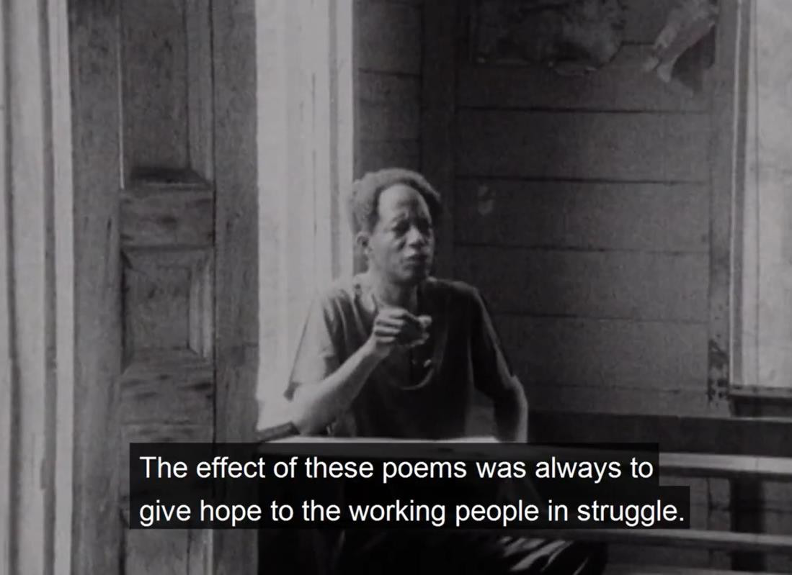
I close with some frames from The Terror and the Time of Kwayana’s discussion of the poetry and the influence at that time. The frames follow the visualization we did of the poem Cartman of Dayclean. There are five (5) more sequences in the film where Kwayana elaborates on the poetry and its significance as well as contribution to the anti-colonial struggle. I hope to publish these frames and discussion in the near future.
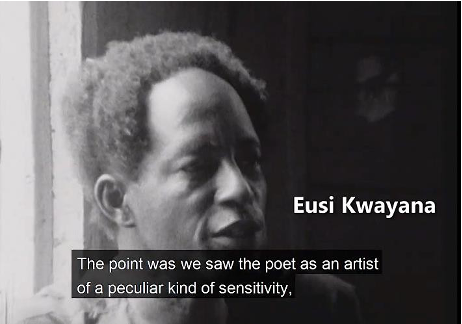
Here Eusi alerts us that the poet is an artist with a peculiar kind of sensitivity. That sensitivity is that he is speaking to workers with his language of observation and understanding of their reality.
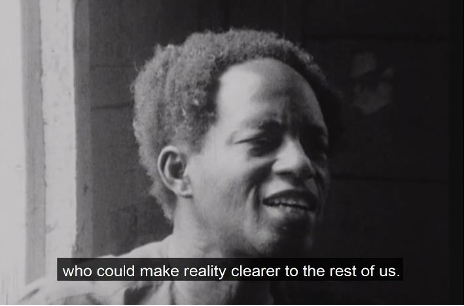
The poems make the reality of the subject clear to all of us, workers, teachers, and professionals.
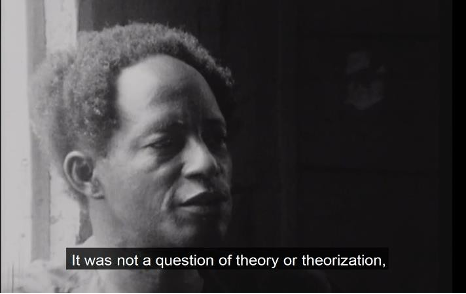
Eusi tells us it was not necessary to know the theory or theorization of the words or the poetry. The structure carried a meaning that many could relate to.
The poems were themselves explaining their theory as they reached into experiences that almost all were sharing. They were meeting the challenge of the time.
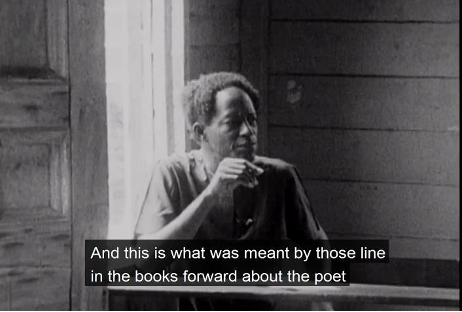
The poems were published as Poems of Resistance . It was later banned after the British invasion of 1953. All copies were confiscated by the police and burned.
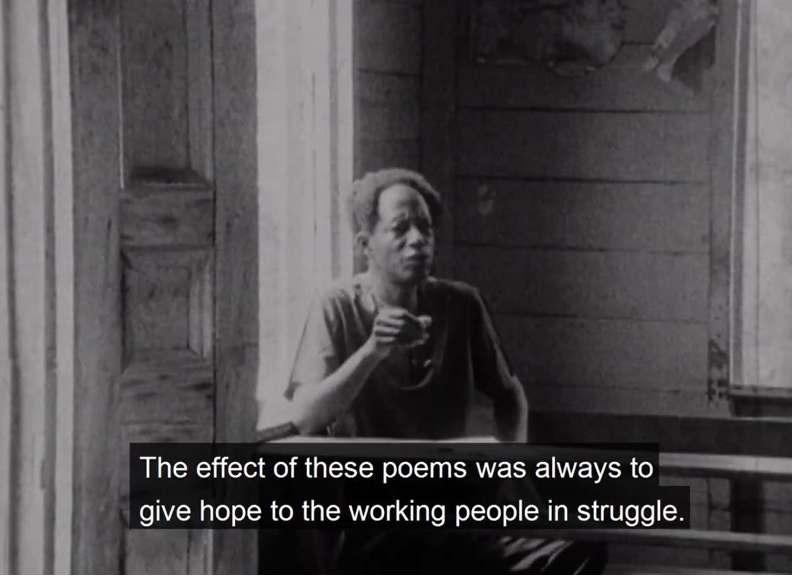
This is an amazing way to explain the work of the poet, or any artist producing work that is meant to be part of social change. The original meaning of the word culture had to do with the caring of plants and animals. The roots of the word culture relate to agriculture, nurturing, cultivating, and caring, where food provides nutrition for the body. Nurturing the mind provides knowledge and meaning. So here, for me, Eusi hints that the poet provides the nurturing of the mind and consciousness.







Discussion