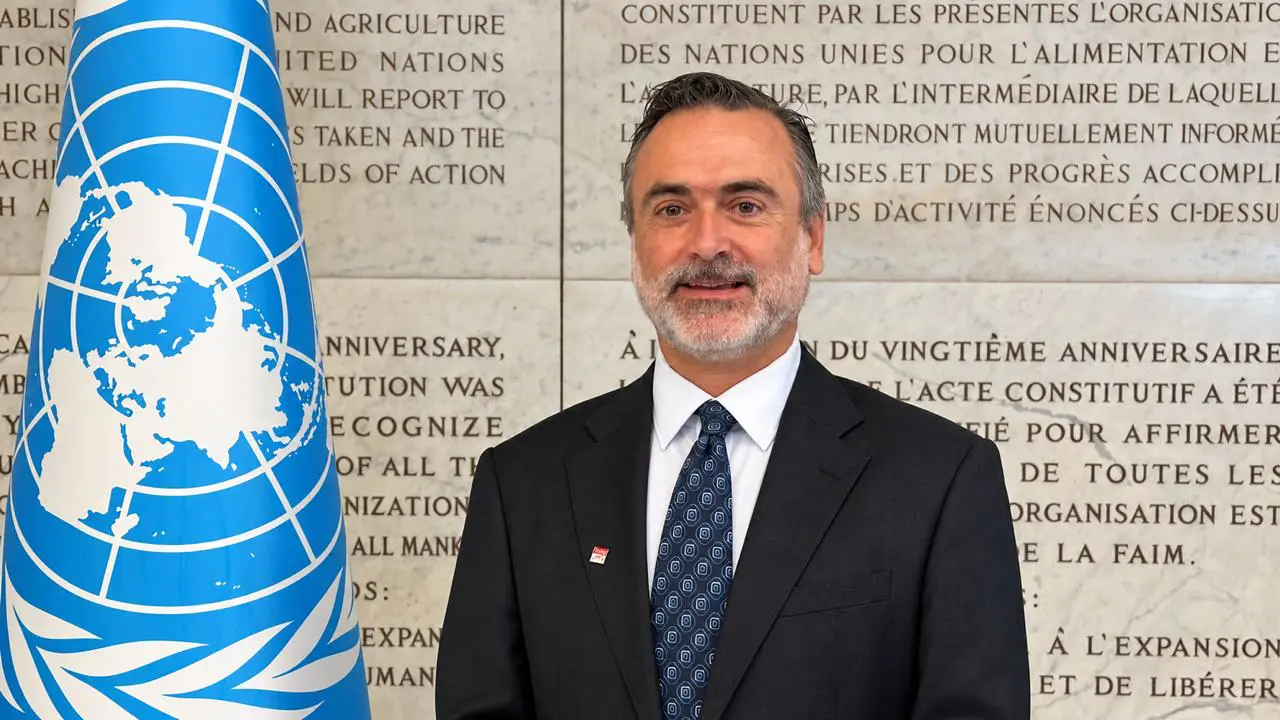
By Juan Echanove
Right to Food Team Leader
Food and Agriculture Organization of the United Nations (FAO)
This article draws on my opening keynote at the 5th Food Law, Policy & Diplomacy Conference, marking the launch of the International Joint Research Group on Agrifood Law and Food Systems.
Imagine a country where agricultural exports are growing, investment is rising and new technologies are reaching farms. Yet many families still cannot afford a healthy diet, smallholders struggle to keep their land, and children depend on food assistance. How successful is that food system? The answer depends on what we believe food systems are ultimately for, and that question should guide every conversation about their transformation.
Those of us working in the sector approach this challenge from different directions. We focus on production, nutrition, climate, markets, technology or rural livelihoods. Each perspective matters. But we also need a shared basis for deciding where change should lead and how to judge its results. I believe the right to food provides that framework: everyone should be able to feed themselves and their families adequately, sustainably and with dignity.
This is a commitment grounded in international human rights law, including the International Covenant on Economic, Social and Cultural Rights and the FAO Right to Food Guidelines. Its practical value extends to anyone making decisions that affect food. It helps connect the work of an agricultural planner, a nutritionist, a mayor, a researcher or a parliamentarian around the people their decisions are meant to serve.
Take an agricultural investment. Higher yields and stronger markets may bring substantial benefits. A right to food perspective asks us to examine who can access those opportunities, whether smallholders have a say, what happens to people’s access to land and water, and whether better production translates into better diets. These questions help us design investments whose success reaches beyond aggregate figures and becomes visible in people’s lives.
The same applies to school meals. Announcing a programme is an important step, but its value depends on whether children can actually rely on it. Who is responsible for delivery? Is there a budget? What happens to a child excluded because of missing documents or inadequate school facilities? Can parents raise a concern and get it resolved? The right to food connects a nutritional ambition with the decisions needed to make it work.
That is what makes it useful as a framework for transformation. It helps us move from broad objectives to practical choices about resources, responsibilities and participation. It also helps expose familiar gaps: a law that nobody has the capacity to implement, a strategy without funding, or a consultation whose participants have no influence over the outcome. People experience these gaps as missed meals, lost livelihoods and unanswered requests for help.
Food security tells us whether people can access sufficient, safe and nutritious food. The right to food helps us understand the decisions and relationships behind that situation, including who has the power and responsibility to improve it. People are recognized as rights-holders who can make claims, participate in decisions and seek a remedy. Governments have obligations to respect, protect and fulfill that right, including creating conditions in which people can provide for themselves.
For those working in the sector, this offers a way to connect activities that too often proceed separately. Agricultural policy affects livelihoods; wages and social protection affect purchasing power; procurement shapes what schools serve and which farmers supply them. Climate measures influence access to productive resources. Bringing these decisions together around the right to food makes it easier to identify where one policy supports—or undermines—the objectives of another.
Africa’s new cycle of commitments under the Comprehensive Africa Agriculture Development Programme offers an important opportunity to put this approach into practice. The Kampala agenda and the 2026–2035 strategy can help countries link agricultural investment with nutrition, fairer access to resources and stronger participation. Asking whose livelihoods improve, whose diets become healthier and whose voice shapes investment decisions gives transformation a clearer direction.
This is equally relevant in Europe. Food poverty, unequal access to healthy diets, pressure on farmers and the widespread consumption of ultra-processed foods all raise questions about how food systems serve people. Discussions about minimum incomes, school meals, sustainable procurement and access to land already address much of the substance of the right to food. Recognizing that connection can help turn separate debates into a more coherent public agenda.
Cities show how concrete this can become. Decisions about school kitchens, markets, public land and municipal purchasing can influence both the food people eat and the livelihoods of those producing it. Experiences in Rome, Valencia, Ghent and Mouans-Sartoux illustrate different ways of bringing sustainability, nutrition and social inclusion together. The right to food allows room for these different approaches while providing a common test: are they making adequate food more accessible, and can the people concerned help shape them?
Dignity is central to that test. Food assistance can keep someone fed while leaving them stigmatized, dependent or without meaningful choice. Food banks and charitable organizations often do extraordinary work, especially during emergencies. Their contribution should also lead us to ask why people need their help and what would enable them to afford adequate food through ordinary means. Lasting progress means strengthening people’s ability to act for themselves, with reliable support whenever they need it.
Participation, accountability, non-discrimination, transparency, human dignity, empowerment and the rule of law—the principles we bring together under the acronym PANTHER—help translate this approach into everyday practice. They ask whether people can influence decisions, understand how resources are used and challenge exclusion. A programme designed around these principles is better equipped to identify problems early and respond to the people affected.
At FAO, we support countries in applying this thinking through legislation, national strategies, monitoring, parliamentary action, training and access to justice. Academic observatories help connect evidence with policy; parliamentarians can link commitments to budgets and oversight; courts and other institutions can help people obtain remedies. The purpose of connecting this work is to make public commitments effective in people’s lives.
Research and international cooperation have an essential role too. The questions facing food systems cross disciplines and borders: climate change, trade, conflict, artificial intelligence and biotechnology all affect how food is produced and accessed. Networks such as the International Joint Research Group launched in Brussels can help us understand these connections and examine whether the changes we promote are delivering the benefits we intend.
Agrifood transformation is already happening. The choices we make now will determine who benefits, who carries the costs and whether people have a voice in their future. The right to food gives us a framework for making those choices with a clear purpose: enabling everyone to eat adequately and live with dignity. For everyone working to transform food systems, that provides both a direction and a demanding measure of success.







Discussion