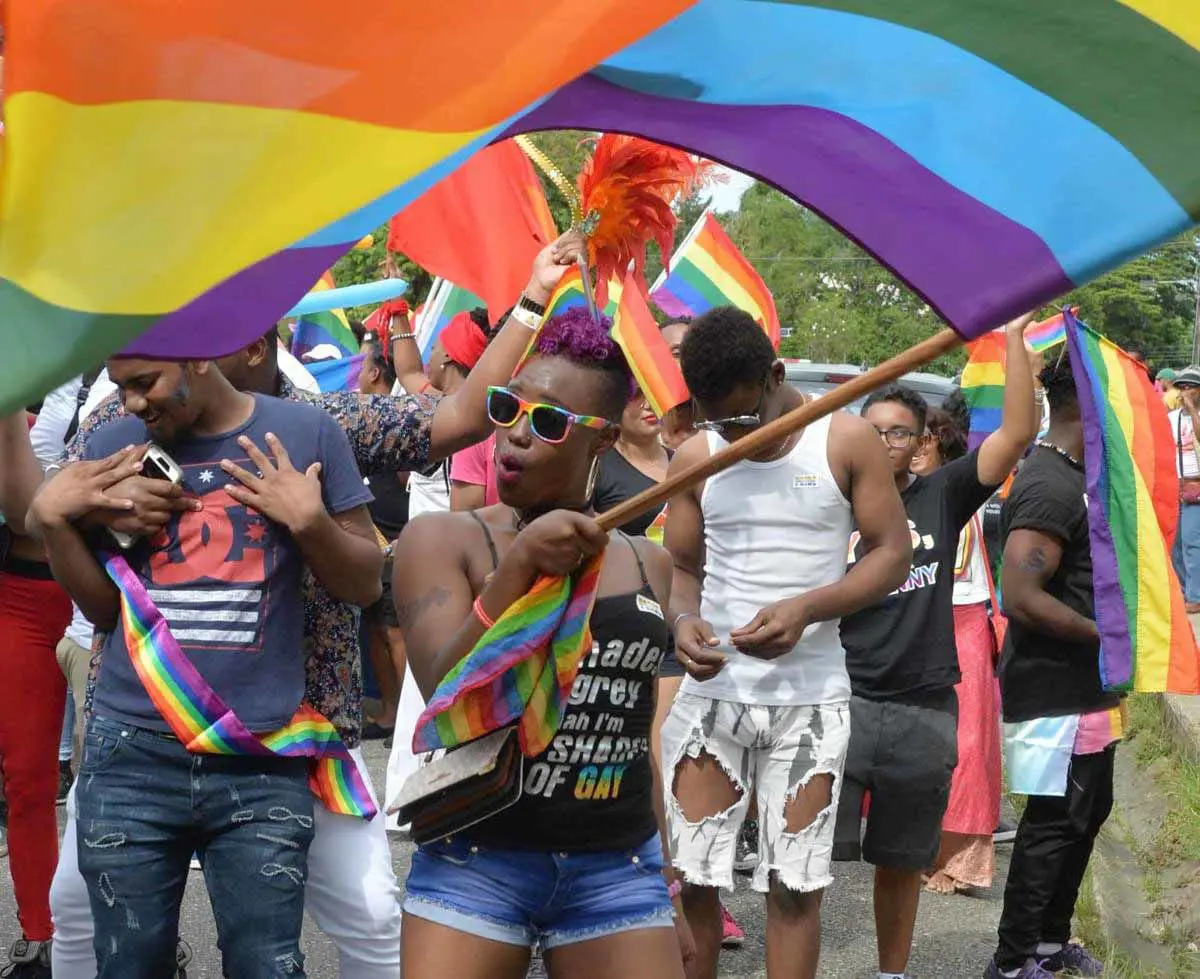
(Trinidad Express) It is now official.
Consensual sex between adults of the same sex in private is no longer a criminal offence in Trinidad and Tobago.
And adults — whether in same-sex or heterosexual relationships — can no longer be prosecuted under Section 13 of the Sexual Offences Act for consensual anal intercourse in private.
The Privy Council on Tuesday delivered the final and most significant ruling yet in a constitutional battle which began almost ten years ago, dismissing the State’s challenge and upholding Jason Jones’ right to engage in private, consensual sexual relations without being branded a criminal.
But while the case was brought by Jones, a gay man challenging laws which had a particular impact on the gay community, the effect of the ruling goes beyond homosexual relationships.
Under the previous wording of Section 13, a man who engaged in consensual anal intercourse with another man could be prosecuted. So too could a man who engaged in consensual anal intercourse with a woman.
In other words, a woman and her male partner could have faced criminal sanctions for engaging in the act, even in the privacy of their own home and even where both adults consented.
That is no longer the case.
The five-member Judicial Committee of the Privy Council — Lord Reed, Lord Briggs, Lord Sales, Lord Burrows and Lady Rose — allowed Jones’ appeal and dismissed the Office of the Attorney General’s cross-appeal.
It means that Sections 13 and 16 of the Sexual Offences Act must be interpreted in accordance with the Constitution so that they do not criminalise private, consensual sexual relations between adults.
The Board ruled that the laws infringed Jones’ fundamental rights, particularly his right to respect for his private and family life.
“The ability to form a deep connection with another person through an intimate and loving relationship is a vital interest for all human beings,” the judges said.
For decades, Sections 13 and 16 carried serious criminal consequences for sexual conduct between consenting adults.
Section 13 dealt with the offence of buggery. Before the law was modified by Justice Devindra Rampersad in 2018, the provision criminalised sexual intercourse per anum by a man with another man or by a man with a woman, regardless of whether the parties had consented.
The offence carried a maximum penalty of 25 years’ imprisonment.
It meant that the law did not only affect gay men. Consensual anal intercourse between a man and a woman was also capable of attracting the same criminal sanction.
Section 16 dealt with “serious indecency” and carried a penalty of five years’ imprisonment.
The provision defined serious indecency as an act, other than sexual intercourse, involving the use of the genital organs for the purpose of arousing or gratifying sexual desire.
That definition was broad enough to cover sexual acts including oral sex. As a result, consensual oral sex between adults — whether between two men, two women, or a man and a woman — could potentially fall within the scope of the criminal law.
Thus, the impact of the legislation was not confined to homosexual couples.
Adults in heterosexual relationships could also potentially face criminal consequences for consensual sexual acts carried out in private.
Although Section 16 contained limited exceptions, including for certain conduct between a husband and wife, the law still treated other private consensual sexual activity as potentially criminal.
The Privy Council’s ruling now brings the long-running constitutional challenge substantially to an end, although the Board has left open the question of the precise final form of the remedial order.












Discussion