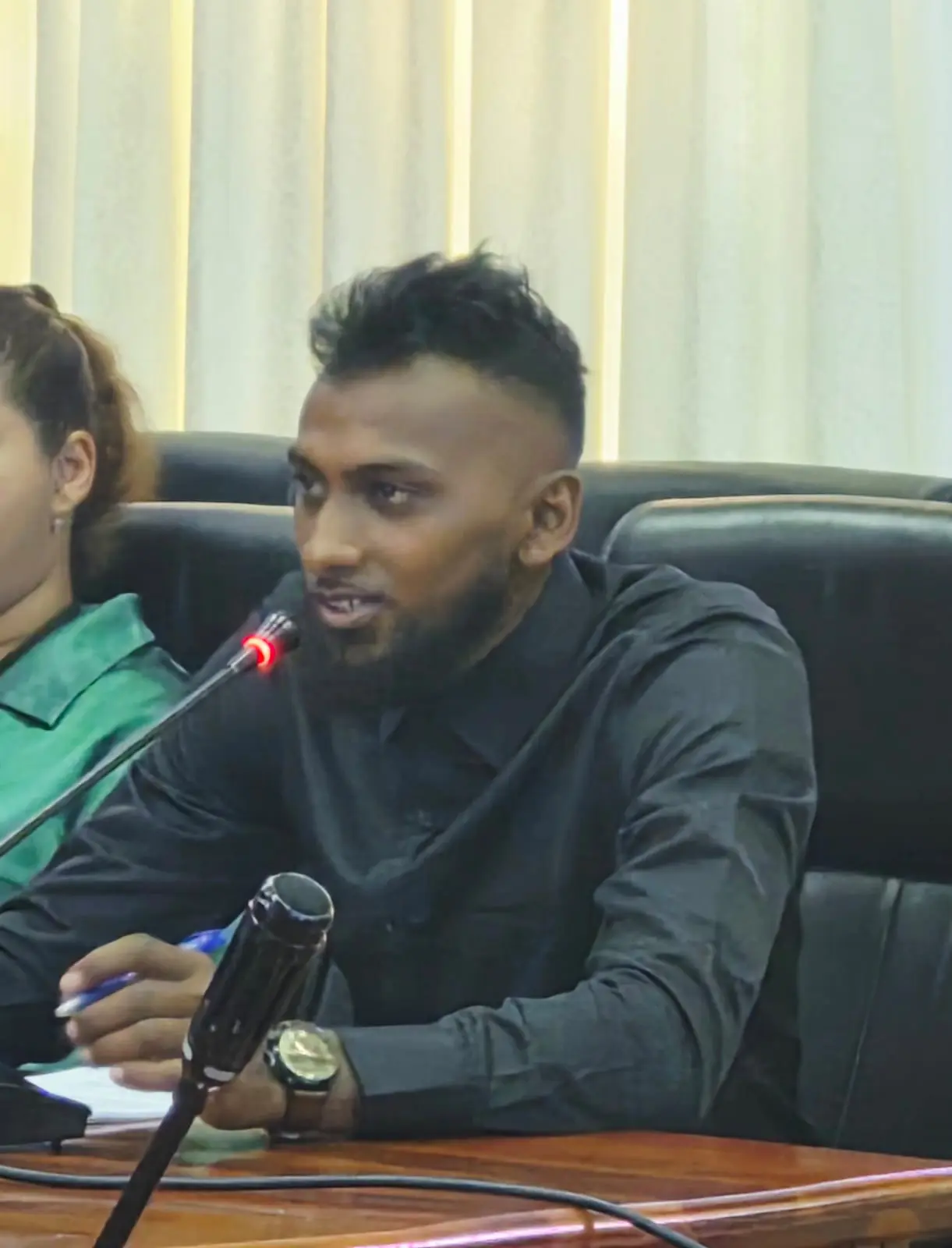
-recorded videos while in the water
A survivor of the MV Barima tragedy has recounted how he fought for about two minutes under water, struggling to find an escape as passengers and cargo were swept around him when the vessel capsized, before eventually breaking through the surface and finding two life jackets.
Rajwan Komar, who was among the survivors of the July 18, 2026 tragedy, told the Commission of Inquiry (CoI) yesterday that he feared he would die as he struggled beneath the water, unable to distinguish between up and down in darkness, screams and the force of water rushing into the boat.
He recalled that the ferry suddenly shifted sharply to its right before cargo crashed across the vessel and passengers were thrown towards the starboard side. Within seconds, he said, people were piled on top of one another as water rushed into the vessel, leaving passengers disoriented and fighting for survival.
Komar described the experience as terrifying, saying he felt his strength fading as he struggled under water. For a moment, he said he thought he would die but he eventually found an opening and managed to resurface.
When he emerged, he saw the overturned MV Barima with its propellers pointing into the air and observed two to three survivors on top of the exposed hull.
A short distance away, he spotted two life jackets whose reflective strips caught the faint moonlight. He swam towards them and managed to grab hold of both. Komar said that as he moved away from the vessel, other passengers around it were being pulled underwater by the suction as the ferry sank.
Among the most distressing moments he recalled was seeing a baby surface briefly two or three times before disappearing beneath the water.
Before recounting the moments of the capsizing, Komar detailed several concerns he observed during the journey from Georgetown. He testified that less than two hours after departure, the vessel experienced repeated engine problems, with its speed dropping significantly and the engine appearing to lose power.
He estimated that this occurred two to three times, during which mechanics were seen working to restore the engine. He also said water was splashing onto the lower deck shortly after the vessel entered the Demerara River.
Concerned that the water was entering faster than it was being drained, he alerted sailors passing nearby. However, he said they responded dismissively, rolled their eyes and walked away.
Komar, who was travelling on the MV Barima for the first time, said he observed more than 100 passengers crowded into the front section of the passenger deck. He described the area as cramped and said cases of Stag beer were placed beneath passenger benches and along the walkways.
Commissioner Nyree Dawn Alphonso focused her questioning on the MV Barima’s loading arrangements, its loading capacity and the number of passengers aboard.
Komar told the commission that, based on photographs he took when the vessel moved away from the wharf before additional cargo and passengers were loaded, the water appeared very close to the vessel’s upper steel fender.
He explained that he took the photographs after the vessel manoeuvred away from the wharf, following difficulties getting it out, and before passengers boarded. He said additional cargo was subsequently loaded before passengers were brought aboard.
Asked about the number of people on the ferry, Komar estimated that close to 200 passengers were aboard, although he acknowledged that he couldn’t say for sure.
Alphonso also questioned him about his decision to transport a motorcycle on the vessel and Komar explained that between 11 a.m. and noon, he approached a female Transport and Harbours Department staff member responsible for coordinating cargo loading and was told there was room for the motorcycle. He subsequently purchased it, returned to the wharf and paid the freight charges.
Alphonso thanked Komar for providing the photographs and videos, describing the footage as particularly helpful to the inquiry. She also commended him for documenting aspects of the tragedy while he was fighting for survival in the water.
Commissioner, Dr. Andrzej Jasionowski commended Komar for his efforts to help other survivors, particularly a young woman to whom he provided a life jacket. He also praised him for recording videos while stranded in the water, describing the footage as important forensic evidence for the inquiry.
The commissioner also examined the layout of the vessel and the arrangements for passengers with Komar describing the lower deck as congested, with cargo, a generator, wooden crates and other items obstructing movement. He said there was essentially one passageway along the port side through which passengers and crew had to move.
Jasionowski questioned Komar about a generator and its exhaust pipe, which he had mentioned in his evidence. Komar responded that the generator was not running when he observed it, but he noticed what he considered poor welding on two large pipes. He expressed concern that if the generator operated, exhaust gases could become trapped inside the vessel and affect people on the lower deck.
Jasionowski also sought clarification about two flares Komar said he witnessed while stranded at sea. Komar estimated that the first flare was fired at approximately 12:20 a.m., while the second was launched sometime between 1 a.m. and 2 a.m., closer to 1 a.m., as a helicopter passed overhead.







Discussion