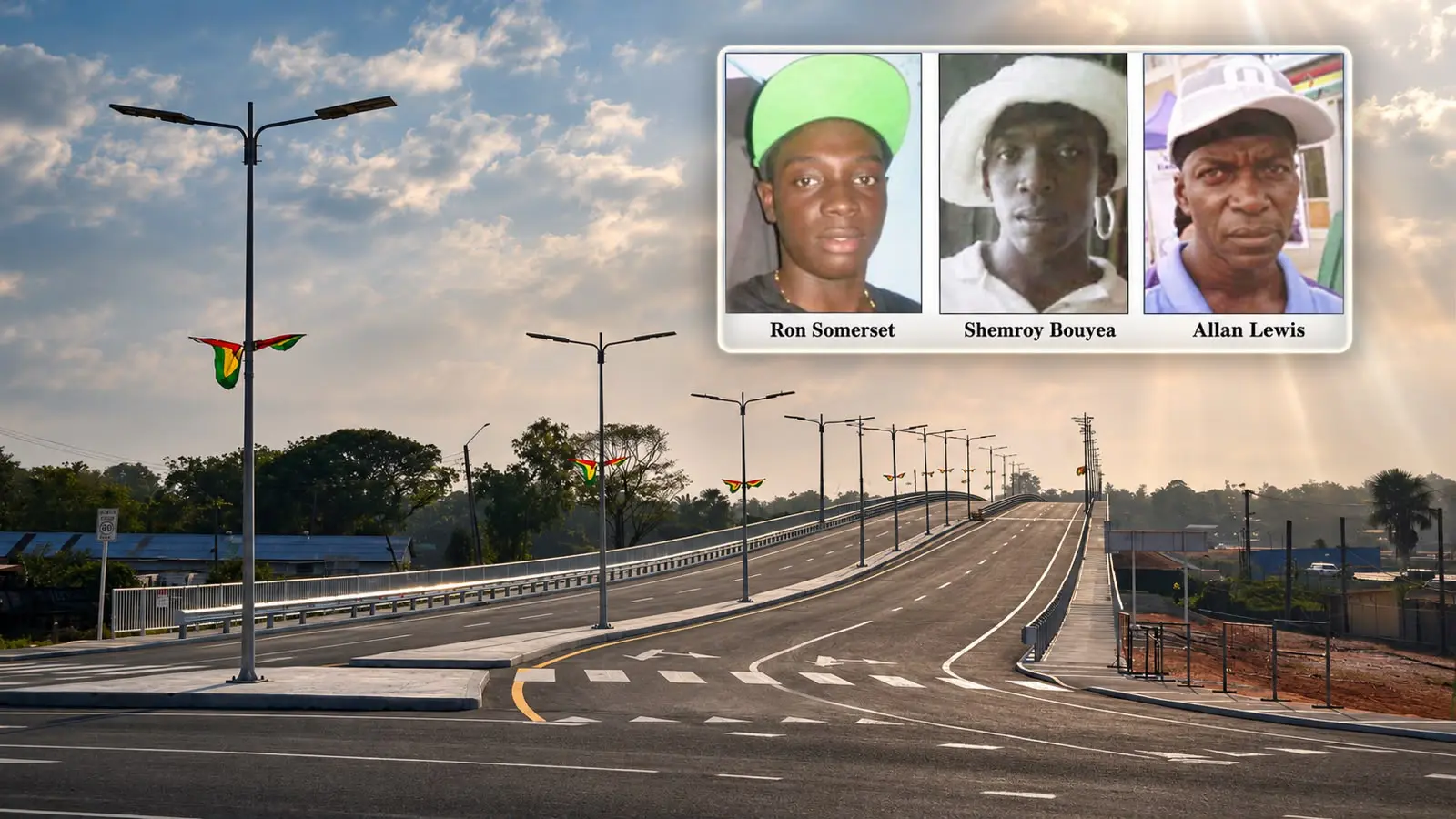
The decision to name the newly commissioned US$35 million Mackenzie-Wismar Bridge after former Prime Minister Samuel Hinds has sparked criticism among some Linden residents, who say the announcement disregards the town’s painful history, particularly the deaths of three residents during protests against increased electricity tariffs in 2012.
Speaking with Kiskadee Watch following yesterday’s commissioning ceremony, several residents expressed disappointment with President Irfaan Ali’s decision, arguing that the bridge should have retained its original Mackenzie-Wismar name or been dedicated to another individual whose contributions they believe better reflect the town’s history.
For some, the controversy extends beyond the name itself. The bridge is closely associated with the July 18, 2012 protests, during which three Lindeners — Shemroy Bouyea, Ron Somerset and Ivan Lewis — were shot and killed as residents demonstrated against the then People’s Progressive Party/Civic (PPP/C) government’s proposed increases in electricity tariffs.
Hinds was serving as Prime Minister during that period.
One resident described the announcement as a painful reminder of the tragedy and questioned the appropriateness of naming the new crossing after a senior member of the administration in office when the killings occurred.
“It’s a kind of spit in the face to the Lindeners,” the resident told Kiskadee Watch, recalling the protests and the lives lost.
The resident said many Lindeners continue to associate the former crossing with the struggle against increased electricity costs and the deaths of the three protesters.
“We’ve got to live with the name now. On a daily basis,” the resident added.
The concerns were echoed by another resident who acknowledged Hinds’ years of public service but questioned why another individual from the mining town had not been selected.
“It feels like a slap in the face to most Lindeners that I’ve spoken to already on the issue,” the resident said.
The resident argued that Linden has produced numerous individuals whose contributions to education, business, community development and other sectors deserve recognition.
“I gotta be fair, he served. But I’m still thinking if they don’t have a son or a daughter of this soil that made contributions,” the resident said.
Drawing on personal experience as a cosmetologist who trained others in the community, the resident suggested that the contributions of ordinary Lindeners should not be overlooked when such honours are being considered.
Another resident suggested that the bridge should have been named after former President Forbes Burnham or simply retained the Mackenzie-Wismar name.
“Because I thought they could have named the bridge after Burnham, who created Linden. Or just left it as Linden-Mackenzie Bridge,” the resident said.
The objections also featured prominently in comments from a Linden speaker who argued that the naming decision failed to recognise the historical significance of the 2012 protests.
While acknowledging Hinds’ contributions to Guyana and the bauxite industry, the speaker said his political history could not be separated from the circumstances surrounding the protests.
“I don’t have no problem with Sam Hinds. Sam Hinds has served the country of his birth, as any other person. Some would even say with great distinction,” the speaker said.
However, he questioned how the government could honour Hinds at a crossing so closely associated with the deaths of the three protesters.
He recalled that the demonstrations were triggered by proposed changes to the electricity subsidy, which residents feared would impose a significant financial burden on an already struggling community.
The speaker also referred to the Commission of Inquiry established to investigate the July 18, 2012 events, arguing that its findings should have been considered before the government selected a name for the new bridge.
The Commission found that the three men died from gunshot injuries during the protest and concluded that police were responsible for their deaths.
The speaker also proposed that consideration should have been given to other prominent Lindeners, including sporting figures such as former West Indies cricketer Basil Butcher and Olympian Marian Burnett.
He questioned how relatives of the deceased protesters would feel travelling across a bridge bearing Hinds’ name.
“Imagine how the mothers of this town supposed to feel,” he said.










Discussion