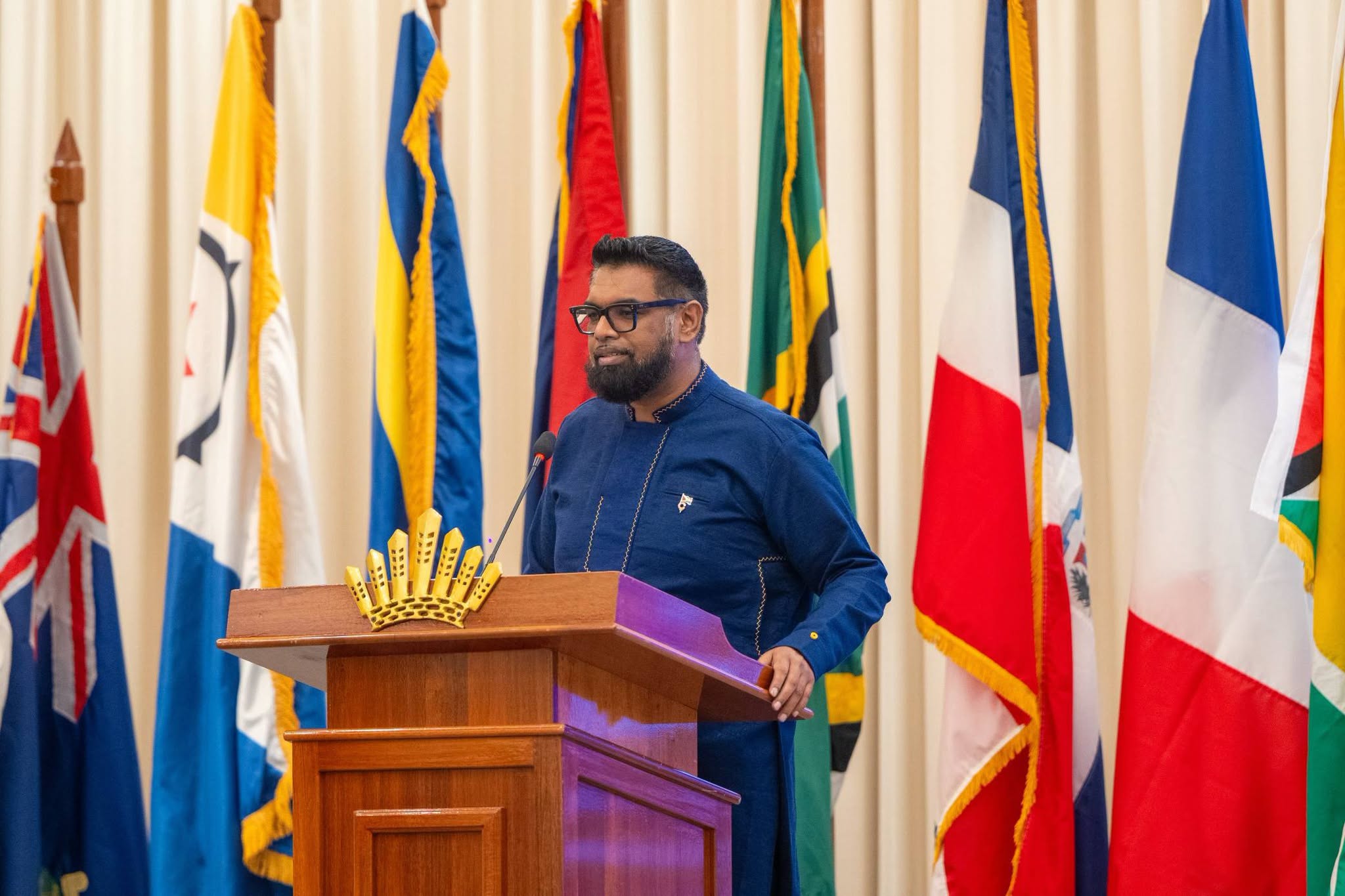
– says public trust safeguards judicial independence, urges wider embrace of CCJ
President Irfaan Ali yesterday proposed a mechanism for briefing judges on regional security threats, including intelligence on criminal networks and terrorism, arguing that the separation of powers should not mean separating information.
Addressing the opening of the Caribbean Association of Judicial Officers’ (CAJO) ninth biennial conference at the Guyana Marriott Hotel, Ali also said public trust helped safeguard judicial independence and urged more Caribbean countries to adopt the Caribbean Court of Justice (CCJ) as their final court.
According to a Department of Public Information (DPI) report, Ali emphasised the importance of adapting to technological and social change while providing timely and accessible justice.
His proposal for security briefings was among the issues raised before 194 delegates attending the three-day conference under the theme “Changing Fundamentals of Judging”. The DPI report did not elaborate on how the proposed mechanism would operate.
Turning to social media, Ali said scrutiny of the courts was legitimate but distinguished criticism from intimidation.
A court could not decide a case by “counting the number of likes, shares, or comments”, he said.
On technology, the President noted that not every Caribbean country had the financial capacity to develop the systems required by a changing world. He asked the conference to produce a paper that could broaden discussion among policymakers.
Welcoming the delegates, Ali said their attendance reflected a common regional commitment to justice and democratic institutions.
“Your presence here represents the region’s shared commitment to the rule of law, the administration of justice, and a continued strengthening of the institutions upon which our democratic societies depend,” he said.
Ali also described the CCJ as “a credit to our region” and questioned why more Caribbean countries had not accepted it as their final court, particularly amid calls for reparations from colonial rulers.
Acting Chancellor of the Judiciary, Justice Roxane George thanked the President and government for their assistance in planning and hosting the conference.
She also acknowledged advice and logistical support from the ministries of Tourism, Industry and Commerce; Culture, Youth and Sport; Foreign Affairs; and Public Works, along with the Guyana Police Force. Justice George said she expected the discussions to benefit both delegates and the public.
The conference, which runs from November 19 to 21, brings together chief justices, judges, magistrates, registrars, court administrators, academics and other stakeholders from the Caribbean and beyond.
In its announcement ahead of the meeting, CAJO said the programme would include presentations, plenary discussions, breakout sessions and specialised judicial forums covering artificial intelligence and technology, the rule of law, public trust, crime and violence, human rights, judicial ethics and judicial wellbeing.
CAJO Chairman and CCJ Judge Peter Jamadar said the theme reflected changes confronting courts across the region.
“The fundamentals of judging are being reshaped by technological advancements, changing societal expectations, and emerging challenges to the rule of law,” he said.
The association said the conference would examine how Caribbean judiciaries could respond while safeguarding the principles underpinning the administration of justice.
The opening programme also listed remarks by CCJ President Justice Winston Anderson and Justice Jamadar, alongside Justice George and Ali. Jamaica’s Chief Justice Bryan Sykes was listed to deliver the featured presentation.
CAJO describes the biennial conference as one of its principal judicial education initiatives, allowing judicial officers to exchange knowledge, share practices and consider ways to improve the delivery of justice.












Discussion