
WIN Member of Parliament Vishnu Panday has questioned President Irfaan Ali’s recent proposal to bring in foreign expertise to assist the Guyana Sugar Corporation (GuySuCo), arguing that similar interventions in the past have failed to produce meaningful results despite significant expenditure.
“The issue of bringing in foreigners again would be a waste of time,” Panday, a former GuySuCo executive, said in response to questions from Kiskadee Watch.
He contended that previous engagements with overseas consultants had delivered little value to the corporation.
“From 2012 to 2014, there were two Indian groups by the name of KAYBOUVEY and Global Cane Technology. Hundreds of millions of Guyana dollars were spent on those two groups [and] no benefits were derived during the period,” he charged.
Panday further noted that between 2023 and 2024, technical personnel from India and Cuba were engaged by GuySuCo.
“Hundreds of millions were spent [and] again no benefits were derived. So why the President is saying again that he will be bringing in foreigners to help GuySuCo?” he asked.
Earlier this month the Guyana Chronicle reported that President Ali said the country would seek to draw on Brazil’s expertise to improve productivity, diversify revenue streams and strengthen the long-term sustainability of the sector.
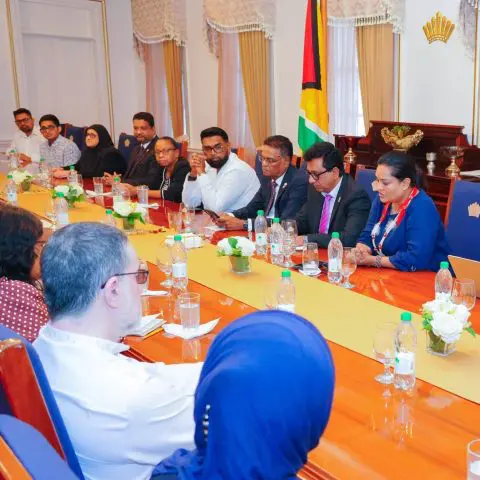
The President had met with the Director General of the Inter-American Institute for Cooperation on Agriculture (IICA), Dr Muhammad Ibrahim and the Vice-Minister of Agriculture and Livestock of Brazil, Cleber Soares, during a recent state visit.
“One of the areas that we need to fix now is sugar. We’re working with India, and we’ve asked IICA for some support on how we can really get this right,” President Ali was quoted as saying during that meeting.
“We have the fixed management issues, technology issues, the modernisation of the mills. We have the mechanisation of the fields is ongoing. We have to look at intercropping to see what value can be created. So, we’re working on those things,” he added in the report.
Criticisms
Responding to President Ali’s criticism of GuySuCo’s management in the said report, Panday argued that management failures alone cannot explain the corporation’s difficulties.
“The President spoke of management failures in GuySuCo, but why? Most of the senior managers were in GuySuCo when production levels were considered to be favourable,” he said.
“The problem is not management, but as I said [previously], the problem is political interference.”
According to Panday, government should remove the current board of directors.
“The government must remove the entire board of directors in GuySuCo, who are all connected to the PPP,” he said.
He was particularly critical of the corporation’s chairman Madanlall Ramraj, arguing that the appointment reflected poor judgement.
On the issue of mechanisation, Panday said the administration’s repeated references to the subject ignored the fact that mechanisation has been underway in the industry for decades.
“Mechanisation commenced in GuySuCo over 50 years ago. Why is this government still speaking about mechanisation when the entire industry has not been mechanised to date?” he asked.
He argued that the slow pace of mechanisation suggested a lack of commitment to the industry’s long-term viability.
No interest
“It is reasonable to conclude that this government has no interest in GuySuCo’s survival but would spend billions of dollars of taxpayers’ money just to keep their supporters voting during general elections,” Panday argued.
Panday also dismissed proposals for intercropping on GuySuCo lands.
“This idea is nonsensical. GuySuCo’s depleted labour force is inadequate for its cane cultivation, therefore who would handle intercropping?” he asked.
Instead, he suggested that lands attached to closed estates should be made available to residents.
“Why not give the lands on the closed estates to people to plant crops intended for intercropping?” he said.
Turning to production targets, Panday identified declining field yields and the poor condition of factories as the principal factors affecting output.
“The main reasons are yield decline and the poor physical state of all the factories,” he said.
He charged that recommendations made by senior agricultural and factory personnel several years ago had been ignored.
“Four years ago, two directors for agriculture and factory recommended the requirements for both yields and factory efficiencies, but [their recommendations] fell on deaf ears. Instead, the government thought it necessary to frustrate the two directors, resulting in both of them leaving the industry at the end of 2024,” he alleged.
Panday said GuySuCo should target approximately 20,000 hectares of cultivation capable of producing 1.4 million tonnes of cane annually.
“At a recovery of 11.0 TC/TS, this would result in a production of 130,000 tonnes of sugar. Such production would see GuySuCo starting to break even and gradually returning to profitability,” he said.
He estimated that output at that level could generate approximately US$59 million in revenue, or about $13 billion, excluding earnings from molasses sales.
Among his recommendations, Panday called for the immediate replacement of GuySuCo’s board and the establishment of a 12-member committee comprised entirely of resident Guyanese with expertise in engineering, agriculture, economics, accounting, human resources, health and safety, opposition members and sugar technology.
“It is recommended that all members of the committee should be resident Guyanese,” he said, adding that the body should provide monthly reports to the Minister of Agriculture and operate for a period of three years.
According to Panday, the committee should be established “at the earliest opportunity to ensure the sustainability of the industry and guarantee employment of its people.”
In November last year Panday strongly rejected President Ali’s reference to a “Panday syndrome” in the sugar industry, contending that the sector’s problems stemmed from political interference and poor management decisions rather than technical shortcomings. “The president’s statement, ‘Panday Syndrome of mismanagement must be removed,’ lacks content and accountability,” Panday wrote in a letter, while asserting that the industry’s difficulties were being used to deflect attention from the government’s handling of GuySuCo.
Panday, who had joined the political party We Invest in Nationhood, which is now the main opposition, called on the government to account for the more than $50 billion it said had been invested in the industry since 2020, in addition to an estimated $50 billion earned in sugar revenues over the same period. He had also questioned the rehabilitation of the Skeldon factory, criticised what he described as unrealistic production targets, and raised concerns over the importation of allegedly diseased seed cane from Brazil and the expenditure of hundreds of millions of dollars on foreign consultants.
Arguing that “political interference will continue to destroy the sugar industry,” Panday had also pointed to billions of dollars allegedly owed to entities including GPL, GWI, the National Insurance Scheme, the Guyana Revenue Authority and suppliers, while maintaining that decisions taken by the government and GuySuCo’s management had contributed significantly to the industry’s decline.
Industrial hub
Meantime, President Ali last Tuesday announced plans for the development of a 50-acre industrial hub at Enmore, as part of ongoing government efforts to expand job creation, entrepreneurship and wider economic opportunities for Guyanese.
The announcement was made during the commemoration of the 78th anniversary of the Enmore Martyrs, according to the Department of Public Information (DPI).
He said the planned development will transform the area into a dedicated centre for agro-processing and small and medium-sized enterprises, supported by improved infrastructure including a new four-lane roadway linking the corridor to the industrial site.
He also said, according to DPI, the project will provide structured space for business development and help workers and their families advance economically.
“A brand new four-lane road that will lead to the Enmore industrial site in which we are going to develop 50 acres of land specifically for small and medium-sized businesses for agro-processing so that our workers can move from one level to another level,” the President said.










Discussion