
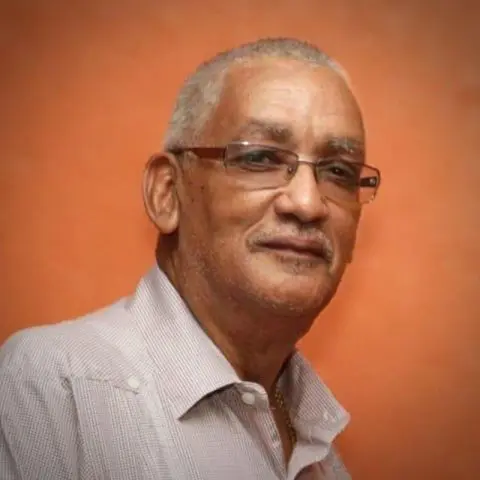
By Alva Solomon
Alva Solomon is a Guyanese journalist who works as a senior reporter with the Royal Gazette newspaper in Bermuda
Last weekend, I was celebrating a milestone I achieved in my journalism career, an occasion which transformed from joy to utmost horror, in minutes.
The message
I hadn’t seen a former Guyanese journalist in several years and after a bit of organizing, we agreed to catch up on old times that Saturday night.
We discussed multiple issues but while chatting with her and her husband, a familiar source sent a message to my Facebook messenger. It was a simple “Hey … gn” and it came at 11.32pm (Guyana time).
I continued chatting with my friends but then another message came from the source at 11.52pm. I suspected since I did not answer the first message, she decided to send another to grab my attention. It read: “MV Barima sink” followed by two voice notes. It was now a few minutes past midnight.

I listened and what she said stopped me in my tracks. I responded and asked for confirmation that indeed MV Barima sank and that people on board were safe. I was quickly visualizing MV Barima on her way to Port Kaituma from Georgetown, slowly sinking with dozens of screaming people in the dead of night, a scene beyond any horror on Netflix.
I was now preparing to leave my friends for the evening and as we drove, I listened to their conversation unattentively as my mind was fully insulated into what I termed at the time, an unfolding catastrophic tragedy beyond belief.
My source continued to send voice notes explaining the situation, but I needed proof before I could have posted anything on my Facebook page.
My Facebook page
Over the course of my two decades in journalism, I have recognized the importance of social media, especially Facebook and its appeal to Guyanese. It is even more important as a source of information for remote indigenous communities like the one where I grew up.
Since I amass thousands of followers on the social media platform, I usually post newsworthy content from time to time. My source is familiar with this mode of information sharing and as such, they recognised since the traditional media houses or more popular Guyanese journalists hadn’t the information on MV Barima at the time, she needed to inform me and that I had to somehow share it with the public.
Amidst the back and forth with my source for evidence of the boat sinking, came multiple voice notes; a few from passengers screaming for help and others detailing what they heard.
I decided I had enough information to inform the Guyanese public since my source was concerned that the people in authority were reacting with little concern as MV Barima listed.
Also, the traditional news outlets hadn’t anything to share and although I no longer work and reside in Guyana, I thought I needed to make the information public.
I drafted a post, read it over for accuracy and posted. Initially I had the words “Unconfirmed reports” but I decided to delete “unconfirmed” since my source had more voice notes to confirm the unfolding disaster.
I had ball by ball information on the reaction times of the authorities including the Transport and Harbours Department and the Guyana Defence Force Coastguard, up until I fell asleep at 2am that Sunday while waiting for the traditional Guyanese media to pick up on the story.
Thankfully Demerara Waves media posted an hour or so after my post, and by then I fell asleep since I was tired from travelling and had a full day ahead that Sunday.
Sunday cancelled
Around dawn that Sunday, I woke up to more posts on social media about MV Barima. This time, the authorities were featured and the press conferences started, with details of passenger numbers, including the rescue of more than 50 people at the time.
That day was supposed to have been about the FIFA World Cup finals. But I cancelled. I needed to somehow answer the growing number of Facebook messages from friends, relatives and associates of passengers and even relatives of staff onboard MV Barima. I answered as much as I could and kept abreast with the story as it developed.
My birthday
I decided to take a break that Sunday afternoon and catch up with a friend I never met in person. It was the intermission that was badly needed on a trip which was supposed to be one of merriment.
Many months before, I had planned the trip with the friend since it marked two decades of me being a reporter. I started my journalism career at Stabroek News, the ever reliable source of news in Guyana. I told my friend what had happened to MV Barima and still in shock, I said I must find a way to enjoy my birthday that Tuesday. I did. But it was a birthday which went back from joy to concern and anger the day after.
The handling of the tragedy
As the days passed, government press conferences played out and as reports surfaced on the tragedy, one thing stood out; how the situation was and still is being handled.
They include concerns about an overweight MV Barima being shot down by the subject minister, numerous calls from civil society for that minister to resign, the threat of penalties from another minister about misinformation, the uncertainty of the exact number of passengers on MV Barima, the arrest of an Opposition MP covering the rescue mission and the criticism of the Opposition Leader who was the only visible MP out at sea in rescue mode.
Familiar territory
I covered multiple stories of the aged North West ferries while at the Stabroek News. I recalled one story in the Stabroek News where I mentioned the ages of MV Kimbia and MV Northcote.

I also recalled one occasion where I helped a passenger to board the MV Kimbia with his luggage amid a mad rush at the T&HD’s Kingston wharf one afternoon back in 2009. When I got on board I snapped photos on SN’s digital camera of the hammocks and thin pieces of mattress which passengers laid on for the 15-plus hour journey to the North West. That afternoon, the packed MV Kimbia hit another vessel as it departed, an incident which my eyes recorded but which was disputed by the authorities.
Childhood memories
As a child I was accustomed to travelling to and from Georgetown on the ferry. It was never a pleasant experience since most of the time, the vessel rocked along the Atlantic Ocean for more than 15 hours. But it is markedly cheaper when compared to taking a flight.
It is the poor man’s way of travel. I always had concerns about the weight of the ferry as crates of goods, vehicles and of course large numbers of passengers would be crammed onto a vessel which had to sail through the rough Atlantic waters. I recall my late grandmother recounting an incident where a fire broke out on one of the ferries while she travelled to Mabaruma back in the late 1980s.
I also recalled the numerous times the ferry broke down and would limp through on a sick engine to or from Georgetown to complete its journey. There was one occasion when I was heading home to the North West, days before Christmas and the vessel suffered a mechanical failure.

These are experiences which tie my attention and concern to this tragedy and to the anguish of those who perished in what is Guyana’s worst maritime disaster.

My sincere condolences to those who lost their loved ones. As I write these words, my good friend Anthony Flores is appealing to the public for any information on his dear grandfather Kenneth Cox who boarded MV Barima last Saturday. And there are many more heartbreaking stories like this.
In the days ahead, people may be held accountable for this horrific, gruesome tragedy. There are calls but only time will tell if those calls will be heard.







Discussion