
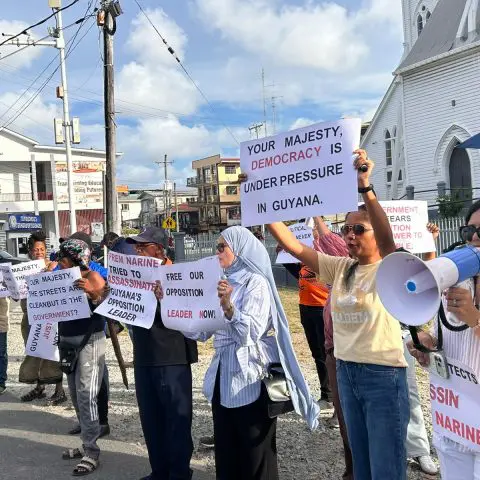
With pressure mounting on the government, the Amerindian People’s Association (APA), joined by civil society representatives and members of opposition parties, yesterday protested outside the Office of the President over the MV Barima tragedy, calling for the vessel to be raised and for the ministers responsible for the sector to resign.
“Indigenous Voices Matter”, “Stop treating our first people as a after though”, ‘Mr President we need all our broken systems fixed!!”, “Edghill must Gooo!”, “Indigenous lives matter” , “We deserve safe passage home” and “Safe passage is a right not a privilege” were the messages on the placards held up by over a hundred protestors yesterday.
APA Executive Director Jean La Rose said the protest was organised in solidarity with the families and communities affected by the capsizing and sinking of the ferry.
“We mourn with the people of Region One and all the other people affected in Guyana,” La Rose told reporters on the picket line.
She said the effects of the tragedy extended to other regions and had left children without parents and families without husbands and wives. She also pointed to the continuing anguish of relatives whose loved ones remain missing.
“We stand here in solidarity with the people because the MV Barima must be raised,” she said. “It carries a lot of information. It carries a lot of evidence. It carries souls of the people. It must be raised so our people can have closure.”
La Rose said the tragedy had exposed what she described as a broken transportation system under which Indigenous communities have endured poor roads, airstrips, aircraft and vessels.

“We are here because our peoples, Indigenous peoples and others, have had to endure poor transportation facilities,” she said.
According to La Rose, Public Works Minister Juan Edghill should step aside to allow for a fair investigation in which witnesses would not feel intimidated and the voices of affected communities could be heard.
“He has to step down so that there is a fair process in terms of investigation, so that people are not intimidated, so that people are truly represented and people’s voices are heard,” she said.
La Rose stressed that the sinking was not solely an Indigenous issue but a national one.

“This is not only an Indigenous problem; this is a Guyanese problem,” she said. “We all have to stand together and we all have to fix this situation. We don’t want any more lives lost.”
Asked what structural changes the APA wanted, La Rose called for better monitoring and enforcement systems across the transportation sector.
“We have to have proper systems in place to ensure that systems are functioning properly,” she said. “There must be monitoring systems so that when somebody goes on a plane, when somebody goes on a boat, when somebody goes in a car or in a truck, there are systems in place to ensure that people get from point A to point B safely.”
She said legislation and policies must be strengthened and there must be improvements to roads, airstrips, vehicles, aircraft and vessels serving hinterland communities.
La Rose also criticised the manner in which the Commission of Inquiry into the tragedy was constituted, arguing that its establishment should have involved wider consultation.
“Our feeling is that a Commission of Inquiry should have included all parties who can contribute to the commission,” she said.
“It should not have been only put in place by the government because we are a divided nation,” she added. “If you continue to do things unilaterally, that will not provide confidence for our people.”
She said affected groups should have been allowed to contribute to the terms of reference and must be assured that the commissioners are suitable for their roles.
Responsibility
Protester Cowen Gittens said the government, as owner and operator of the vessel and regulator of the sector, had to accept responsibility for what occurred.
“They own the vessel, they’re operating the vessel, they’re responsible for the regulations that should be monitoring the vessel as well,” he said.
Gittens called on Edghill and Minister of Public Utilities and Aviation Deodat Indar to resign and allow an impartial investigation.
“I think the right thing that Minister Indar and Minister Edghill should do is to resign at this time,” he said. “Resign their positions and allow a fair investigation to go on so that we can know exactly what happened with this tragedy.”
Gittens said the government had not accepted sufficient responsibility and contended that Indigenous residents had long been forced to travel in unacceptable conditions.
“For some, that’s their only method of transportation. That’s the only way that they can get from the city to their homes through that vessel,” he said.
“If that’s the only means of transportation, it should be of a certain standard. It shouldn’t be at a position where lives are lost before we make a change.”
Another protester, Shane Persaud, said he was standing in solidarity with Indigenous residents who could not travel to Georgetown or speak publicly for themselves.
“We stand with everyone—the Indigenous community, those who can’t make it, those who don’t have a voice, those who can’t travel to come here in support,” Persaud said.
Another protester said she joined the APA-organised picket because the tragedy demonstrated that public systems were failing.
“This is a picket organised by the Amerindian People’s Association, which is to bring us all out here to see clearly that systems are broken and all of those accountable,” she said.
She urged public servants and technical officers with knowledge of institutional failures to speak publicly.
“We know there are many public servants who are trying their best,” she said. “We hope other public servants, other technocrats, start learning to speak out.”
Andrew Campbell, a former teacher at the North West Secondary School who is now a cocoa farmer, said he joined the protest because the government must be held accountable.
Campbell called for the resignations of Edghill, Minister of Amerindian Affairs Sarah Browne and other officials. He said residents of Region One, where people of different ethnicities live, had been neglected for too long.
“How long must we be treated as second- and third-class citizens?” he asked.
Campbell said political representatives from all sides bore responsibility for the longstanding conditions under which citizens have been forced to live.








Discussion