
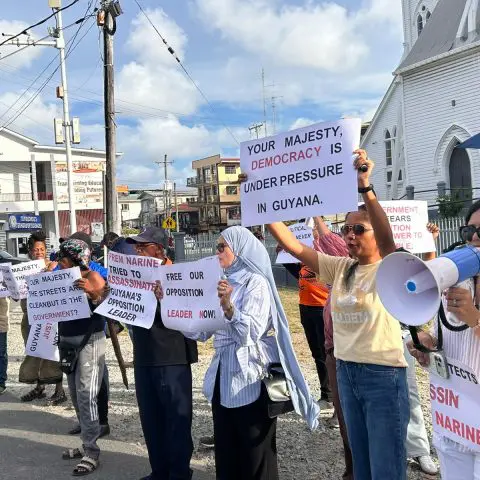
Calls for accountability and major reforms within Guyana’s transportation sector intensified yesterday as the Amerindian Peoples Association (APA) staged another protest outside the Office of the President, demanding answers and renewing calls for the removal of Ministers Juan Edghill and Deodat Indar following the deadly sinking of the MV Barima.
The protesters argued that the tragedy exposed longstanding failures within the country’s maritime transportation systems and called on the government to take responsibility for ensuring safer and more reliable services, particularly for hinterland communities that depend heavily on river transportation.
APA Executive Director Jean La Rose said the responsibility for ensuring safe public transportation systems rests with those in authority, stressing that the MV Barima tragedy extends beyond an Indigenous issue.
“The responsibility lies with the persons who are in charge of ensuring that public and other forms of transportation and other systems are in place when it comes to Indigenous peoples, the interior, and Guyana as a whole,” La Rose said.
She acknowledged that the majority of those who lost their lives in the MV Barima tragedy were Indigenous people but said the impact was felt across the country.
“This is not only an Indigenous matter,” she said. “Unfortunately, the majority of lives lost were Indigenous peoples, but there are others who have been impacted and affected, including through the loss of life.”

La Rose also pointed to recent difficulties faced by passengers aboard the MV Ma Lisha, where travellers were reportedly left waiting at Georgetown for hours without food or water, describing it as another indication of systemic failure.
“That is a very good example of the system not being there,” she said.
She argued that proper systems should have been in place to monitor vessels and ensure passenger safety.
“Had there been a system checking in, counting, weighing, checking the boat, checking who’s running the boat, all of those would have been in place,” La Rose said.
“To have people register, come in to register at three, and late into the night, the boat still has not departed, it’s really a failure, and it continues to show failure of the system.”
Another protest supporter, Vidyaratha Kissoon, said the MV Barima tragedy should have resulted in urgent action to reform Guyana’s transportation systems.
“It is horrible that we continue to see, despite this tragedy, that there’s no urgent need for reform of systems,” Kissoon said.
He raised concerns about the Commission of Inquiry into the MV Barima disaster, pointing to what he described as objections and possible conflicts of interest surrounding the process.

Kissoon also criticised what he described as a disconnect between government officials and ordinary citizens who rely on public transportation.
Referencing the challenges faced by passengers aboard the MV Ma Lisha, he questioned why Cabinet members were not experiencing the same conditions faced by commuters.
“Why isn’t the Cabinet on that boat going in? Why didn’t the Cabinet take that ferry with the other people and go? Why are they taking flights?” he questioned.
Kissoon argued that the situation reflected a lack of planning and understanding of Guyana’s growing transportation needs, particularly in the North West District.
“There’s no sense of planning, that you don’t understand how things are moving in Guyana,” he said. “The North West probably has more people; there’s more need for more transportation.”
He also questioned the role of technical professionals in decision-making, saying greater reliance should be placed on qualified experts.
“This is the 21st century. Where are the technocrats? Where are the qualified people? Why aren’t the qualified people speaking out?” Kissoon asked.
Kissoon said he supported calls for the removal of Ministers Edghill and Indar, arguing that accountability must be taken at the highest levels.
“The buck starts with them, accountability lies with them, and that they should go,” he said.
Meanwhile, protester Rohan Sagar shared a personal connection to the tragedy, telling this publication that his baby cousin was aboard the MV Barima and is now “at the bottom of the ocean.”
Sagar, who was born in the hinterland, said he maintains a deep relationship with the region most affected by the tragedy and believes the state has yet to answer key questions surrounding responsibility.
“The state has not yet answered one key question, which is why there is no culpability at their level,” Sagar said.
He pointed out that the MV Barima was owned and operated by the state, questioning why accountability had not extended to those responsible for oversight of the vessel.
Sagar also questioned the response time of state resources following the sinking.
“I am trying to understand what measure of respect was given to the survivors. Were they treated like human beings?” he questioned.
He said the Guyana Defence Force has maritime assets in the Pomeroon River and questioned why assistance did not reach the scene sooner.
“The Guyana Defence Force has a maritime asset in the Pomeroon River and would have taken that boat 30 to 35 minutes to the site where the MV Barima sunk,” Sagar said.
He also referenced the deployment of maritime assets to Linden during Tuesday’s protest action, questioning how state resources are prioritised.
Sagar maintained that the MV Barima could not have operated without receiving approval from the relevant authorities.
A Region One resident who participated in the APA-led protest said Guyanese must demand accountability and insist on safer transportation systems.
The resident said it is the government’s responsibility to ensure proper transportation infrastructure is available and functioning, especially for communities that depend on river travel.
The protester said the MV Barima tragedy provides an opportunity for accountability and for long-term improvements to be made to the country’s transportation sector.
The APA-led demonstration is the latest public action following the MV Barima disaster, with protesters continuing to demand answers, transparency, and reforms to Guyana’s maritime safety systems.







Discussion