
-no estimated cost or timetable provided
The government yesterday unveiled proposals for extensive works in Melanie Damishana and Non Pareil, including more than 26 kilometres of walkways, 43 kilometres of concrete drains, 43 fire hydrants and 122 additional streetlights under its Model Village Initiative.
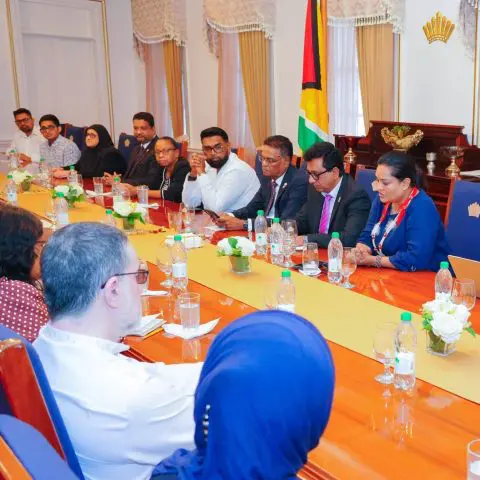
The plans were presented during a consultation at the Melanie Nursery School led by President Irfaan Ali and Minister of Health Dr Frank Anthony. The meeting formed part of a series being held by the President and ministers across the country.
No estimated cost or timetable for the proposed works was disclosed during the portion of the engagement posted in a video on the President’s Facebook page.
Ali told residents that Melanie would serve as a pilot for an initiative which the government intends to implement in every village.
“You are the pilot. This is what is going to be implemented in every village across our country,” he said.
According to the presentation, engineers, architects, planners and development specialists had surveyed the community over several months and compiled an assessment of its infrastructure and public spaces. Residents were invited to comment on the proposals and identify matters which the team might have overlooked.
Chairman of the Buxton/Foulis Neighbourhood Democratic Council, Walston Martins, while at a police barricade during a protest that was held during the event had said there was no consultation with the council on the initiative. He also questioned whether a two-hour meeting could constitute meaningful consultation with residents about the development of their community.
Ali at the meeting said the initiative was intended to go beyond physical infrastructure and incorporate safety, economic activity, culture, environmental protection and residents’ quality of life.
“We don’t want every community to be the same, but we want every community to have the same level of service,” he said. “The transformation that you see in one area in Georgetown must be the lived transformation of every citizen across our country.”
The President said three out of every four Guyanese still lived in villages, according to the most recent census, making village development critical to the country’s wider transformation.
He said the programme would seek to reduce conflicts caused by the location of mechanic shops, spray-painting businesses, entertainment venues and markets within residential areas. Designated spaces would be established for some of those activities, he added.
The proposals include an industrial parking area for trucks and heavy equipment and a separate district for entertainment businesses.
“The mechanic shops, the spray-painting shops, all of these things [will be relocated]. Then one reserve for all the entertainment places,” Ali said. “So you’ll have an entertainment district not between the neighbourhood when the granny wants to sleep.”

The President said the development plan would also consider security cameras, police outposts, fire hydrants, drainage, small-business opportunities and access to financing through the Guyana Development Bank.
Comprehensive approach
Meanwhile, Anthony said the government wanted to take a comprehensive approach to infrastructure rather than rehabilitating roads without adequately addressing drainage.
“We want to do the roads, we want to do a slope so that roads can be properly drained,” he said. “Sometimes we do the roads and then there’s like an earthen thing that blocks the water from running into the drain… When it rains, you have water accumulating, it undermines the road and then sometimes we are back to square one.”
He said walkways were also proposed because increased traffic had made it hazardous for pedestrians in many communities.
The survey covered approximately 470 acres and identified 73 roads, 1,730 households, 44 businesses, five government facilities and five places of worship in Melanie and Non Pareil.
The communities have approximately 43,400 metres of drains, including 8,700 metres of alleyway drains which the government says must be cleaned and maintained.
The presentation proposed constructing 26,900 metres of walkways, 32,200 metres of hardened road shoulders and 43,400 metres of concrete drains. Officials also proposed work on five roads, seven bridges and a section requiring revetment.
While one part of the presentation referred to 23 culverts requiring installation or repairs, a later summary said approximately 70 culverts would be constructed.
The government also plans to increase the number of fire hydrants in the community from three to 43.
Ali said an assessment had identified 100 utility poles for replacement and the need for 122 additional streetlights.
“Lighting is key so that when people come home in the evening they can walk safely, knowing that not only you have lights, but you have the Safe Country programme securing you,” he said.
Four playgrounds and three proposed green spaces would also be upgraded, while 423 trees are to be planted along approximately 27,700 metres of roadway. Fourteen public spaces are earmarked for improvement.
Anthony said landscaping and properly maintained greenery would be important components of the programme.
“We want to put in some trees and we want to groom them so they look nice—not just bush all over the place,” he said.
Officials said surveys had identified 556 locations where building materials or other items were obstructing public spaces, 70 derelict vehicles, 56 roadside vending locations and approximately 100 areas where garbage had accumulated along road shoulders.
Anthony said roadside vendors would not be displaced but organised in cleaner and safer locations. He suggested that food vendors could be brought together in a food court which might attract visitors to the community.
“Our plan is not to displace the vending. It’s to make it more structured, more hygienic, cleaner, safer,” he said.
The President stressed that residents would also have responsibilities under the initiative, including keeping their surroundings clean, respecting neighbours and protecting public infrastructure.
“We can have the best infrastructure in the community, but if someone decides not to respect the space of another person and will play the music loud all night and destroy the sleep or affect the life of the elderly, then we will not be able to enjoy the fullness of our community,” Ali said.
He added that the programme should create communities where elderly persons could enjoy their retirement, children could play safely and families could gather freely.
“Stronger, resilient and sustainable communities are communities that are built to last,” he said. “It is not only about physical infrastructure; it is about how we process our own existence within the community, how we take care of the environment [and] how we behave with each other as neighbours.”
Ali said representatives of government agencies were present to address residents’ individual concerns involving housing, the National Insurance Scheme, drainage and other matters. Those cases would be recorded on a digital dashboard for follow-up, he said.
The Model Village Initiative initially targets 23 communities before being expanded nationally. Consultations began earlier this week and have been held in Regions Three, Four and Five, with meetings also scheduled for Regions Two and Six.










Discussion