
-families of missing still waiting for answers
Three weeks after the MV Barima capsized off Guyana’s Essequibo coast, the country is still grappling with its deadliest maritime disaster while dozens of families continue to live with grief, uncertainty and unanswered questions.
The vessel went down on the night of July 18 while travelling from Georgetown to Port Kaituma, turning what should have been a routine journey for passengers and crew into a catastrophe that has claimed at least 73 lives, according to the latest figures publicly reported by the authorities. Seventy-six people were rescued, while approximately 30 others remained unaccounted for after the formal search-and-recovery phase.
But three weeks later, the tragedy has evolved beyond the search for survivors and the recovery of bodies.
It has become a national reckoning over Guyana’s ferry system, the condition and management of state-owned vessels, passenger registration, cargo loading, crew conduct, maritime regulations, the country’s search-and-rescue capacity and, ultimately, who should bear responsibility when a public transportation system fails so catastrophically.
And while the Government has established a five-member Commission of Inquiry and sworn in all five commissioners, there is still no publicly announced date for when the Commission will begin its substantive work or where its hearings will be held.

That uncertainty has added to concerns among families, civil society groups, opposition politicians and members of the public who have demanded a transparent process capable of answering the many questions raised since the vessel disappeared beneath the sea.
The MV Barima departed the Transport and Harbours Department’s Goods Wharf in Georgetown at approximately 3:20 p.m. on July 18, bound for Port Kaituma.
At the time, authorities initially said the vessel had 116 passengers and 17 crew members aboard 133 people in total. Kiskadee Watch was among the media organisations reporting on the unfolding disaster from the early hours of the morning.
The first reports were that the vessel had capsized near Iron Punt in the Pomeroon area after transmitting a distress signal shortly before 11 p.m.
Initial official figures suggested 53 people had been rescued. That number quickly increased to 67 and then 69.
As the operation unfolded, however, it became clear that the official passenger manifest did not account for everyone who had actually boarded the vessel.
Kiskadee Watch reported that of the first 67 survivors, only 35 appeared on the manifest, meaning 32 rescued persons were not recorded on the passenger list. That revelation immediately raised questions about how passengers were being boarded and counted on the state-run ferry service.
Dramatically
The eventual estimate of the number of people aboard rose dramatically.

Prime Minister Mark Phillips later said approximately 179 people were believed to have been on the vessel when it sank.
That figure transformed the scale of the disaster.
In the days immediately following the sinking, Kiskadee Watch spoke with survivors who provided accounts that raised questions about the condition of the vessel, its cargo and the circumstances leading up to the capsizing.
Survivor Helena Moonsammy described seeing the rear of the vessel heavily packed with boxes. She said that when the vessel suddenly tilted and water rushed in, shifting cargo compounded the danger.
Moonsammy had travelled with seven children and initially feared she had lost all of them.
Other survivors described spending hours in the dark water, clinging to mattresses, freezers, containers, pieces of material and other floating objects in order to stay alive.
Eighteen-year-old Wayne Atkinson told Kiskadee Watch that he spent approximately six hours in the water after the vessel went down. He said he had been sleeping when the boat suddenly leaned over.
Another survivor, identified as Adreiena, said passengers had reported water entering the vessel and alleged that there was no functioning pump available to remove it.
Businessman Donald Modeste also told Kiskadee Watch that the vessel was heavily loaded with cargo and claimed it had experienced problems before leaving Georgetown. He described the vessel becoming stuck at the wharf and later operating on one engine.
Public Works Minister Juan Edghill initially said the vessel was not overloaded with either passengers or cargo and suggested that rough tides and a large wave caused it to tilt and sink.
At the time, he said the manifest showed 116 passengers and approximately 268 tonnes of cargo, while the vessel was licensed to carry significantly more.
But as more survivors spoke publicly, questions about loading became increasingly difficult to dismiss.
Original
The Government later acknowledged that the number of persons aboard was far higher than the original manifest indicated.

The issue is now expressly within the mandate of the Commission of Inquiry, which has been instructed to examine the loading of the vessel, passenger boarding, conditions aboard the vessel and other circumstances surrounding the sinking.
Another major question concerns the MV Barima itself.
Built in 1939, the vessel was approximately 87 years old when it sank.
Minister Edghill maintained that it had been maintained in accordance with established procedures and had last been dry-docked in 2024. He said it was scheduled for another dry-docking in the latter half of 2026.
Prime Minister Phillips subsequently confirmed that maintenance work had been moving through the procurement process and that Cabinet had already granted a no-objection for the process.
Kiskadee Watch questioned why the planned works had not been completed before the disaster.
The issue is not simply whether the vessel had a current certificate or whether it had undergone previous rehabilitation.
The deeper question is whether an ageing vessel operating on a demanding route was structurally and mechanically fit for the conditions in which it was being used.
That is now one of the matters the Commission has been specifically tasked with examining, including the vessel’s seaworthiness and maintenance history.

The investigation also took an unexpected turn when the Government disclosed that the captain and another crew member had tested positive for a narcotic substance.
The revelations intensified scrutiny of crew recruitment, testing, supervision and operational standards aboard state-operated vessels.
The Commission’s mandate includes examining the competence and conduct of the crew, meaning the circumstances surrounding the crew members’ alleged drug use and any other claims concerning their conduct are expected to form part of the broader inquiry.
Another major unanswered question is the response between the time the distress signal was received and the first survivors being rescued.
Timeline
The Prime Minister subsequently provided Parliament with a detailed timeline.
According to that account, the Air Traffic Control Centre received the distress signal at 10:43 p.m. The Georgetown Lighthouse received the information at 11:01 p.m., and the Maritime Rescue Coordination Centre was informed at 11:03 p.m.
The Coast Guard then deployed assets.
But the first five survivors were not rescued until approximately 2:27 a.m., about three and a half hours after the distress signal was received. Nineteen more were rescued at 4:14 a.m., followed by another 53 at 5:13 a.m.
The Government has defended the response and said the Maritime Rescue Coordination Centre was activated and multiple agencies were mobilised.
But the timing has nevertheless become one of the central questions surrounding the disaster.
Kiskadee Watch and others have questioned the country’s readiness to respond to maritime emergencies, including the availability of helicopters, rescue vessels, divers and other equipment.
The Commission has been expressly mandated to review the adequacy and effectiveness of the search, rescue and recovery operations.
As the official response unfolded, local fishermen and private sector entities played a critical role.
Local fisherman Haresh Singh helped identify the location of the sunken vessel on July 20, while private sector resources were also used in the search.
The wreck was eventually located approximately 31 nautical miles northwest of the point where the initial distress communication was received.
France subsequently deployed divers, while Trinidad and Tobago and Brazil also provided support.

At one point, 19 vessels and two aircraft were involved in the operation.
The international assistance was critical because the conditions around the wreck proved extremely difficult for divers, with darkness, mud deposition and poor visibility limiting access.
The search soon became primarily a recovery operation.
Revised
By July 20, 27 bodies had been recovered and authorities had revised their estimate of the number of people aboard to 179.
By July 21, the number of recovered bodies had risen to 41.
By July 22, Kiskadee Watch reported that 57 bodies had been recovered, with 44 positively identified and 18 already released to families.
By July 24, the death toll had reached 72, and the following day the Government reported 73 bodies recovered.
The human cost was evident across communities in Region One, the Pomeroon-Supenaam region and elsewhere.
Families were forced to travel between hospitals, mortuaries, information centres and wharves while waiting for word of relatives.
Some families buried parents and children together.
Others were left waiting for bodies that had not yet been found or identified.
Among the most painful accounts was that of Shameer France, who survived while accompanying his brother Percy France, who had been travelling with the body of his wife to the Pomeroon for her funeral.
Instead, the journey ended with the body being lost in the disaster, while Percy and other family members were believed to have perished.
Kiskadee Watch also reported on families who lost multiple relatives, including parents and children.

For many in the North West District, the MV Barima was not simply a ferry.
It was a lifeline connecting communities to Georgetown and other parts of the country.
Its passengers included people travelling for business, family matters, funerals, medical appointments and access to government services.
The tragedy therefore struck at the heart of communities that already depend heavily on river and sea transportation.
On July 28, police charged three Transport and Harbours Department employees with murder in connection with the deaths.
They are Captain Kevin Price, Chief Mate Rondell Dwayne Roberts, and Goods Superintendent Delon Granderson.
The men appeared before Chief Magistrate Judy Latchman and were remanded to prison. Their case was transferred to the Charity Magistrate’s Court.
The charges represent a major development in the criminal investigation.
But they have also generated a separate national debate over whether criminal responsibility should rest only with individuals aboard the vessel or whether the investigation must extend to the institutional and governmental systems responsible for the ferry service.
The Commission’s mandate explicitly allows it to examine whether negligence, misconduct, dereliction of duty or failures by an individual, entity or institution contributed to or caused the disaster.
The criminal case and the Commission of Inquiry are separate processes.
A murder charge against three employees does not, by itself, answer questions about procurement, vessel maintenance, passenger registration, regulatory oversight, staffing, crew testing, loading procedures or the national search-and-rescue system.
Political confrontation
The tragedy also became the centre of a political confrontation.
Opposition parliamentarians demanded the removal of Public Works Minister Juan Edghill and Minister of Public Utilities and Aviation Deodat Indar.
The National Assembly descended into disorder as opposition MPs protested the Government’s handling of the disaster and demanded accountability.
Opposition parties also questioned whether the Government should have unilateral control over the composition and terms of the inquiry.
APNU MP Dr Terrence Campbell sought an urgent parliamentary debate on the terms of reference, arguing that the scale of the tragedy required scrutiny of the vessel’s seaworthiness, regulatory oversight, passenger records and search-and-rescue response.
The Joint Opposition later welcomed the establishment of a Commission but criticised the lack of consultation over its composition and argued that a separate technical marine safety investigation should also be conducted.
The anger was not confined to Parliament.
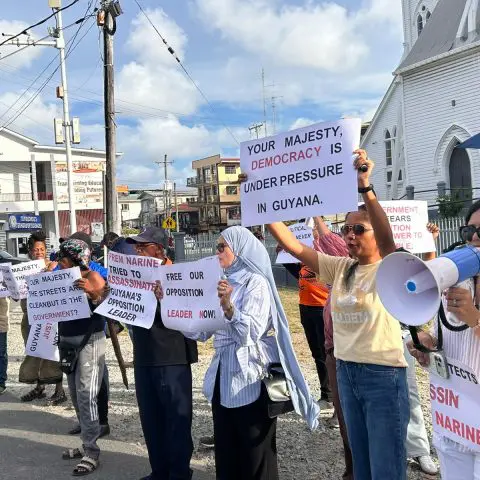
The Amerindian Peoples Association and other citizens protested outside the Office of the President, calling for accountability and improvements to Guyana’s transportation systems.
Civil society groups, including Red Thread, called for Minister Edghill’s removal and demanded an independent investigation capable of examining maritime safety, compliance with international standards and possible negligence.
The protests later evolved into broader citizen-led demonstrations.

The emerging “We The People” movement, including young Guyanese and University of Guyana students, brought the tragedy into a wider conversation about accountability, government responsibility and the role of citizens in demanding answers.
At the centre of the demonstrations was a simple question:
Who is ultimately responsible when a state-owned transportation system fails and dozens of citizens die?
President Irfaan Ali announced that a Commission of Inquiry would be established to investigate the tragedy.
On July 26, the five commissioners were named.
The panel is chaired by Justice Godfrey Phillip Smith of Belize, with:
Captain Hamada Fouda, a Jamaican maritime surveyor and compliance auditor;
Nyree Dawn Alfonso, a Trinidad and Tobago attorney specialising in admiralty and maritime law;
Rear Admiral (Ret’d) Hayden Pritchard of Trinidad and Tobago; and
Dr Andrzej Jasionowski, a Polish naval architect and marine engineer.
The President said the Commission would examine virtually every major issue raised since the disaster.
Its mandate includes the loading of the vessel, boarding of passengers, conditions aboard, the capsizing and sinking, the search-and-rescue response, compliance with maritime laws and regulations, negligence or misconduct, seaworthiness, maintenance and crew competence.
It is also expected to recommend legislative, regulatory, institutional and operational reforms.
This is now one of the major unanswered questions.
The five commissioners have been sworn in. Chief Magistrate Judy Latchman administered the oath to the commissioners at State House on July 30, with four appearing in person and one participating virtually.
Yet, as of August 9, there has been no publicly announced date for the first substantive sitting of the Commission of Inquiry and no confirmed public venue for its hearings.
There has also been no clear public timetable explaining when witnesses will begin giving evidence, when families and survivors will be invited to testify, or how the Commission intends to conduct its hearings.
The President said when the panel was announced that the commissioners would determine their own procedures and methods of work.
Three weeks after the disaster, many questions remain.
Questions
Why were so many people aboard the MV Barima who were not reflected on the passenger manifest?
How were passengers allowed to board without being recorded?
Was the vessel overloaded with people, cargo, or both?
Was cargo properly secured?
What happened to the vessel’s engines before and during the journey?
Was water entering the vessel before the final capsizing?
Was the vessel structurally and mechanically fit to operate?
Were maintenance recommendations completed?
Why was an 87-year-old vessel still operating on this route?
What role did the crew’s alleged narcotics use play, if any?
Were crew members properly supervised and tested?
Why did the first rescue occur approximately three and a half hours after the distress signal?
Were sufficient rescue assets available?
Were the country’s helicopters and rescue vessels ready?
Was the national search-and-rescue system adequately prepared for a disaster of this scale?
And perhaps the biggest question:
Did this tragedy result from the actions of three individuals, or did a wider institutional failure allow a chain of problems to develop until the MV Barima went down?
The criminal prosecution of the captain, chief mate and goods superintendent will now proceed through the courts.
But the Commission of Inquiry has a much broader responsibility.
It will examine not only what happened aboard the MV Barima on the night of July 18, but what happened before the vessel ever left Georgetown.
It will examine the systems that allowed the ferry to depart, the systems that recorded passengers, the systems that regulated cargo, the systems responsible for vessel maintenance, the people responsible for monitoring crew conduct and the national infrastructure responsible for responding when the vessel sent out its distress signal.
And it will determine whether the tragedy was preventable.
That is ultimately what the families want to know.
For three weeks, Guyana has mourned. Bodies have been recovered. Funerals have been held.
Survivors have returned home carrying memories that will likely remain with them for the rest of their lives.
Three employees now face murder charges.
A five-member international Commission has been sworn in.
But the central work of establishing the truth has yet to publicly begin.
Until that happens, the MV Barima tragedy remains more than a disaster recorded in numbers.
It remains a national question still waiting for an answer.







Discussion