
A dispute among judges of the CCJ which flared into the open with the leaking of email threads has been seen as shaking confidence in the work of the tribunal, raising serious concerns about the security of communications among them and calling into question the future of the President of the court, Justice Winston Anderson, who is at the centre of the controversy.
Yesterday’s disclosures in the Trinidad Express were the most serious blow to the standing of the Caribbean Court of Justice (CCJ) since it began operations in April, 2005 and has raised concerns in Georgetown and other capitals that subscribe to it as their final court of appeal.
Never before under the tenure of previous Presidents of the court, Justices Michael de la Bastide, Sir Dennis Byron and Adrian Saunders has there been exposure of this type of acrimony among judges as written about by Trinidad Express investigative reporter Mark Bassant.
In what will be seen as a bid to limit the fallout, the CCJ on Saturday issued a statement to the Trinidad Express which reaffirmed its judges’ commitment to independence, impartiality and integrity but did not answer specific questions posed to it by the newspaper.
The Sunday Express report had said that five of the court’s six sitting judges had challenged the leadership of Justice Anderson.
The CCJ’s statement did not specifically deny or otherwise address the allegations reported by the Sunday Express, including claims of unilateral decision-making, attempts to influence judicial decisions and manipulation of the composition of panels. It also made no reference to questions submitted by the newspaper.
“The Court is mindful that questions and allegations presented without the benefit of context, background, or an appreciation of the nature of judicial deliberations, collegial discussions, and institutional governance may lend themselves to misunderstanding or mischaracterisation,” the CCJ said.
It added: “For that reason, the Court wishes to reaffirm that the Judges of the Caribbean Court of Justice remain committed to the tenets of judicial conduct enshrined in the United Nations Bangalore Principles of Judicial Conduct—independence, impartiality, integrity, propriety, equality, competence, and diligence.”
The court said maintaining public confidence was fundamental to upholding the rule of law and preserving trust in the administration of justice.
“The Caribbean Court of Justice remains committed to providing accessible, fair and efficient justice for the people and states of the Caribbean Community,” the statement said. It was unclear yesterday whether this statement was composed with the input of all the judges of the court.
The Sunday Express reported yesterday that internal correspondence showed five CCJ judges raising concerns over what they described as Justice Anderson’s “authoritarian” and “dictatorial” leadership. The correspondence reportedly began with a proposed judicial dress code but erupted into a wider airing of concerns about the internal governance of the court.
Anderson, a Jamaican, was sworn in as the fourth president of the CCJ on July 6, 2025.
According to the newspaper, he circulated a proposed judicial dress code to the judges on June 22, 2026, advising that it would be discussed by the Regional Judicial and Legal Services Commission (RJLSC) four days later.
Justice Chile Eboe-Osuji objected, arguing that the proposal should first be discussed and approved by the judges before being placed before the commission. Based on the email threads circulated, Justices Chantal Ononaiwu, Arif Bulkan, Maureen Rajnauth-Lee and Peter Jamadar subsequently expressed similar concerns about the process.
Justice Bulkan was said to have argued that the process adopted was important to maintain shared relations among the judges. He also raised the possibility that a rigid dress code could affect religious and ethnic minorities.
Justice Rajnauth-Lee referred to the approach used under former CCJ president Justice Saunders when the court revised its Code of Judicial Conduct. She said that process had involved months of meetings and several revisions before the judges approved the document and forwarded it to the RJLSC.
The Sunday Express said Justice Jamadar’s correspondence went beyond the dress-code proposal and raised concerns about the discharge of his judicial functions and the court’s internal environment.
Justice Jamadar reportedly described that environment as increasingly “toxic” and alleged interference in matters before the court, including the extradition proceedings involving Guyanese Opposition Leader Azruddin Mohamed and his father, businessmen Nazar Mohamed.
He warned of what he perceived as “emerging or creeping patterns of anti-democratic approaches” towards the judges in matters affecting their core functions. If such a pattern existed, Justice Jamadar said, it could threaten the administration of justice in both the court’s Original and Appellate jurisdictions.
Justice Eboe-Osuji subsequently endorsed Justice Jamadar’s concerns and called for an urgent meeting of the judges. He reportedly said he had never before witnessed the level of “dictatorship” he had seen in the administration of the CCJ in recent months.
According to the Sunday Express, Justice Eboe-Osuji alleged that Justice Anderson had earlier told the judges he did not regard himself as “running a democracy” and would administer the court as he considered appropriate.
He also alleged interference in the outcome of cases and referred to the Mohamed extradition matter and Barrow v Caricom. In the Mohamed case, Justice Eboe-Osuji claimed that Justice Anderson had proposed announcing a decision at a time and in a manner which a clear majority of the other judges had strongly regarded as inappropriate.
Justice Eboe-Osuji warned that disenchantment among the judges might be approaching “a crisis point” if it was not addressed.
The allegations follow earlier concerns in Guyana about Justice Anderson’s engagement with political leaders on the long-stalled confirmation of the country’s Chancellor and Chief Justice.
Justice Anderson visited Guyana from October 14 to 17 last year for the swearing-in of Guyanese jurist Arif Bulkan as a CCJ judge. During the visit, he paid courtesy calls on President Irfaan Ali, then acting Chancellor Justice Roxane George, Attorney General Anil Nandlall, Caricom Secretary-General Dr Carla Barnett and representatives of several opposition parties.
Stabroek News reported on October 18 that Justice Anderson had met opposition representatives two days earlier to discuss judicial reform and the state of the judiciary.
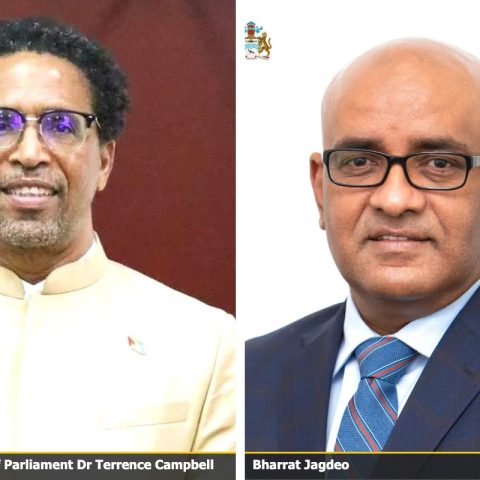
The meeting was hosted by the PNCR and APNU and was attended by then Opposition Leader Aubrey Norton, APNU parliamentary leader Dr Terrence Campbell, PNCR General Secretary Sherwin Benjamin, WIN leader Azruddin Mohamed and Forward Guyana Movement leader Amanza Walton-Desir.
A statement from APNU at the time described the meeting as a “forthright interchange” and an opportunity to advance judicial reform and justice delivery. The opposition parties expressed appreciation for the engagement and reiterated their commitment to an independent judiciary and regional cooperation.
However, on November 7, Norton disclosed that Justice Anderson had raised with him the substantive appointment of then acting Chancellor Yonette Cummings-Edwards.
Under Guyana’s Constitution, the substantive appointments of the Chancellor and Chief Justice require agreement between the President and the Leader of the Opposition.
Norton said Justice Anderson had initiated the engagement and that he had made clear his opposition to the supersession of any judicial officer, including Justice Cummings-Edwards. He said he ended the discussion when it became clear that the engagement was not proceeding in the context he had assumed.
“All I would say to you is that I was engaged by him. I gave him my views on the situation. And outside of that, I know of no other role that he would have played,” Norton said at the time.
Asked whether Justice Anderson had acted at President Ali’s request, Norton said he could not confirm this but considered it reasonable to suspect that this was the case.
Norton said the engagement had raised questions about the credibility and impartiality of the regional court.
“I will never see them in the same light that I saw them at the inception of its establishment,” he said.
He added: “I would say to you that this last set of engagement raised serious concerns about the impartiality of the Caribbean Court of Justice.”
When Stabroek News subsequently contacted Justice Anderson’s office for clarification, he said he did not wish to speak at all.
During the delivery of the CCJ’s judgment in the case of the Mohameds on July 29, there were two oddities. Justice Jamadar was not recognised by the Deputy Registrar of the court and had to draw this to her attention and Justice Anderson announced that Justice Eboe-Osuji would not be present for the reading of the decision.











Discussion