By Dr. Nand C. Bardouille
For the second year in a row, two leading Caribbean voices laid bare disparate paradigms on international cooperation and multilateralism. Speaking with an eye toward their respective countries’ and the region’s most pressing transnational challenges, they shared their visions for all the world to see.
Trinidad and Tobago‘s Prime Minister Kamla Persad-Bissessar addressed the United Nations (UN) on September 22, followed by Barbados‘ Prime Minister Mia Mottley two days later. Together, these speeches offer a direct window into their countries’ foreign policy priorities and global stances.
Each address was used to different effect to help establish this picture.
Persad-Bissessar framed the world ‘as it is’, building out a transactional narrative for the conduct of international relations that is at once attuned to the existing structures and dynamics of global power.
For her part, Mottley critiqued the historical forces that shaped our current world. By drawing attention to unequal power relations throughout history, she illuminated her country’s ambitious foreign policy.This agenda centers on an emancipatory narrative, which targets a rigged multilateral system, highlighting how major international institutions consistently fail vulnerable nations.
Persad-Bissessar has provided little to no backing for this narrative. This suggests a disagreement between Port of Spain and Bridgetown over how small states — specifically Small Island Developing States (SIDS) and low-lying coastal nations — ought to wield agency in international politics.
No wonder, then, there is little basis in reality for the expectation that Bridgetown and Port of Spain could take a clear position on the roots of — and the way out of — the current crisis of multilateralism.
Growing foreign policy-related rifts
Bridgetown and Port of Spain are thus worlds apart on the multilateral system’s prospects for a turnaround, highlighting a powerful new foreign policy-related cleavage between the 14-strong sovereign member states that comprise the Caribbean Community (CARICOM).
As leading members of this bloc, Barbados and Trinidad and Tobago have fundamentally altered global perceptions of how this regional grouping of small states (as SIDS) can practically carve out a collective path to navigate international economic and/or security policy shifts.
The bloc’s constituent treaty enshrines the coordination of member states’ foreign policies as a core pillar. Yet, by aligning with the Donroe Doctrine, Trinidad and Tobago has drawn the ire of virtually all its sister CARICOM member states, fueling friction with the bloc.
A recently issued CARICOM Secretariat news release that references the 26th Special Meeting of the bloc’s Council for Foreign and Community Relations (COFCOR), held on September 21, downplays the true complexity of holding such a meeting at this juncture, let alone the likelihood that it can work through policy areas of contention. (An organ of CARICOM, COFCOR is the primary vehicle for the coordination of its member states’ foreign policies.)
Competing national interests are now the order of the day. CARICOM’s divisions over Cuba are especially telling of this reality, which has eroded traditional regional consensus regarding this largest island in the Caribbean Sea.
A long-standing friendly nation to this bloc, Cuba is in the grips of one of its most severe multi-dimensional crises in decades.
With Cuba currently in Washington’s crosshairs, Trinidad and Tobago has repeatedly kept its distance from CARICOM statements criticizing the tightening economic and commercial restrictions imposed on this republic.
Trinidad and Tobago has solidified its position as one of Washington’s most pivotal strategic allies in the Latin America and Caribbean region, aligning tightly with the United States across major security, trade and energy policy spaces. It has emerged as a critical component in Washington’s rollout of the Donroe Doctrine, which hinges on the U.S. 2025 National Security Strategy and 2026 National Defense Strategy.
A tale of two UNGA speeches
Speaking at the 2026 UN General Assembly High-level Week, Persad-Bissessar announced a major foreign policy shift: Trinidad and Tobago is tightening its strategic alliance with the United States to fight transnational organized crime. To address such a shared threat, she strongly endorsed U.S. military and counter-narcotics operations in the wider region.
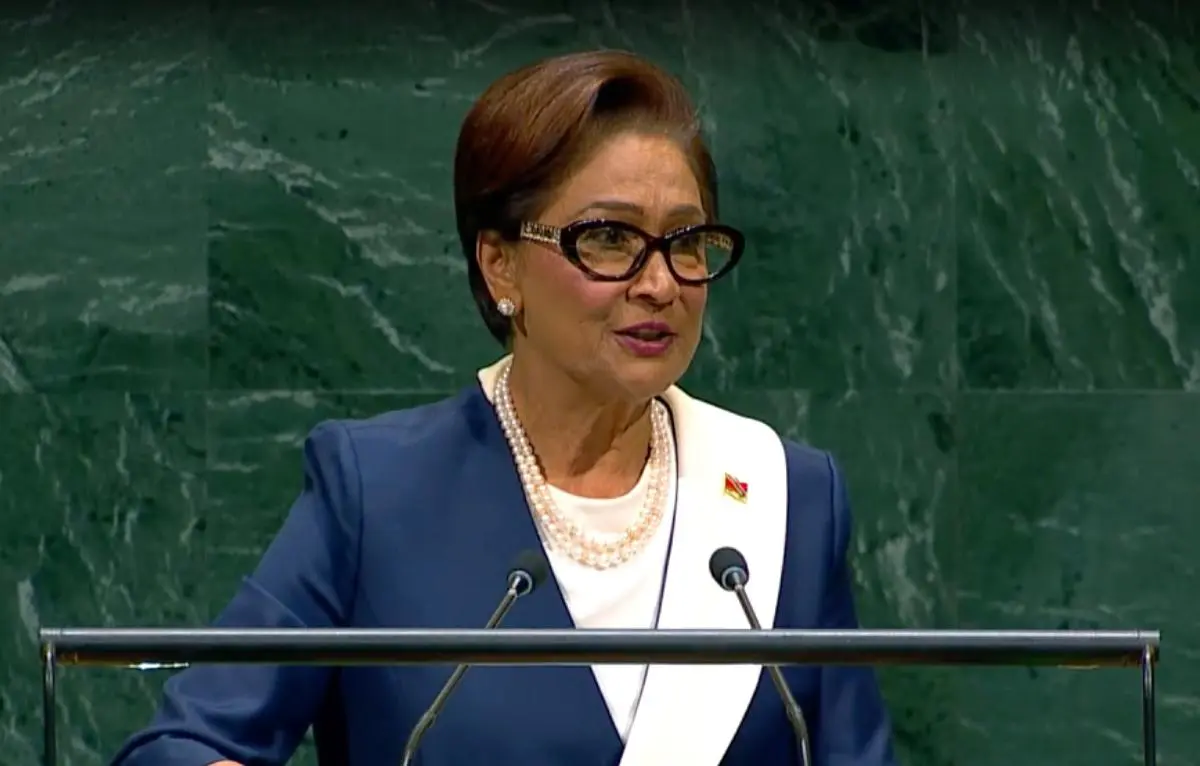
Trinidad and Tobago’s securitized approach to multilateral cooperation prompted the Trump administration to invite the nation into key U.S.-led security initiatives, including the Shield of the Americas and the Americas Counter Cartel Coalition (ACCC).
Trinidad and Tobago views its participation as vital to dismantling the sophisticated weapon- and drug-trafficking syndicates that directly threaten its citizens and state institutions.
For Port of Spain, then, national security (specifically, a law-and-order-driven domestic policy agenda) and geopolitical rent-seeking are the driving forces for its foreign policy positioning and security cooperation with Washington.
Looking ahead to Trinidad and Tobago’s 2027–2028 UN Security Council (UNSC) term, Persad-Bissessar pledged that her administration would push for stronger global cooperation to curb illicit arms flows and counter emerging technological threats.
By securing a non-permanent UNSC seat for only the second time, Trinidad and Tobago elevates its global profile.
During her UNGA speech, Persad-Bissessar also stated, “We will approach our tenure with an independent and practical outlook, working constructively with all members of the Council and seeking common ground wherever possible.” Trinidad and Tobago’s milestone UNSC seat naturally invites closer scrutiny of its foreign policy, Security Council chamber conduct and behind-closed-doors consultations. Ultimately, this spotlight ties the nation’s strategic alignment with the U.S. directly to prevailing concerns.
Mottley’s most urgent priority at the aforesaid High-level Week was to place the crisis of multilateralism in a deeper context: amplify calls to protect and fairly manage the global commons, not least because small states are disproportionately affected by decisions they have little hand in making. Barbados’ national statement, therefore, pressed for meaningful and impactful changes within the UN — including restructuring the UNSC — to make it more responsive to such calls, underscoring collective responsibility.
Mottley is urging global reforms to ensure small island nations do not lose their voice amidst today’s geopolitical power shifts.
Lacking a seat at the proverbial table, such nations ultimately suffer from opaque decision-making.
Connecting UN reform to power and representation, Mottley argued that current international structures must evolve. She noted that these systems still reflect outdated post-World War II dynamics and priorities, leaving them ill-equipped for modern existential threats.
Through the Barbados-spearheaded Bridgetown Initiative, Mottley has called for the World Bank to expand its mandate in three key areas: explicitly funding climate adaptation, widening access to concessional finance for vulnerable nations and expanding natural disaster clauses to pause debt repayment. She argues that this institutional evolution is vital for positioning vulnerable nations against the climate crisis — an issue UN Secretary-General António Guterres calls the “most profound intergenerational power imbalance.”
Mottley’s wide-ranging speech also underscored the risks of artificial intelligence, while reaffirming Barbados’ call for reparatory justice, among other matters in which it has a stake.
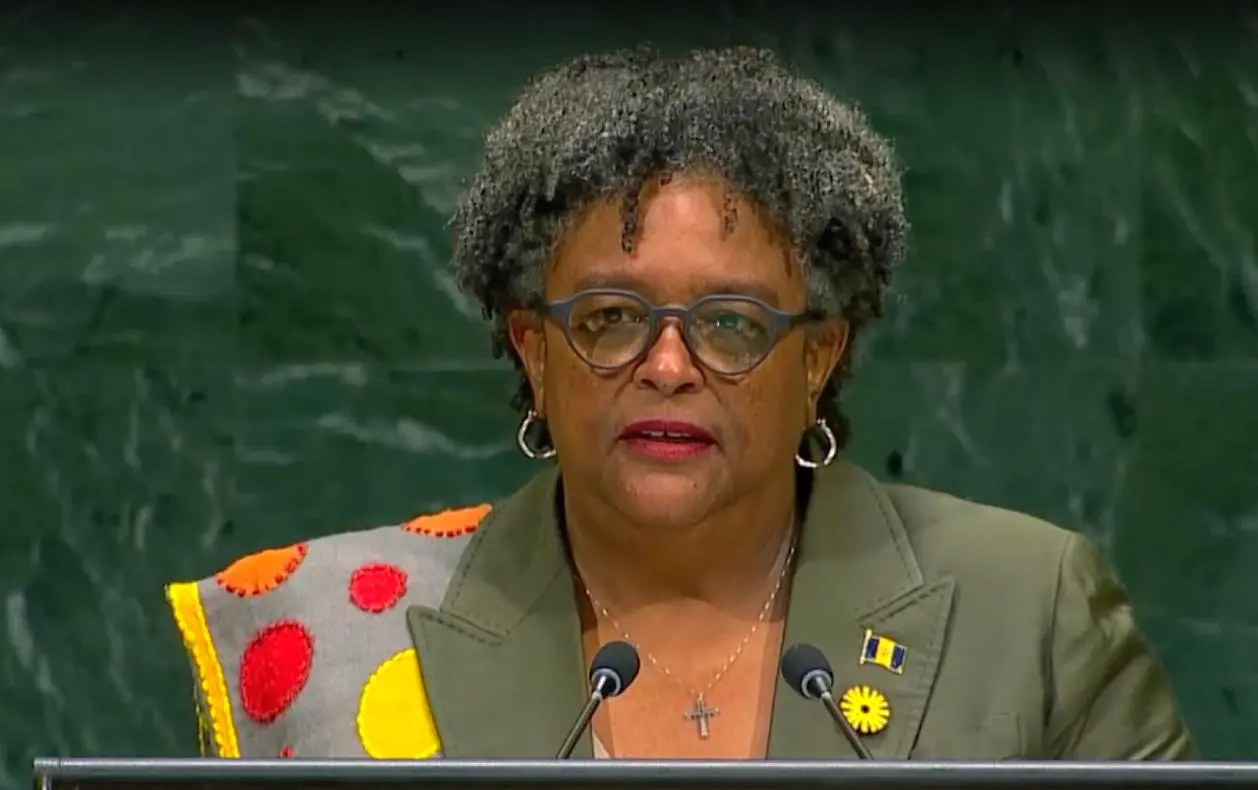
She also emphasized that small states depend on a rules-based international order. Rejecting geopolitical power plays that threaten to turn the Caribbean into “a theatre for confrontation or for the unilateral and unjustified use of force,” she insisted that the region must remain a ‘Zone of Peace’.
This is a direct, strategic counter-narrative to Persad-Bissessar’s speech from the same General Assembly rostrum last year, when she put the boot into the bloc’s long-standing foreign and security policy consensus on the region’s positioning as a ‘Zone of Peace’.
In short, Mottley views heavy U.S. security and military expansion in the region with serious concern. Out of concern for Caribbean nations, she has openly criticized Washington’s unilateralism. Mottley and some other CARICOM leaders argue that the rise of unilateralism poses high and very real risks to small states, significantly compounding the challenges currently faced by multilateralism.
While co-hosting the inaugural Partners for Multilateralism, International Law, Peace and Prosperity (P4M) summit on September 21, Mottley offered a sneak peek of this viewpoint. (Co-sponsored by Barbados, this high-level meeting culminated in a joint declaration reaffirming a shared commitment to multilateralism, international law, peace and prosperity amid rising global polarization.)
Such a perspective also found expression in some other CARICOM member states’ national statements, which place an emphasis on the vital role of a rules-based international order for such small states.
Jamaica’s Foreign Minister Kamina Johnson Smith captured this perfectly during her September 26 UN address, stating: “For small states like ours, a rules-based international order is not an abstract diplomatic preference. It is fundamental to our sovereignty, our security and our development.”
A study in contrasts
For all its diplomatic unity on climate change and sustainable development, along with other focal areas of global governance, CARICOM remains sharply divided on matters of security.
Having rocked the boat, but for altogether different reasons, the respective High-level Week diplomacies of Barbados and Trinidad and Tobago have borne this out.
These two CARICOM member states differ widely in their foreign policy focus and how they garner support for their priorities.
While both leaders made the case for a more responsive multilateral system, Mottley is seeking to make her mark through a focus on the need to overhaul this superstructure’s institutional apparatus and, by extension, deal with associated global power dynamics. Whereas Mottley focuses on systemic overhauls, Persad-Bissessar emphasizes institutional optimization, linked to increased accountability, as well as advancing security cooperation.
The elephant in the room
Along the way, Persad-Bissessar has launched broadsides at regional leaders who questioned Trinidad and Tobago’s diplomatic actions. One clear example is Trinidad and Tobago’s recent foreign policy choices regarding regional security and Venezuela, which gave a distinct fillip to the Trump administration’s Donroe Doctrine.
Policy disagreements over the Caribbean’s designation as a ‘Zone of Peace’ have further fractured CARICOM. This was especially apparent at the height of a months-long U.S. military buildup and naval campaign in the Caribbean Sea known as Operation Southern Spear, which drew a range of reactions from the bloc’s membership.
Over the past few months, the rapid consolidation of operational military and security ties between the United States and Trinidad and Tobago has fundamentally reshaped the regional security landscape.
While regional leaders debate the broader implications of this development, Trinidad and Tobago shows little, if any, regard for repeated calls for member states to “advance foreign policy collectively in [the] uncertain global climate” — especially when such cooperation conflicts with its national interest.
Since returning as Prime Minister of Trinidad and Tobago in May 2025, following a general election victory by her political party, Persad-Bissessar has distanced her administration from several regional foreign policy and security consensuses.
This state of affairs severely undermines decades of cooperative diplomacy among CARICOM member states, interrupting a strong, if occasionally imperfect, history of presenting a common front.
Member states of the Organisation of Eastern Caribbean States (OECS) — a like-minded, close-knit sub-regional grouping whose Protocol Members also belong to CARICOM — are undoubtedly concerned about CARICOM’s troubles.
This collective is now even more committed to harmonizing foreign policy across key OECS priorities. Meeting on September 20, on the margins of the High-level Week in question, the sub-region’s foreign ministers “reaffirmed the OECS’s commitment to a unified, forward-looking foreign policy agenda and to strengthening the region’s collective capacity to advance and protect the interests of its Member States in an increasingly complex international environment.”
Port of Spain is happy to cut its own path by focusing on the ACCC, which Trinidad and Tobago joined earlier this year, raising a host of questions.
At the Shield of the Americas summit on September 22, held on the sidelines of UNGA, U.S. Secretary of State Marco Rubio said the coalition is not just about targeting “cartels and transnational crime in the Western Hemisphere.” Athough the latter focus is its “cornerstone,” Rubio characterized this coalition as also constituting “opportunities to partner up on the economic front and the diplomatic front to speak in one voice, in unison, on issues that unite us and to be able to in international forums, as an example, potentially vote together and pool … our diplomatic resources as well to act in concert in the common interests that we share.”
This summit‘s Joint Statement on Defending Hemispheric Sovereignty, reportedly “designat[ed] 24 cartels, prison gangs, and drug trafficking groups as foreign terrorist organizations (FTOs), laying the groundwork for potential U.S. military involvement in operations across the Western Hemisphere.”
Persad-Bissessar strongly defended Trinidad and Tobago’s involvement in the coalition, framing U.S. military power as a necessary tool against asymmetric threats from transnational criminal networks.
But there is a larger story: Guyana, a CARICOM member state, is a founding member of the Shield of the Americas alongside Trinidad and Tobago. In his September 24 address to the UN, Guyana’s President Mohamed Irfaan Ali pointed out that his country partners with the U.S. and 13 other nations to secure regional peace and prosperity while jointly fighting transnational criminal networks.
A few more CARICOM member states have joined the Shield of the Americas.
In late August, Jamaican authorities advised of this northern Caribbean country’s participation in the Shield.
Belize and The Bahamas are also reportedly participating. Like Jamaica, these two CARICOM member states recently joined.
Reports also indicate that a few Shield members — mostly these three CARICOM member states — did not sign the referenced summit Joint Statement.
Furthermore, it has since come to light that rogue U.S. Drug Enforcement Administration agents were operating illegally in The Bahamas.
Guyana and Trinidad and Tobago were the only CARICOM member states to sign the aforementioned statement. They were on board with the Shield from the outset, requiring no convincing to align with this facet of Washington’s Donroe Doctrine strategy.
The exact motivations driving the new wave of CARICOM nations to join the Shield remain unclear. Some observers suggest that certain CARICOM member states may have chosen to go along to get along with the United States.
Final reflection
Deep divisions over global cooperation have fractured CARICOM. The United States, which increasingly demands painful diplomatic concessions, dominates this dynamic.
In the circumstances, for the most part, CARICOM member states are on the defensive. But there are notable exceptions that freely exert foreign policy independence.
In sum, the underlying reality is that CARICOM’s current diplomatic environment serves simultaneously as a strategic opportunity for select member states and a source of disruption for the rest. This crossroads may come at a steep long-term price for this bloc.
_____
Nand C. Bardouille, Ph.D., is the outgoing manager of The Diplomatic Academy of the Caribbean in the Institute of International Relations at The University of the West Indies (The UWI) St. Augustine Campus, Republic of Trinidad and Tobago. The views expressed here are his own.








Discussion