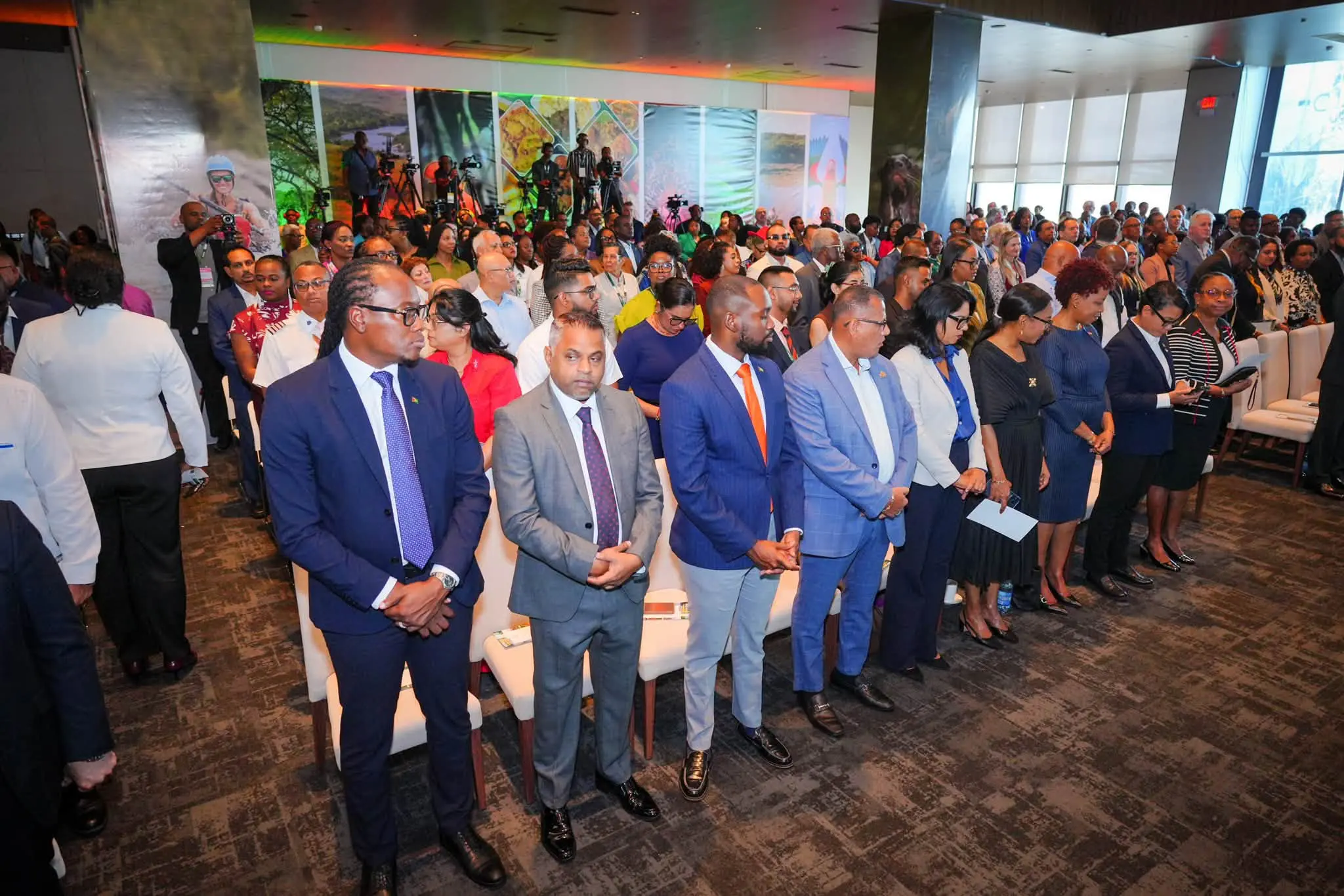
President Irfaan Ali yesterday urged Caribbean governments and investors to develop an integrated regional transport system and expand their approach to tourism investment, warning that the region’s natural attractions would not be enough to protect its competitiveness.
Addressing the opening of the Caribbean Tourism Organisation’s (CTO) State of the Tourism Industry Conference (SOTIC) in Georgetown, Ali called for a regional vision extending to 2035, supported by better connectivity, new partnerships and stronger preparations for disasters.
“For tourism to succeed, compete, and stay alive in this region, we have to scale up our thinking, scale up our infrastructure, scale up our commitment,” he said.
Guyana is hosting the conference for the first time under the theme “Tourism Futures: Smart, Sustainable and Inclusive”. The week’s activities run from October 5 to 9, with the main conference sessions on October 7 and 8.
Ali’s address was preceded by a rich cultural performance featuring Guyanese songs, dances and drumming, showcasing the country’s culture, creativity and diversity. The ceremonial opening took the form of tourism ministers bursting coconuts and tasting pieces of the flesh, in place of the customary ribbon-cutting.
Setting aside his prepared remarks at the outset, Ali said there needed to be a stronger connection among investment, investors and governments if Caribbean tourism was to withstand emerging challenges.
He identified transport links as a major regional disadvantage and said countries elsewhere were investing heavily in infrastructure to secure their place in the global tourism market.
“The only thing that can take us forward by scale is integrated infrastructure, starting with an integrated transport system,” he said.
Ali argued that visitors attracted to Caribbean beaches could also be interested in travelling to Guyana, Suriname or Belize, but the region needed the connections to make those combined experiences possible.
He also renewed his call for regional tourism branding to reflect the Caribbean’s forests, rivers and biodiversity alongside its island attractions.
The President warned that satisfaction with the region’s natural advantages could leave it poorly positioned for changes in visitor expectations and international competition.
“Our natural product and our natural beauty are important assets. But if we are complacent about the way we retool, reorganize, reorient, revalue, reposition this asset, we are not going to optimize its value in the future,” he said.
Drawing
Drawing a comparison with West Indies cricket, he said the region had once dominated that sport through its natural talent, but could not assume that an earlier advantage would endure without adaptation.
Much of his address examined investments in the Middle East and Latin America, which he said Caribbean policymakers and businesses needed to study more closely.
He pointed to luxury resorts, sports, entertainment, conferences, cultural attractions and digital tourism as areas receiving substantial investment. The region, he said, should consider partnerships with destinations whose financial resources made direct competition difficult.
Ali urged the CTO to help identify major international events which the Caribbean could collectively seek to host over the coming decade, with infrastructure developed around those objectives.
He also challenged investors to create new attractions, suggesting that Guyana could provide the land and scale for a world-class tropical forest night safari.
“We need the conference to deliver to the people of the region a vision to 2035, in which CTO places itself central to that vision, connecting to new partnership and new markets and integrating into those new partnership and markets,” he said.
Turning to Guyana, Ali cited the planned second terminal at the Cheddi Jagan International Airport, Timehri, proposed airports in Lethem and Berbice, road links and a deep-water port as elements of a connected development programme.
He said airports should themselves offer visitors an experience and communicate something about the destination.
“That is why we’re investing in Terminal 2, not only as a new terminal, but as a terminal that will tell the story of Guyana and where Guyana aspires to be,” he stated.
Stabroek News reported in February that the Ministry of Public Utilities and Aviation had invited proposals for the design, construction and financing of municipal airports at Rose Hall, Canje, and Lethem.
Ali also linked tourism development to Guyana’s efforts to position itself internationally through biodiversity. He said the country had applied to host COP in 2030 with CARICOM’s backing and would hold a second Global Biodiversity Alliance summit later this month.
The alliance was launched at an inaugural summit in Georgetown in July 2025. Stabroek News reported that its priorities included conserving land and marine areas, incorporating biodiversity into development planning, mobilising finance and supporting Indigenous peoples and local communities.
The President also criticised the region’s failure to make learning Spanish compulsory, saying this had limited its ability to build closer tourism links with Latin America.
Towards the end of his address, he turned to European visa procedures, criticising arrangements which required applicants to travel to Trinidad or Suriname to submit biometrics.
“In a day of digitization and AI, we have the EU that is operating from a Stone Age kind of operation,” he said.
Ali argued that the time and expense involved complicated participation in international conferences and were inconsistent with the opportunities offered by modern technology.
He said tourism’s recovery from the COVID-19 pandemic demonstrated the industry’s resilience, but that this now had to be reinforced through infrastructure, investment, partnerships and a coordinated regional strategy.








Discussion