
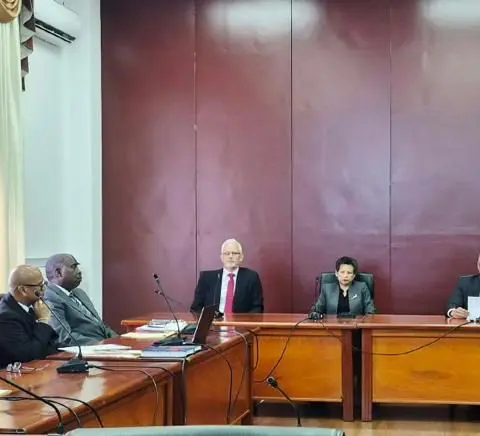
Caribbean Court of Justice (CCJ) President Justice Winston Anderson yesterday reported a recent overall 40% increase in filings before the court and said the institution must deepen its reach and strengthen its impact after spending its first two decades building its foundations.
Addressing the opening of the court’s first itinerant sitting in St Lucia, Justice Anderson outlined plans to improve efficiency, modernise procedures and expand public access as the CCJ began its 2026–2027 judicial year.
“We have spent the first two decades building the Court. Now we must deepen its reach and strengthen its impact,” he said.
His address comes against the background of the public dispute arising from leaked correspondence among CCJ judges in August. The emails raised concerns about his leadership, consultation, judicial panel assignments and the handling of cases. Justice Anderson has rejected allegations of panel manipulation and improper influence.
Sitting with him in St Lucia are Justices Maureen Rajnauth-Lee, Denys Barrow, Peter Jamadar Chantal Ononaiwu, Chile Eboe-Osuji, and Arif Bulkan.
Yesterday, Justice Anderson did not directly discuss the controversy, focusing instead on the court’s work, accessibility and relationships across the region.
He said judicial independence and impartiality, technological innovation and a commitment to service remained central to its operations.
According to Justice Anderson, the court delivered 70 judgments in its appellate jurisdiction during the last judicial year, arising from appeals and special leave applications from the five states which use it as their final appellate court.
Since its establishment, he said, the CCJ had heard and determined more than 500 matters across its original and appellate jurisdictions.
He also reported that the court had delivered judgments in nine matters from St Lucia since that country accepted its appellate jurisdiction in 2023. These concerned issues including property rights, taxation, the detention of funds, judicial review and breach of contract.
Justice Anderson said there had been a 600% increase in judgments issued for St Lucia compared with a corresponding period when the country used the Judicial Committee of the UK Privy Council. He did not set out the underlying figures for that comparison in the supplied transcript.
The President acknowledged that other countries had not accepted the court’s appellate jurisdiction as quickly as had been hoped.
“The pace of accession to the appellate jurisdiction by other member states has not been as swift as we would have hoped,” he said.
Nevertheless, he maintained that the court had continued to develop Caribbean jurisprudence and provide accessible and efficient justice.
Looking ahead, Justice Anderson said nine appeals and 14 special leave applications were before the court in its appellate jurisdiction, while judgments had been reserved in eight matters.
“As the Court’s case load continues to grow, we will rigorously apply our case management and judgment delivery procedures to ensure the efficient and timely administration of justice,” he said.
He outlined measures intended to make the institution easier to use and its decisions easier to understand. These included an online payment system introduced in August, a redesigned website and a chatbot to help users find information.
The court had also introduced videos explaining cases before judgment delivery and summaries afterwards, while continuing to livestream hearings and publish judgments.
Justice Anderson said the CCJ’s travelling sittings were important to maintaining its connection with Caribbean people.
“When the Court travels, we are reminded that justice is not simply administered from the bench. It also requires us to remain connected to the people whom we have the privilege and responsibility to serve,” he said.
The visits allowed judges to engage with litigants, attorneys and other stakeholders, while providing opportunities to listen and learn.
The assurances about the court’s work follow the disclosure of internal correspondence which exposed disagreements over a proposed judicial dress code and wider concerns about its administration.
In his August response, Justice Anderson acknowledged removing Justice Eboe-Osuji from a panel hearing a preliminary application following a disagreement over courtroom attire. He maintained that the decision had nothing to do with the judge’s views and acknowledged that he might have handled the dress-code issue too forcefully.
The Organisation of Eastern Caribbean States Bar Association and the Organisation of Commonwealth Caribbean Bar Associations called for investigations into both the allegations and the disclosure of the correspondence, while reaffirming their support for the court.
The Regional Judicial and Legal Services Commission said the concerns should be addressed through established governance mechanisms and a transparent and independent review. It subsequently clarified that it had neither confirmed the allegations nor said that it had ordered a review. The court also changed its panel arrangements to require all judges to sit in matters unless excused for a legitimate reason.
Closing his substantive remarks yesterday, Justice Anderson said the court would enter the new judicial year with a renewed commitment to its mandate and service to the region.












Discussion