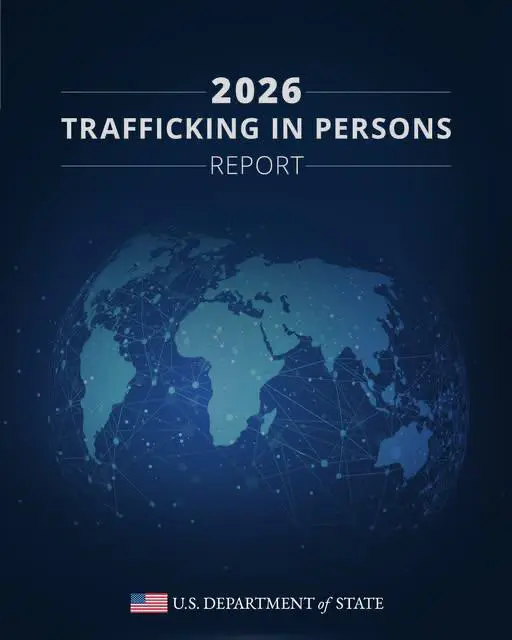
Guyana has retained the highest ranking in the United States’ annual assessment of efforts to combat human trafficking, although the latest report records fewer investigations, reduced funding and a sharp fall in the number of identified victims referred to care.
The 2026 Trafficking in Persons Report places Guyana on Tier 1, recognising that the government meets the minimum standards for eliminating trafficking. However, its assessment also identifies a deterioration in victim protection and repeats several concerns raised last year.
According to the Guyana chapter, authorities identified 390 victims in 2025 but referred only 25 to care, compared with 416 victims reported as identified and referred in 2024. Investigations fell from 31 to 16, while prosecutions increased from three suspects to four. One trafficker was convicted in each year.
The report credits the government with prosecuting suspected sex and labour traffickers, detaining a person convicted in absentia during the previous reporting period, training officials and opening a transition home for victims.
Nevertheless, it says the government inadequately supervised recruitment agencies, failed to prevent workers from being charged recruitment and placement fees, and did not adequately address trafficking risks at worksites affiliated with China.
Concerns carried over
The assessment broadly follows last year’s pattern of recognising government efforts while identifying persistent weaknesses in enforcement and protection. However, the latest findings are less favourable in several areas.
The 2025 report credited Guyana with identifying more victims and increasing protection and prevention funding. It also raised concerns about recruitment agencies, screening in the interior, Chinese and Cuban workers, and enforcement of compensation orders. Those concerns over recruitment, interior enforcement and restitution remain substantially unresolved.
The latest report says the government has been reviewing labour recruitment legislation for four consecutive years without completing the changes. It identifies the growing number of agencies recruiting for the oil sector as a particular concern.
Guyana lacks a formal mechanism to regulate and oversee recruitment and screen for trafficking indicators, the report says. It also identifies gaps in laws governing recruitment fees, changes to contracts without workers’ consent and the withholding of wages to compel continued service.
Investigations declined by approximately 48 per cent between 2024 and 2025. The fall follows an earlier decline: last year’s assessment recorded 31 new investigations in 2024, down from 77 in 2023.
The latest report also describes a suspected labour trafficking case in which the government pursued a settlement rather than a criminal conviction. The defendant was ordered to pay outstanding wages and the victim’s transportation costs to return home.
Trafficking trials continued to take an average of two years and sometimes as long as four. The report attributes delays to shortages of trained court personnel, postponements and difficulties preparing cases.
It further says reliance on victims’ testimony resulted in prosecutions being dropped when victims declined to testify.
Victim protection weakened
Of the 390 victims identified in 2025, 296 women and eight girls were exploited in sex trafficking, while 85 adult men were exploited in forced labour. One boy was subjected to an unspecified form of trafficking.
Fifteen victims were Guyanese and 375 were foreign nationals from Venezuela, Brazil, Cuba, the Dominican Republic, India and Colombia.
The government allocated $116.9 million for victim services, including support to non-governmental shelters. The latest report compares this with $132.6 million in 2024, representing a reduction of approximately 12 per cent.
Prevention funding fell more sharply, from $169.5 million to approximately $83.25 million, a reduction of about 51 per cent.
Despite that reduction, the report assessed overall prevention efforts as having increased, citing public education, reporting mechanisms and other measures.
A 30-person transition home was completed in July 2025 to accommodate victims during a voluntary 10-day reflection period, when law enforcement questioning is prohibited.
However, non-governmental organisations reported that some shelters closed during 2025, potentially exposing victims to further exploitation. Distance also delayed services for people in remote areas, while fear and trauma made some reluctant to accept assistance.
The report notes that the trafficker convicted during the period was not ordered to pay restitution. It also identifies continuing weaknesses in the law’s provisions for enforcing compensation orders.
Cuban and Chinese workers
One significant change from last year concerns Cuban workers.
The latest report says Guyanese authorities sought fair labour conditions for Cuban personnel and measures to address forced labour concerns, after which Cuba ended the bilateral health cooperation agreement in early 2026.
According to the assessment, 370 Cuban government-affiliated workers were in Guyana in 2025. Guyana offered direct employment and protection to the workers, approximately 110 of whom remained, while the others returned to Cuba.
However, observers reported that the government did not consistently ensure that those who stayed received their wages.
Concerns over Chinese workers persisted. Although authorities reported screening arriving workers and inspecting worksites, they did not identify trafficking victims among this population.
The report says Chinese nationals employed on Chinese state-affiliated projects and at mining operations owned by China-based companies face conditions indicative of forced labour. It also says the government did not assess trafficking risks in agreements for projects under China’s Belt and Road Initiative.
Caribbean comparison
Guyana’s Tier 1 status places it alongside The Bahamas and Suriname among the highest-rated governments in the region. Both countries retained Tier 1 in the 2026 assessment.
Jamaica, Trinidad and Tobago, Belize, Antigua and Barbuda, and the Dominican Republic were placed on Tier 2. These governments were assessed as making significant efforts but falling short of full compliance with the minimum standards.
Barbados and Saint Lucia remained on the Tier 2 Watch List for a second consecutive year, while Cuba was placed on Tier 3, the lowest category.
Among the stronger examples, the report credits Suriname with prosecuting more suspected traffickers, including a former police officer, and providing services to all identified victims. The Bahamas increased staffing in an investigative unit to address enforcement gaps.
At the other end of the scale, the assessment identifies a government policy or pattern of forced labour in Cuba’s overseas labour programme, including medical missions. Cuba’s Tier 3 placement reflects the US assessment of the government’s response and involvement in exploitation.
The rankings measure government action rather than the prevalence of trafficking. Guyana’s higher placement therefore does not establish that it has fewer victims or less exploitation than countries in lower categories. The State Department expressly cautions that Tier 1 does not mean a country is free of trafficking.
What the tiers mean
Tier 1 is the highest category and applies to governments meeting the minimum anti-trafficking standards. Tier 2 applies to governments that do not fully meet those standards but are making significant efforts.
The Tier 2 Watch List adds scrutiny where there are additional concerns, including a failure to demonstrate increasing efforts. Tier 3 applies to governments that neither meet the standards nor make significant efforts to do so.
Guyana’s continued top-tier placement comes against a background of new protection and reporting initiatives.
Stabroek News reported in August 2025 that the Ministry of Human Services and Social Security had introduced victim protection procedures, a children’s trafficking-awareness storybook, QR codes for reporting concerns and a simplified guide to the 2023 anti-trafficking law.
The latest assessment nevertheless says limited state presence in the interior continues to impede monitoring, victim identification and enforcement. Trafficking occurs in mining, agriculture, forestry, construction, domestic service and shops, while women and children are exploited in sex trafficking in both interior communities and urban areas.
The report warns that the full extent of trafficking in remote mining communities remains unknown.









Discussion