Nigel Westmaas
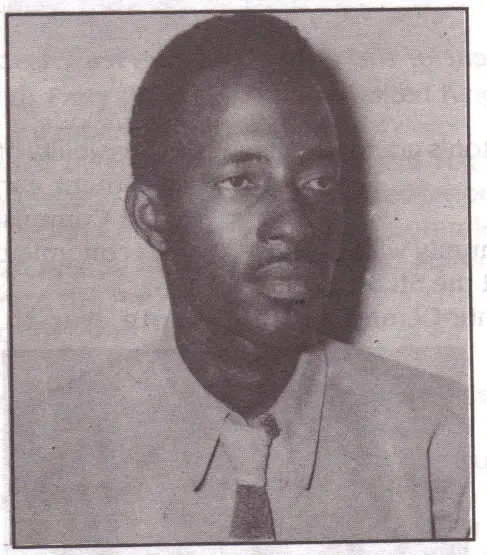
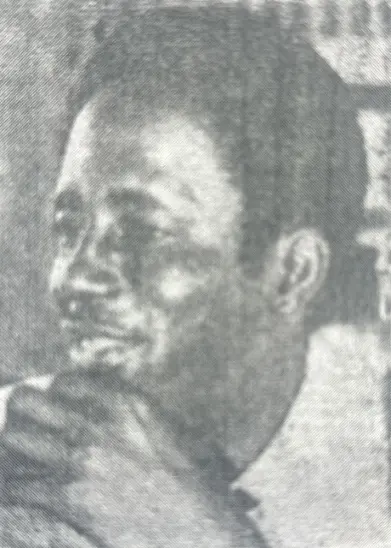
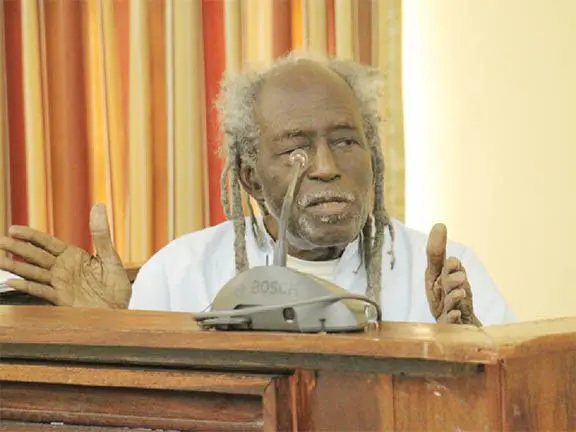
And so, Eusi Kwayana has passed, leaving us to reckon with the immensity of a life that helped shape Guyana. What a man! What an extraordinary human being! Across more than a century, he bore witness to the making of modern Guyana and helped form it with a searching mind, a courageous spirit and an unwavering honesty and conscience. Born on April 4, 1925, Eusi Kwayana brought the experience of a village teacher, the resolve of an anticolonial organiser, cultural activist, and political activist to the long, unfinished struggle over Guyana’s future.
Over many years, I had the good fortune, along with others, to remain in regular contact with Eusi Kwayana. Every conversation was an education in political ethics, memory, language, literature and his organic relationship to principle. A telephone call with Eusi could begin with an obscure political organization from the 1940s, move to a village expression or a line of poetry, and end with a sharply drawn judgment on a major political figure. He carried nearly a century of Guyanese experience, but he never treated history as something safely settled in the past.
What struck me repeatedly was the combination of extraordinary recall and complete accessibility. Eusi would call to clarify a detail, correct a date, identify a forgotten activist or explain a phrase whose meaning had faded from common use. He remembered organisations, personalities, meetings and arguments that had disappeared from the public record. He could summon the People’s Free Press of the late 1940s and early 1950s, the British Guiana East Indian Association, the Indian National Congress of British Guiana, the Labour Party, the early PPP and ASCRIA. He remembered not only leaders, but the organisers, teachers, farmers, printers, musicians and village figures whose work sustained public life.
A Living Archive of Guyanese Experience
Eusi’s historical memory was never merely a collection of names and dates. It preserved the texture of society. He remembered the Atwater Kent radios of an earlier period and recalled drinking alcohol on VE Day in 1945, when he vomited after imbibing and declared to himself that rum was unfit for human consumption. He never drank again. He recalled listening to Radio Moscow in the 1950s on a blue Berec radio, at a time when the airwaves were largely relegated to Radio Moscow, the Voice of America and the BBC. He laughed about his first small ‘matchbox’ car, bought from artist Aubrey Williams in 1952 for $250, whose car brakes were so unreliable that he sometimes had to jump out to stop it. The radiator also didn’t work. He finally got a Morris Oxford (he even recalled registration number, 619) after he became minister in 1953, but it was always loaded with people whom he gave a lift seeking a ride between Buxton and Georgetown. Eusi recalled briefly meeting Hubert Critchlow at Critchlow’s office in 1949 or 1950. “He told me everyone in Russia has three square meals per day ”, Eusi remembered. Critchlow also told him that he had once shared a platform with Joseph Stalin.
These details mattered because they returned politics to the ground on which it was lived. Eusi remembered village halls, estate meetings, market crowds, handbills and failed fundraising dances. He recalled helping the People’s Free Press organize a dance at Tipperary Hall in Buxton under the patronage of ‘the people’s young champion Cheddi Jagan.’ Despite arranging the Tom Charles orchestra, only about twenty people attended. Eusi could tell such a story without embarrassment. Political life, in his telling, was made up not only of victories and celebrated speeches, but also of disappointments, miscalculations and work that had to be attempted again.
His recollections reached even further into the language and social history of Guyana. He distinguished between village Creole, estate Creole and Georgetown urban Creole. He explained ‘children’s property,’ a phrase for inherited family land whose ownership was understood across generations even when formal documentation was weak.
Kwayana was a “writing machine.” The Buxton sage produced hundreds of works across multiple genres, including poems, critical reviews, short stories, letters to newspapers, opinion pieces, song lyrics, obituaries, court motions, parliamentary interventions (motions and speeches), editorials, political statements, essays, press releases, and plays for both theatre and grassroots events. His writing extended across literary, cultural, political, and legal arenas, reflecting the extraordinary range of his disciplined mind. The range was evident early in his career. In the 1940s, he wrote an environmental column under the pen name “Adam Drops”, addressing subjects that included ‘air conditioners’ used at the time. Around 1946 he wrote his first play, Prodigal Daughter, for the Diocesan Youth Movement. His engagement with the performing arts continued into the 1960s, when he wrote theatre reviews under the name Kiskadee Cloud. These early literary activities reveal a writer whose interests reached well beyond the political commentary and activism for which he became widely known. In one of the most remarkable, lyrical essays, “Politics of the Heart”, Kwayana reflected on Martin Carter’s poetry and its impact on Guyana.
Conscience, and Political Independence
Eusi’s politics were defined not simply by the causes he supported, but by the lines he refused to cross. His opposition to racial violence did not depend on political convenience. Neither did his criticism of party power. He could admire, advise and work alongside figures such as Cheddi Jagan and Forbes Burnham while retaining the independence to criticise them. He recalled Burnham’s intelligence, humour, confidence and political skill, but he also documented the abuses and distortions of the Burnham era. He recalled that Prime Minister Burnham once wanted to provide him with a telephone so he could consult him on foreign affairs. Eusi told him to install it at the County High school instead.
Eusi was a political thinker whose ideas grew from close attention to Guyanese realities. In one conversation, he recalled discussing republicanism with Burnham. When Burnham said he wanted Guyana to become a republic, Eusi asked what kind of republic would it be: a banana republic, or a cooperative republic? Within days, he remembered Burnham had adopted the language of a cooperative republic. Whatever later became of the official doctrine, the story reveals Eusi’s determination to make political language answerable to social purpose.
Kwayana’s life and ethical outlook were grounded in deep and active commitment to women’s dignity, equality and autonomy. His solidarity with women was not simply a matter of principle; it found expression in his daily conduct and political practice. He embodied a feminist ethic before that language became commonplace in his political and social milieu.
In 1976, speaking at the University of the West Indies on ‘aspects of pseudo-socialism in Guyana,’ he examined the machinery hidden behind the doctrine of party paramountcy. Many moons on, that paramountcy is still with us like an albatross across political movements.
Rooted in Guyana, Connected to the World
Eusi’s interest in cooperatives was practical as well as theoretical. He spoke of the role of the African Society for Cultural Relations with Independent Africa (ASCRIA) in encouraging the Young Farmers’ Cooperative, whose members planted cassava, plantains, bananas, pumpkins, greens and other crops. They endured heavy rain, built their own boat and carried produce to Stabroek Market and the Guyana Marketing Corporation. He remembered the organisers, including Roy Wilson and Ohene Koama, and emphasized their discipline and resourcefulness.
The same rootedness shaped his engagement with race. He understood that Black Power acquired a distinct meaning in Guyana, where African cultural assertion had to be pursued within a deeply divided plural society. He was attentive to, and critical of, anti-Black ideas and biases transmitted through religious and colonial institutions. He also criticised prejudices directed toward Amerindian communities. Yet his commitments were not narrow or exclusionary. He maintained associations across ethnic lines, spoke at meetings of the Indian National Congress of British Guiana (of which he was a member) and sometimes used Hindi phrases in his speeches. One phrase he recalled was ‘Yah desh hamari matribhoomi hai’: ‘This country is our motherland.’
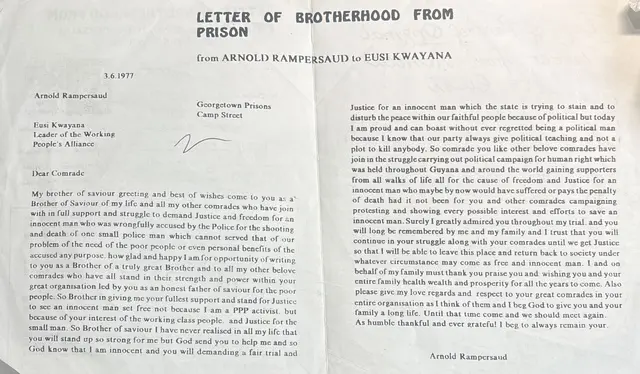
Kwayana was a member of the international Arnold Rampersaud Defence Committee, which also included Ralph Ramkarran, Janet Jagan, Walter Rodney, Malcolm Rodrigues and others. Rampersaud, a PPP activist charged with the murder of a policeman, sent Kwayana a message of brotherhood while in prison.
Eusi’s Guyanese commitments opened outward into a wide internationalism. He followed African liberation struggles closely and helped make ASCRIA part of a larger Pan-African conversation. He recalled the Pan-Africanist and Black Revolutionary Nationalists Seminar organized in Georgetown in February 1970, which brought a large North American delegation and addressed Guyana’s possible role as a refuge for liberation fighters. His accounts also connected Guyana to Biafra, Malawi, Angola and the wider politics of African decolonization.
His travels brought him into contact with some of the major political figures of the twentieth century. During a visit to Ghana in 1964–65, he met Kwame Nkrumah three times. Nkrumah asked him what Jagan was doing, drew a diagram on his desk to explain colonialism, spoke sadly about Patrice Lumumba and arranged for Eusi to study the kibbutz system in Israel because of Africa’s interest in cooperative development. While in Ghana, Eusi also heard Che Guevara speak. At Lusaka in 1970, he spoke with Julius Nyerere at the airport. These encounters never seemed to inflate his sense of importance. He remembered them because they formed part of the interconnected memory and history of anticolonial struggle.
Even during the crisis of 1964, Eusi’s instinct was to seek principled international support. He recalled sending a cable to Nkrumah asking for assistance, in part to distinguish his position from those turning toward the CIA. Nkrumah’s reply urged him to seek an understanding with his political opponents. Eusi remembered that counsel as deeply encouraging. The episode captured both the international scale of Guyana’s crisis and the necessity of a national settlement.
Generous Teacher, Enduring Legacy
Eusi never separated politics from education. He was a teacher in the formal sense, but also in the older and larger sense of a person who believed knowledge must circulate. His conversations could move naturally from a political quarrel to Shakespeare, W. H. Auden or Martin Carter. When the outbreak of the Second World War emerged in conversation, he immediately recalled Auden’s poem ‘September 1, 1939.’ He quoted Macbeth from memory. He also preserved in memory the story behind Martin Carter’s line ‘I bent down listening to the land.’ According to Eusi, he and Carter had ridden bicycles together, and Carter once stopped at Le Resouvenir, in an area associated with the 1823 Demerara uprising, and physically bent toward the earth as if to hear the historical land itself.
That image could also describe Eusi’s own method. He listened to the land. He listened to villages, estates, religious traditions, political meetings and the language of everyday people. He paid attention to what official history ignored. He knew that a nation’s political thought could be found in constitutions and party manifestos, but also in proverbs, memories, family property, market speech, village argument and the moral judgments of ordinary citizens.
The privilege of speaking with Eusi lay partly in the knowledge he shared, but also in the manner of the sharing. He did not guard memory as private property. He returned to old questions, volunteered corrections and supplied unexpected connections. His criticisms of people were never gossip for its own sake. They reflected an effort to distinguish service from self-interest, principle from opportunism and genuine public leadership from performance.
He had a keen sense of humour. Once an activist at Rodney House was not delivering on assignments and Eusi quipped: “he wants the job but not the work”. He remembered being teased with nicknames, being heckled at public meetings and watching ambitious politicians maneuver for position. An earlier account, from 1953, illustrates this quality when the young Sydney King faced a hostile village audience. Rather than resent the protest, he told the crowd that their disagreement had caused no bitterness and that he would rather see grown people show signs of life than sit silently when they objected. The audience broke into applause. That capacity to respect dissent was not an incidental charm. It was central to his democratic character.
Eusi Kwayana’s life cannot be reduced to a single organization, ideology or period. He was the village teacher and young minister; the anticolonial organizer; the Black cultural nationalist; the critic of authoritarian rule; the cooperative advocate; the internationalist; the conscience in the Working People’s Alliance; and the elder who continued to think, write, remember and intervene.
Despite his towering contributions, Kwayana remains one of the most misunderstood figures in Guyanese political history. Reflecting on this in Caribbean Daylight (1992), a New York-based newspaper edited by Rohit Kanhai, Kwayana remarked, “My habit of looking critically at my own actions has provided other actors with a shield. This habit, which I think is a good one, provides others with cover, and all they do is add more and more to their storehouse of non-responsibility to win some quick short-lived advantage: whatever is not founded on truth will fall apart because reality has no supports on which falsehood can rest.”
Eusi gave us more than testimony about the past. He modeled a way of belonging to a country: critically, courageously and without surrendering one’s moral independence. He reminded us that memory carries obligations. That is the enduring force of his example, and it is why his voice will forever remain indispensable to any serious understanding of Guyana. And his influence extended across the Caribbean. The late political activist, Tim Hector of Antigua, once reflected on an intellectual exchange with Kwayana in Buxton: “I grappled intellectually with Eusi Kwayana, the finest personage produced in West Indian politics, on practical as well as philosophical subjects.”
Walk in glory, “Tall boy”. My solidarity and heartfelt condolences to his sons Kofi and Alaf, his daughter Iyabo and all members of his near and extended family and friends.







Discussion