Dear Editor,
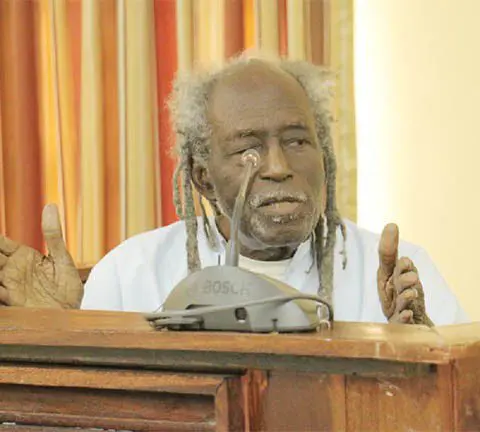
Eusi Kwayana has transitioned at the age of 101 after a very eventful life. I first met him personally in 1986 in Queens, NY after inviting him to give a talk to a political group agitating for free and fair elections in Guyana. Having returned to Guyana in 1988, I would visit the WPA’s HQ on Croal Street, where we continued our dialogue intermittently.
Growing up as Sydney King in Buxton in the aftermath of efforts by the Negro Progress Convention and Garvey’s UNIA to address challenges facing African Guyanese, the 21-year old schoolteacher was attracted to the Marxist approach of the newly-formed, multiracial Political Action Committee (PAC) in late 1946. Three PAC members ran for office in the 1947 elections but only Cheddi Jagan, competing in the Central Demerara Constituency that included Buxton, won a seat. He was supported by Sydney King and another young man, Balram Singh Rai from BV.
Before and after the determinedly multiracial PAC-successor PPP’s victory in 1953, King thwarted Burnham’s quest to seize leadership of the party on several occasions. However, in the fallout of the PPP’s removal from office, he became disillusioned with several of Jagan’s moves – especially after Burnham’s 1955 split.
Jagan’s condemnation of King as an “ultra-leftist deviationists”, his rejection of the proposed WI Federation and his 1956 written address to the PPP Congress (to mobilize upper-strata Indians he now defined as “progressive”) convinced King that Jagan was pandering to Indians, to the detriment of Africans. The final straw was King deciding to run as an independent candidate in the 1957 elections and the PPP-Jagan opposed him with Balram Singh Rai, while PPP-Burnham supported him. He lost, became even more strident about Jagan and the “Indian threat” to Africans and became Vice Chairman and General Secretary of the PNC launched in 1958 and editor of their organ “New Nation.
In a series of unrelentingly strident articles in 1961, with Queens master HH Nickolson writing pseudonymously as “Vigilance” in New Nation and the Chronicle, King helped label the post-1957 PPP government as an Indian government out to destroy Africans. He was expelled from the PNC just before the 1961 elections for opposing Burnham’s support for independence possibly under Jagan’s PPP.
He co-founded the African Society for Racial Equality (ASRE) with HH Nickolson and proposed “joint and equal prime ministership” or partition. In his 1962 booklet “Next Witness” – a compilation of incidents of 1961 election-related “violence” by Indians against Africans, while ignoring those by Africans against Indians, he declared his intention to expose, “(‘the coward’) Jagan’s racial insolence and his cold-blooded organisation of the East Indians for the conquest that has always been their dream.” He concluded: ‘The (PPP) Government, the GUILTY party in the matter of racial conflict, wished to hide the truth because it wants immediate independence under a constitution, which will leave it free to strangle the breath of the African people and the minorities, to create here an East Indian State, to plant the East Indies in the West Indies.”
Readmitted after the PNC was installed into office in 1964, King was rewarded with several appointments including Land Settlements and Chairman of the Guyana Marketing Corporation, enabling him to assist African farmers. He formed the African Society for Relations with Independent Africa (ASCRIA) after he toured nine African nations on Burnham’s behalf and changed his name to Eusi Kwayana – black man from Guyana.
He fell out with Burnham in 1971 after accusing the latter of betraying African Guyanese by selling out to “Indian and Portuguese interests”. ASCRIA coalesced with Moses Bhagwan’s Indian Progressive Revolutionary Associates (IPRA) to form the “multiracial” WPA, even though Bhagwan assured me personally then that his grouping was “political” and not culturally oriented like ASCRIA. Earlier in 1970, I was part of a student-group that walked out of a meeting at Queen’s College after Black Power advocate Stokley Carmichael, invited by ASCRIA, announced that Africans had to organize separately from Indians. Kwayana supported Carmichael’s stand. It was after Walter Rodney, who defined Black Power in the Caribbean as including both Africans and Indians joined the WPA in 1974, that the party earned its multiracial reputation.
To his credit, Kwayana apologized in 1978 for conflating his assessment of Jagan’s racism onto his Indian supporters between 1961 and 1971 but by then he had established the premises of modern African-Guyanese politics. He also denounced the 1998-beatings of Indians by African Guyanese and the killings by post-2002, Buxton-based gunmen.
RIP Eusi Kwayana.
Sincerely,
Ravi Dev








Discussion