By Benjamin Outar
Benjamin Outar is an economics student at the University of Toronto’s Trinity College, focusing on development economics and the intersection of the public and private sectors. He is a research assistant with the university’s Elite Africa Project, which studies economic elites, and is an editor of his college newspaper, the Trinity Times. As an undergraduate, he studied abroad in Hong Kong and Singapore, and held internships at Yale University, Intact Financial, and Frontier Group, a public policy think tank. Benjamin’s interest in development and international affairs is also informed by his family’s history. He is a citizen of Guyana, although he was born in the United States. His father was born in New Amsterdam, Guyana, and his grandparents trace their roots to Miss Phoebe and East Canje. His grandmother was a nurse in New Amsterdam and Berbice. His family later immigrated to Brooklyn, New York, and he grew up in the Boston area.
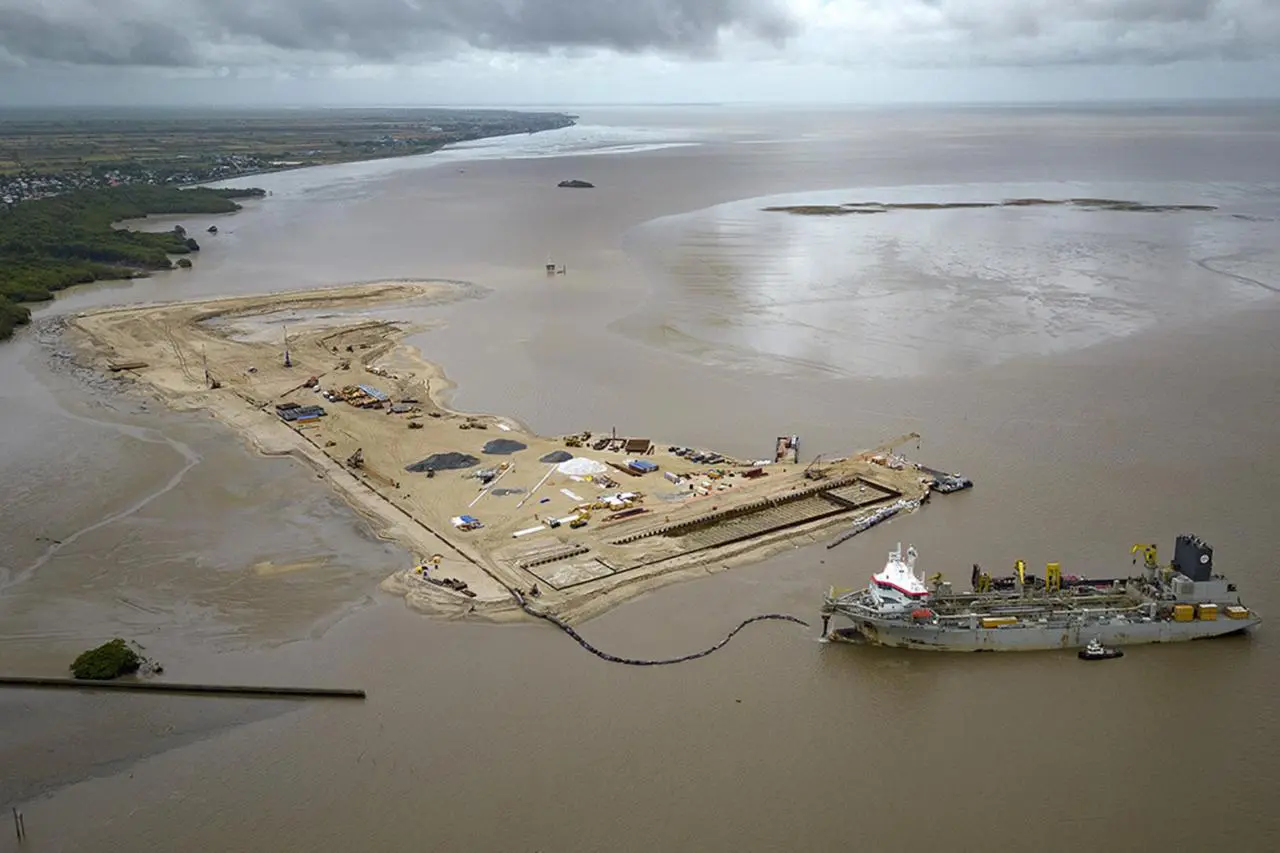
Guyana’s Stabroek Block has seen a meteoric rise from the first oil draws in 2019 to roughly 900,000 barrels per day in mid-2026. In August 2026, Exxon confirmed it had fully recovered its US$55B investment nearly two years ahead of schedule, increasing Guyana’s share of oil revenues from 12.5% to nearly 40% under Guyana’s profit-sharing agreement. And these agreements have already had a substantial impact. In the third quarter of 2026, Guyana reportedly received US$1.89B in revenues, up from US$565M during the same timeframe in 2025.
As Guyana plans to collect 40% of all oil revenue in the future, the country faces a fundamental challenge: how to convert a temporary resource windfall into lasting economic prosperity. Guyana established the Natural Resource Fund (NRF) in 2019 to manage this unprecedented influx of oil wealth. This sovereign wealth fund’s primary goal is to “ensure that volatility in natural resource revenues does not lead to volatile public spending.” In 2021, the government overhauled the Fund’s governance, introducing an independent Board of Directors and withdrawal ceilings. While withdrawals have remained within these limits, the government has consistently sought the maximum withdrawal, using nearly 100% of 2025 oil revenue, with a further $2.37B withdrawal planned in 2026. These decisions raise a more fundamental question than whether Guyana has adopted the right sovereign wealth fund policies: can the NRF protect the country from the destabilizing effects of oil wealth if its resources remain subject to short-term political decision-making?
Oil-rich nations are often victims of “Dutch disease,” a term used to describe a phenomenon in which resource wealth takes over a nation’s economy and drives down other industries. The Economist coined the term in 1977 after the Netherlands saw its manufacturing drop following the 1959 discovery of the Groningen natural gas field. While these countries may experience short-term economic prosperity, this concentration on a finite resource can lead to an economic cliff. For any country that very quickly comes into large sums of money, infrastructure to manage the funds correctly is key to ensuring the money can be saved for future generations. The challenge is not simply to insulate oil revenues from the economy or government, but to create an institution capable of managing those revenues according to long-term national interests rather than short-term political incentives.
Sovereign wealth funds have historically, and increasingly, provided one institutional mechanism for managing this tension; more than 40 have been established over the past two decades alone. In Asia and Europe especially, sovereign wealth funds have been tools to maintain economic stability and advance broader domestic economic objectives. The economic intuition for a resource-rich country is analogous to that of a professional athlete: athletes have a short window during which they will earn very high wages, but that income has to last them the rest of their life. For resource-rich nations, a sovereign wealth fund helps spread those funds across the generations. They are also a significant component of the global economy, owning 6% of all public equities in 2026. Amongst sovereign wealth funds, there are key examples of both success and failure: Norway’s sovereign wealth fund owns 1.5% of global equities and has sustained a large welfare state, while Malaysia’s 1Malaysia Development Berhad faced political scandal and led to the Prime Minister’s downfall.
Several policy decisions can predict and facilitate the successful management of Guyana’s NRF. The experience of sovereign wealth funds around the world suggests that Guyana’s success will depend less on the size of its oil wealth than on the institutional design governing it. The NRF should therefore be insulated from short-term political discretion while retaining the capacity to support long-term domestic economic development. Norway, Timor-Leste, South Korea, Singapore, and Malaysia demonstrate the opportunities—and risks—Guyana must navigate.
While strong sovereign wealth fund governance over the long term is essential, it alone does not guarantee protection from mismanagement. This lesson can be learned from a similarly small nation that came into oil wealth and faces territorial disputes: Timor-Leste. The island nation regained independence from Portugal and Indonesia in 2002 and started the Timor-Leste Petroleum Fund three years later. The fund followed best practices in theory and was supported by the IMF, with a legislated 3% withdrawal cap per year, consistent reporting, public disclosures of holdings, and independent oversight. However, withdrawals have consistently exceeded the stipulated cap, made possible by a precautionary override clause in the fund’s constitution. After Timor-Leste’s independence struggle, wartime leaders became prime minister and president, and were able to use their personal credibility to supersede the law, over-withdrawing and leaving the fund on pace for depletion in the 2030s, while the oil fields whose revenue seeded the fund are also running dry. To compound the damage from this mismanagement, Timor-Leste did not reinvest the Fund in developing the domestic economy, meaning oil revenues contributed over 80% of GDP at its peak. As the fund’s revenue was not properly directed domestically, over 40% of the nation remains in poverty while the Petroleum Fund holds billions offshore. Turning back to the Guyanese NRF, simply calling for the best policies and bringing in expertise does not automatically mean a sovereign wealth fund is immune to failure. Rather, Guyana’s fund must be a separate, apolitical entity designed to operate like any other private fund, with a “fiduciary responsibility” to the nation’s people.
A nation whose approach serves partially as an example to look towards for inspiration is South Korea, and its Korean Investment Corporation. The KIC has also existed since 2005 and focuses on boosting the domestic economy by managing trade surpluses. Because Korea has such an advanced domestic economy to begin with, the fund serves as a tool of the government–an income source and a fiscal stabilizer that allows Korea to use its economic strength internationally and abroad, trading currencies and investing in global companies aligned with the nation’s ambitions. Through the wealth Guyana will grow over the coming decades, developing the domestic economy to survive on its own can allow the NRF to transform from a fund that holds up the domestic budget to one that complements it and connects Guyana with the rest of the world. This is a lesson from both Timor-Leste and South Korea: Timor-Leste underinvested in its domestic economy and broader institutional capacity, increasing its dependence on petroleum revenue. South Korea, by contrast, entered the creation of its sovereign wealth fund with a strong and diversified domestic economy, supported by established financial, private-sector, and non-governmental institutions. Its sovereign wealth fund could therefore complement an already-capable economy rather than serve as a substitute for the institutions and productive capacity needed to sustain one. To continue the athlete analogy from earlier, decades from now Guyana will need to develop an income source other than just the reinvested profits from what it earns from oil today, and the work to begin that development can start right now.
It is notable that Guyana developed its sovereign wealth fund before a diversified domestic economy could form, contrasting with the case in South Korea. Guyana’s President Irfaan Ali stated in 2021 that the government was investigating various fund models to learn from, and chose to take lessons from, but not copy, certain nations due to differences in domestic economic characteristics. He highlighted that “in the Norwegian model (…), we have to understand that Norway adopted that model after the country had a certain level of infrastructure, service and development.” This is a key lesson which the Guyanese government has emphasized – that simply following the most successful fund design does not guarantee success, particularly when there are more fundamental economic characteristics to consider.
Still, there are several factors which the successful funds share, which, notwithstanding the specificity of the Guyanese context, can be taken as key learnings for the future. A primary characteristic of success is institutional independence. Most strong funds separate the management of the country’s natural resource wealth from the executive government, allowing for continuity of policy and avoiding mismanagement, as previously mentioned with 1MDB in Malaysia. There are exceptions, such as Saudi Arabia’s Public Investment Fund, which is wholly controlled by the Crown Prince. One might argue that the Crown Prince’s lifetime term allows for policy continuity, and the nation’s aggressive anti-corruption campaigns in the early 2020s helped focus the fund’s mandate on diversifying the economy away from just oil. In general, however, separation from the decision-making power of individual leaders allows for predictable fund performance, which can then translate to predictable support for the domestic economy. In Singapore, for example, predictable returns on the fund’s investments since 1981 mean the government can maintain a consistent budget through unpredictable macroeconomic trends and economic uncertainty.
Another common factor when analyzing successful funds is being rule-bound. This may sound elementary, but consistent laws and policies on withdrawal levels, public holding disclosures, a commitment to operating, investment and income transparency, and otherwise operating like any other private investment fund both make the fund a credible partner to work with and attract global talent to contribute to its management. In Singapore, a zero-tolerance government policy against corruption permeates throughout the society and indeed through the fund. In Equatorial Guinea, the fundoperated such that the President could withdraw from it as he pleased, and household wealth saw no appreciable increase during the early-2000s oil boom. For Guyanese at home and in the diaspora as well as onlookers, the activities and public face of the NRF can serve as a window into the economic characteristics and strength of the nation’s institutions on the whole.
While true that Guyana is at an earlier stage compared to, say, Norway, the withdrawal patterns we are seeing today paint a concerning picture of the direction of national spending on the whole. Spending early through just one income source risks creating a habit that continues once the domestic economy has received substantial investment, opening the door to entrenched corruption and mismanagement. Still, Guyana could find success in breaking with the Timor-Leste approach and using the fund actively to intervene in the domestic economy where necessary. Whether to seed the tourism economy, attract business, or invest in human capital through educational and professional opportunities, the NRF can be the economic lever to spur dynamic, meaningful and sustainable growth, if used responsibly. But to achieve this, the fund’s role must be reframed within the government, from simply a funnel for oil funds going into the national budget, to another tool in the government’s development toolbox, though it may slow down initial growth. Approaching the fund with this discipline can set the tone for future tools at the Monetary Authority’s disposal, setting a long-term vision for the nation to grow while securely managing the extreme wealth it is only just beginning to realize.







Discussion