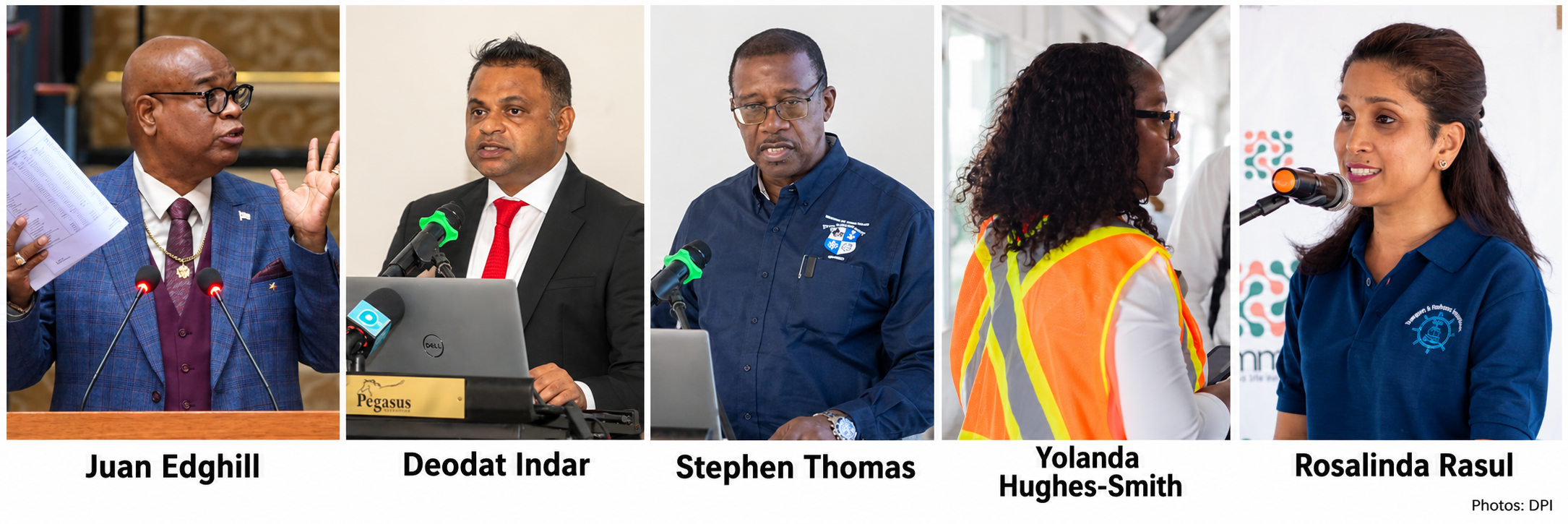
Civil society organisations yesterday called for Ministers Juan Edghill and Deodat Indar and three senior maritime and transport officials to be placed on administrative leave pending the findings of the Commission of Inquiry into the MV Barima disaster, while demanding specialist forensic expertise for the recovery of the wreck.
At a virtual press conference, the groups also sought immediate public release of the commission’s final report, real-time broadcasting of its hearings and clearer procedures for survivors, bereaved families and other citizens to submit evidence.
Former Environmental Protection Agency (EPA) head Dr Vincent Adams meanwhile argued that the tragedy reflected broader failures in safety and emergency preparedness. He recalled refusing to sign an emergency oil-spill response plan because it lacked a risk assessment, but said the authorities proceeded nonetheless.
Human rights activist Danuta Radzik, who read the organisations’ joint statement, said accountability for the July 18 disaster had to extend to the highest levels of the institutions responsible for the vessel and its operations.
The groups called for administrative leave for Public Works Minister Edghill; Public Utilities and Aviation Minister Indar; Maritime Administration Department (MARAD) Director General Stephen Thomas; Transport and Harbours Department General Manager Yolanda Hughes-Smith; and the department’s board chairperson, Rosalinda Rasul.
“Stepping down from their post is not an admission of guilt,” the statement said.
The organisations argued that delegation of authority did not absolve senior officials of responsibility. They said that information already in the public domain warranted holding the officials accountable for alleged negligence and incompetence. Those allegations have not been established by the commission.
The statement was issued on behalf of the Amerindian Peoples Association, Guyana Trades Union Congress, Guyana Organisation of Indigenous Peoples, Oil and Gas Governance Network, Organisation for the Victory of the People, Red Thread, Crossroads Women’s Centre, Transparency Institute Guyana Inc. (TIGI), We the People, the Gen Z Youth Movement and individual supporters.
Forensic salvage
The groups questioned whether the procurement process had secured the expertise necessary to raise the Barima while preserving evidence.
They alleged that none of the three bidders met the stipulated salvage-experience requirements and that none specialised in forensic salvage.
Radzik said forensic salvage differed from ordinary property recovery because it prioritised preserving evidence, maintaining its chain of custody and preventing contamination or disturbance.
The organisations called on government to immediately secure a company capable of recovering the vessel with the highest possible prospect of preserving evidence. They said an appendix to their statement identified companies with relevant expertise.
BK International was awarded the salvage contract earlier this month. Kiskadee Watch reported on October 17 that the published National Procurement and Tender Administration Board record put the award at $1.034 billion, with an October 6 award date.
The entry identified the operation as recovery of the wreck off Devonshire Castle Flats, Essequibo Coast, on a “no cure, no pay” basis. It did not specify a mobilisation or recovery deadline, detailed contract conditions or the approved salvage method.
Kiskadee Watch subsequently reported on October 18 that BK had not publicly clarified its timetable, equipment or technical arrangements. The newspaper was unable to speak with company head Brian Tiwarie when it visited the company’s office.
Survivors and relatives had also questioned the company’s experience during the commission’s engagement at Port Kaituma. Kiskadee Watch reported that Kevon Thomas, whose brother Kyle’s body was recovered while another brother, Brian, remained missing, pressed for a definite recovery date. Families stressed the importance of examining the wreck and recovering remains for burial.
Radzik had raised the recovery delay during a September protest outside Edghill’s office.
“We don’t want to assume anything. We want them to tell us,” she told Kiskadee Watch then.
The organisations also sought an independent technical marine casualty investigation, arguing that a commission of inquiry could not substitute for one. They urged that the investigation take account of the International Maritime Organization’s framework, the Safety of Life at Sea Convention and Guyana’s Shipping Act.
Safety and preparedness
Adams said the inquiry needed to identify the underlying failures that allowed the disaster to occur, rather than confining responsibility to the vessel’s crew.
He stressed the importance of determining whether adequate procedures existed, whether personnel were trained and whether those responsible followed and enforced safety requirements.
“Everything starts from the head,” he said.
Adams’s EPA contract was terminated in November 2020, after the PPP/C returned to office. Stabroek News reported at the time that he had approximately 30 years’ experience at the United States Department of Energy.
Drawing on his tenure at the agency, Adams said he had declined to sign an emergency oil-spill response plan because a risk assessment had not been done, but the authorities went ahead.
“How could you put together a plan without knowing what the risk will be and how do we respond to it?” he asked.
He argued that emergency planning must establish the hazards, the resources required to respond, the training of responders and the exercises needed to test preparedness.
Adams linked those concerns to the country’s expanding oil and gas operations, saying investment had to be accompanied by effective oversight and emergency response capacity.
He questioned whether responders had the specialised training and equipment required for an incident involving gas facilities, and how they would gain access in congested areas.
Adams accused government of treating safety and environmental safeguards as impediments to development and said the Barima disaster should be examined in the context of broader institutional weaknesses.
His concerns about preparedness predate the ferry disaster. Kiskadee Watch previously reported his warning that a reported anomaly involving the Gas-to-Energy pipeline highlighted gaps in technical expertise and regulatory oversight for responding to a major offshore incident.
TIGI President Mike Singh also questioned national emergency readiness, asking how Guyana would respond to a major aircraft accident at sea, along the coast or offshore.
Singh said TIGI had rejected the commission’s composition from the outset. He questioned the suitability of several appointees, accused government of seeking to control information and expressed a lack of confidence in BK’s ability to undertake the salvage.
Witnesses and public access
The organisations said the inquiry’s credibility depended on transparent procedures and meaningful access for those most directly affected.
They described reports alleging that witnesses were being discouraged from giving evidence or placed under pressure by the secretariat as “extremely alarming.”
They also questioned Secretary Javed Shadick’s independence.
The statement complained of insufficient information about submitting evidence, the status of submissions, hearing schedules and the establishment of a commission website.
Radzik said a September 2 letter seeking a meeting with Chairman Justice Godfrey Phillip Smith had been emailed and a copy delivered to his office in Belize, but had not been acknowledged.
The letter sought discussion of the inquiry’s framework, hearing procedures, secretariat and arrangements for survivors and bereaved families to have their evidence and views recorded.
The groups acknowledged what they described as a recent announcement permitting broadcasts with a two-hour delay, but questioned why real-time access remained restricted.
Kiskadee Watch had previously recorded that media workers were informed at the opening of evidentiary hearings that livestreaming would not be permitted, although recording and coverage were allowed.
The organisations argued that families in Region One, other citizens and the diaspora should be able to follow the proceedings as they unfolded.
“Limiting access or shutting them out from seeing the proceedings as they unfold in real time is unacceptable,” the statement said.
They sought real-time broadcasting, preferably without delay, and equal, unimpeded media access, subject to lawful restrictions.
Public report
While acknowledging the President’s statutory authority to appoint a commission, the organisations argued that consultation on its composition would have strengthened public confidence.
They said the commission and its report were funded by the public treasury and should serve the Guyanese people, particularly survivors and families who lost relatives.
The groups called for the final report to be released immediately upon completion and invoked constitutional principles of citizen participation and accountability.
Asked by Kiskadee Watch what further action was contemplated if their demands were not met, Radzik said some changes had followed earlier criticism. She stressed that several demands were directed to the commission and its administrative machinery.
She said a petition bearing 176 signatures from organisations and individuals in Guyana, the region and the diaspora had been submitted, along with the correspondence seeking a meeting.
The organisations were also considering applying to appear before the commission.
“This is a national tragedy,” Radzik said, pointing to the groups’ links with affected communities in Region One and elsewhere.
University of Guyana language lecturer and activist Charlene Wilkinson criticised the arrangements for the commission’s initial engagement with families. She said the small meeting space within the larger conference centre had helped set a disrespectful tone.
Wilkinson, also questioned whether the inquiry adequately accommodated the language needs of those giving evidence.
Red Thread’s Wintress White similarly questioned how commissioners unfamiliar with Guyana’s local circumstances would understand the experiences being presented.
Frederick Collins, speaking for TIGI, offered a different assessment of the evidence emerging. He said he was pleased that information addressing his questions about communications and the emergency response was coming into the public domain.
Collins also stressed the press’s role in maintaining scrutiny and public attention.
The Barima sank on July 18 while travelling from Georgetown to Port Kaituma. The five-member inquiry was sworn in on July 30, and public evidentiary hearings began on October 14. Kiskadee Watch has reported that 73 lives were lost in the disaster.








Discussion