-inquiry hears about missing safety records
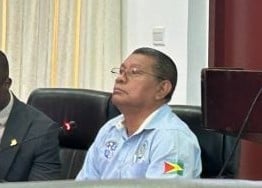
A former maritime safety director who testified yesterday before the MV Barima CoI about missing records among others things has been advised by the inquiry to seek legal advice before answering further questions.
Guyana’s maritime safety oversight and emergency response arrangements came under scrutiny at the Commission of Inquiry (CoI) into the July 18 sinking of the MV Barima and the loss of around 100 lives, as former Director of Maritime Safety at MARAD, Captain John Flores, testified that records for older government-operated ferries remained missing and that communication was a major challenge during the rescue operation.
Flores, who joined the Maritime Administration Department (MARAD) in 2016, said the agency lacked substantial documentation for ferries previously managed by the Transport and Harbours Department (T&HD). MARAD had to approach the department to obtain registration documents and certificates and establish files for the vessels.
However, he acknowledged that the documentation gap remained unresolved when he left the position. While newly acquired vessels had certification, records for older vessels, including the MV Barima and others, remained unavailable.
Questioned about safety certificates, load-line certificates, stability booklets and loading manuals, Flores said he was uncertain whether all those requirements applied to the government ferries, indicating that the relevant legal requirements would need to be clarified.
He also acknowledged that he had not requested a deadweight survey, referred to during the questioning as a “declining test”, and said he had not seen stability documentation for the ferries.
Flores testified that inspection reports sometimes identified deficiencies serious enough to prevent vessels from operating until the problems were corrected. However, he could not recall the specific deficiencies recorded against individual ferries, saying the relevant inspection and survey records would have to be examined.
His evidence leaves questions about the completeness of MARAD’s records, the certification and survey requirements applied to government-operated vessels, and how compliance with applicable safety standards was verified.
The inquiry also examined the systems available to maritime authorities when the MV Barima issued a distress signal on July 18.
Flores acknowledged that communication was a major problem that night, particularly because the Maritime Rescue Coordination Centre (MRCC) had not yet been formally commissioned.
Although personnel were occupying the MRCC building, equipment installed there had not been formally handed over, and familiarisation training was still required. The new equipment was expected to allow the centre to receive distress alerts directly by satellite, reducing its reliance on information relayed through the control tower.
In the absence of a fully operational MRCC, officials relied largely on mobile phones and radios at the Lighthouse, whose communication range was limited.
Flores said authorities worked around those limitations by using vessels in the immediate area that had satellite internet or WiFi, alongside liaison officers from agencies including the Guyana Defence Force, police, the Civil Defence Commission and regional authorities to relay information and instructions.
He also referred to plans to establish additional sub-centres along the coast to improve communications, although he did not have a formal document detailing those arrangements before the commission.
The testimony raised questions about how effectively information could be shared between agencies and vessels during a large-scale maritime emergency, particularly when communications infrastructure was not fully operational.
Despite acknowledging the communication difficulties, Flores maintained that the response to the MV Barima disaster was prompt and more than adequate. He rejected suggestions that there had been delays in the response, apart from the time required to establish the nature and source of the distress beacon signal.
He explained that personnel had already been dealing with a distress incident involving a fishing vessel earlier that night before turning their attention to the subsequent alert.
The beacon signal, received through the established alerting arrangements, was not registered to a specific vessel, meaning officials initially had to investigate its source while using the available position and timing information to begin plotting and coordinating a response.
Flores also said the operation was constrained by the challenges of conducting search-and-rescue activities at night, suggesting that more people might have been rescued had the operation taken place in daylight.
When asked what could have been done better, he identified communication as an obvious area of concern.
The evidence therefore presented two aspects of the response: Flores’s position that personnel acted promptly with the resources available to them, and his acknowledgement that communication arrangements presented significant challenges.
Questions over preparedness and accountability
The commission also examined how emergency resources were coordinated and how families of missing passengers were kept informed.
Flores said the Civil Defence Commission assisted with food, water, meals and supplies during the operation, while requests for assistance were made as needs arose. He indicated that further work might be required with the commission to strengthen arrangements for supporting maritime disasters.
On communicating with families, Flores said he could contact owners of privately operated vessels, but relied on Transport and Harbours Department management for passenger-manifest information in the case of the MV Barima.
Commissioners stressed the importance of clearly identifying who is responsible for informing families about missing relatives, providing regular updates and communicating with them sensitively while search operations are ongoing.
The inquiry also heard that the country’s search-and-rescue arrangements were organised around separate maritime, aviation and land plans rather than one overarching national plan. Flores said he had no deputy in his coordinator role, although two supervisors assisted him, prompting concerns from the commission about reliance on experienced individuals to compensate for potential structural weaknesses.
The examination of the maritime response plan, communication arrangements and coordination between agencies forms part of the commission’s wider scrutiny of preparedness for major emergencies.
The Commission also paused its questioning of Flores to allow him to seek legal advice after the examination turned to his responsibilities as MARAD’s former Director of Maritime Safety and the documentation requirements applicable to government-operated ferries. Flores told the commissioners he was not fully prepared to address that line of questioning and needed time to research whether the ferries were exempt from certain documentation requirements. The commission said the issue was central to its inquiry and indicated that Flores could return to address it after consulting legal counsel.







Discussion