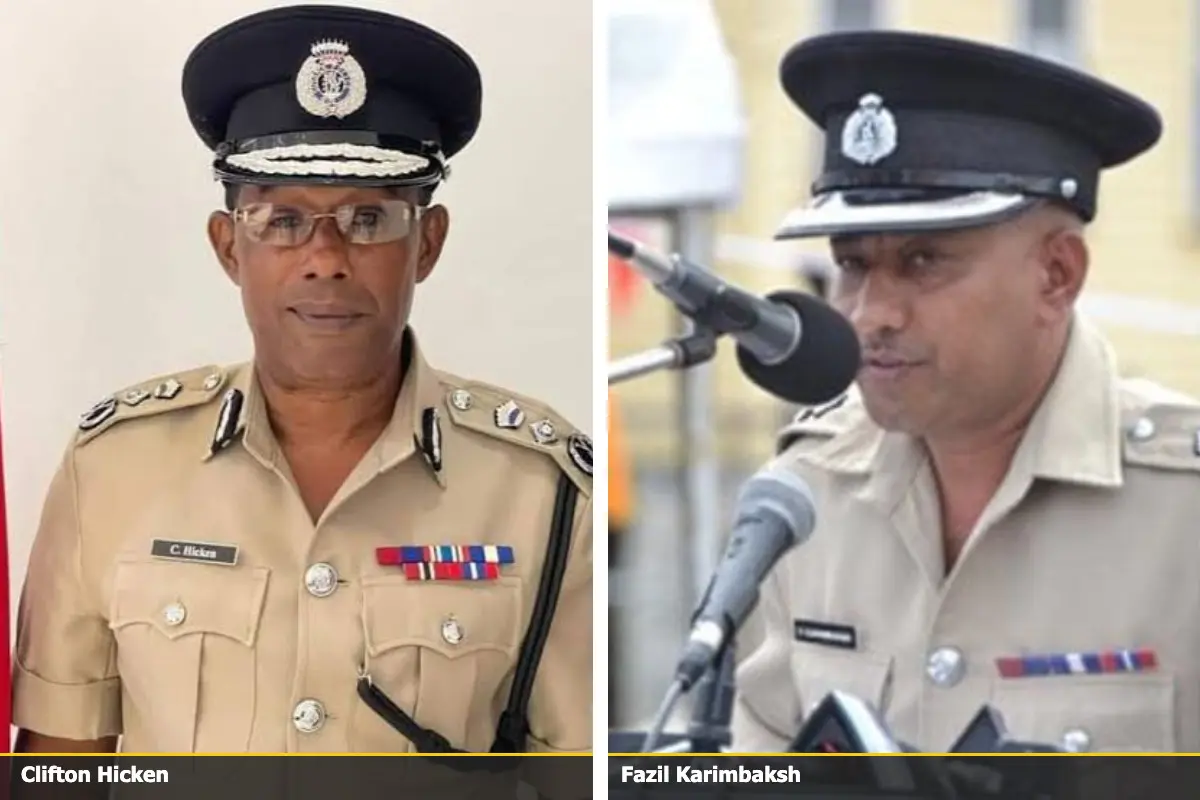
A legal opinion provided by the Office of the Attorney General may have been behind Commissioner of Police Clifton Hicken’s withdrawal of the letter granting Deputy Commissioner Fazil Karimbaksh leave prior to retirement, as it expressly recommended rescission and intervention by the President.
The nine-page opinion is dated October 12, the same date as Hicken’s withdrawal letter. However, it has not been confirmed whether the Commissioner acted on that advice.
“The Commissioner would be required to rescind his letter in respect of leave, and the President would be required to address the letter,” the opinion concludes.
The document argues that the Commissioner’s ordinary constitutional disciplinary powers do not extend to a Deputy Commissioner. It nevertheless acknowledges that he could act under another valid constitutional or statutory authority, including a lawful delegation where legally permissible.
Although provided by the Attorney General’s office, the opinion does not identify its individual author or carry a signature.
The leave dispute arose after allegations of rape and threatening behaviour were made against Karimbaksh, who heads the Special Organised Crime Unit (SOCU). Police announced on October 8 that he had been sent on leave pending investigation, without specifying the type of leave or its commencement date.
As Kiskadee Watch reported on October 14, Hicken’s October 7 letter concerned 174 days of annualised vacation leave prior to retirement, commencing November 8. Karimbaksh’s attorney, Rizwaun Mohamed, challenged the Commissioner’s authority and disputed the calculation, saying his client’s entitlement was 118 days.
In separate October 12 correspondence, Mohamed protested an alleged instruction preventing Karimbaksh from entering his office that morning and threatened urgent court proceedings. He argued that the October 7 letter did not authorise immediate exclusion.
Hicken’s withdrawal letter cited further consideration of the constitutional and legal framework governing authority over a Deputy Commissioner. It did not expressly confirm whether Karimbaksh would resume duties or explain the effect on the announced investigative leave.
The newly provided opinion examines Articles 211, 212, 225 and 232(9) of the Constitution, alongside section 29 of the Interpretation and General Clauses Act.
“In my opinion, the Commissioner of Police does not possess an independent power under Article 212(3) to exercise disciplinary control over Deputy Commissioner Karimbaksh. That provision is expressly confined to officers below the rank of Inspector,” it states.
Its central argument is that the Commissioner’s position as operational head of the force does not independently confer unrestricted disciplinary authority over every officer.
“Neither administrative convenience nor the ordinary chain of command within the Police Force can independently confer a jurisdiction that the law has withheld,” it states.
Under Article 211(1), the opinion notes, the President appoints the Commissioner and Deputy Commissioners after meaningful consultation with the Opposition Leader and the Police Service Commission’s chairperson, who must first consult the commission’s other members.
The document says this special constitutional arrangement must be respected. However, it cautions that the President’s appointment power does not, by itself, settle the separate questions of leave, suspension and disciplinary proceedings.
It considers whether Article 232(9), read with section 29 of the Interpretation and General Clauses Act, gives the President powers consequential upon appointment.
Section 29 provides, unless the context otherwise requires, that an appointing authority also has powers to remove, suspend, dismiss, revoke an appointment, grant leave, reappoint or reinstate an appointee.
The opinion says this may support presidential authority concerning leave or suspension, but cannot override an express constitutional allocation of power.
“In particular, the existence of an ancillary power to suspend or grant leave does not automatically establish that the President alone may initiate every form of disciplinary proceeding or that such authority is incapable of lawful delegation,” it states.
The document also stops short of excluding the Police Service Commission from disciplinary matters involving a Deputy Commissioner.
It notes that Article 212(1) assigns the commission powers of appointment, disciplinary control and removal concerning officers at or above the rank of Inspector, subject to Article 211(1).
Because Article 211(1) addresses appointments, the opinion cautions against treating that qualification as automatically excluding the commission from every question of disciplinary control over a Deputy Commissioner. Its jurisdiction must instead be assessed alongside the other relevant constitutional provisions.
Home Affairs Minister Oneidge Walrond had publicly supported administrative leave pending investigation, while pointing to the absence of a constituted Police Service Commission. She also confirmed that an investigative team had been appointed. At the time of Kiskadee Watch’s October 5 report, Karimbaksh had not publicly responded to the current allegation.
Red Thread’s Karen de Souza had called for protection of the complainant and Karimbaksh’s removal from any position in which he could influence the investigation, while questioning the independence of an internal police inquiry.
On delegation, the opinion says the particular power must first be identified. Authority covering ordinary personnel or administrative matters cannot automatically be treated as permission to suspend a Deputy Commissioner, initiate disciplinary proceedings or take steps towards removal.
The President must possess the power and be legally entitled to delegate it. Any delegation must be valid, sufficiently clear and cover the proposed action.
“A delegation must be established by reference to its actual legal basis and terms. It should not be presumed merely from the Commissioner’s position within the Police Force,” the document states.
A general direction, administrative practice or assumption of authority is not necessarily sufficient, it adds. The Commissioner cannot exceed a valid delegation or use it to circumvent constitutional safeguards.
The opinion separately addresses removal from office, stating that Articles 211(4) and 225 establish applicable constitutional procedures and protections.
It emphasises that leave, suspension pending investigation, disciplinary proceedings and removal are legally distinct measures. The procedure governing removal does not, by itself, determine who may grant leave or initiate disciplinary proceedings.
Before any decision, it recommends identifying the precise legal power being exercised and observing all applicable constitutional procedures and safeguards.
The opinion addresses authority over Karimbaksh’s employment and disciplinary status. It does not determine the allegations against him, which remain unproven, or provide an update on the criminal investigation.












Discussion