
—two parts of question removed following Clerk’s advice
APNU MP Sherod Duncan says he has submitted parliamentary questions seeking disclosure of the authority for placing a Deputy Commissioner of Police on administrative leave, safeguards for complainants and witnesses, and measures to prevent interference with investigations involving senior officers.
The oral question, submitted on October 16 to Home Affairs Minister Oneidge Walrond, also asks about restrictions on operational duties, any written delegation of disciplinary authority, and access to records and personnel relevant to an investigation.
Duncan said the question expressly avoids asking the minister to address the merits of any criminal allegation.
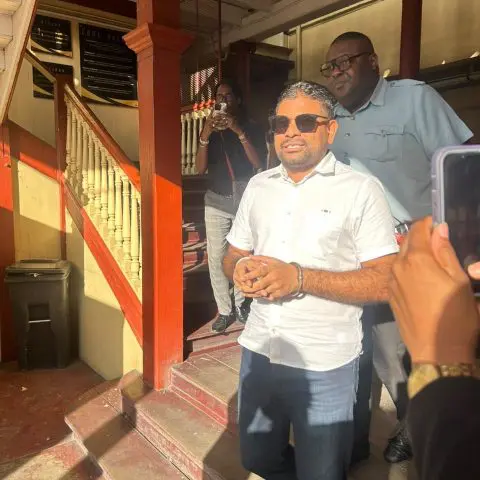
His submission comes against the background of uncertainty over the leave arrangements for Deputy Commissioner Fazil Karimbaksh, who heads the Special Organised Crime Unit and is the subject of an investigation into allegations of rape and threatening behaviour made by a female police inspector.
Kiskadee Watch reported on October 14 that Commissioner of Police Clifton Hicken had rescinded an October 7 letter granting Karimbaksh leave prior to retirement, citing further consideration of the constitutional and legal framework governing authority over a Deputy Commissioner.
Police had announced on October 8 that Karimbaksh had been sent on leave pending investigation. However, the October 7 letter concerned 174 days of annualised vacation leave beginning November 8.
Karimbaksh’s attorney, Rizwaun Mohamed, challenged Hicken’s authority and an alleged instruction preventing his client from entering his office. The withdrawal letter did not explain its effect on the previously announced investigative leave or expressly confirm whether Karimbaksh would resume duties.
Duncan said the Clerk’s office requested the deletion of two parts of his oral question on October 20 before its onward transmission to the Speaker.
One asked how the absence of a constituted Police Service Commission affected the exercise of authority. According to Duncan, the office advised that this sought the minister’s opinion, contrary to Standing Order 20(1)(j).
The other sought information on progress towards reconstituting the commission. The office advised that this concerned a matter on the agenda of the Parliamentary Standing Committee on Appointments, which was responsible for the nomination mechanisms.
Duncan said he agreed on October 21 to remove both parts and renumber the remainder, retaining the other substantive requests.
A separate written question seeks the implementation status of a proposed system for tracking unanswered calls to police stations and asks whether service indicators will be published.
The questions on investigative safeguards follow public calls for protection of the police complainant and scrutiny independent of the force’s command structure.
Duncan said the police questions form part of 13 Questions on Notice submitted in four batches covering public safety, expenditure and essential services.
His September 29 submission addressed admissions and immigration status under the Guyana–United States Migration Cooperation Framework; GPL’s generation capacity, overloaded feeders and transformer replacement; the new Amerindian Hostel; and housing delivery in Region Ten.
Three questions submitted on October 7 concern public-security cameras and the Safe Country initiative, including regional camera totals, contracts, data custody, storage, retention, authorised access, oversight and measures of the programme’s results.
The camera network is already being cited in police enforcement. In a recent report carried by Kiskadee Watch, police said Safe Country footage corroborated reports of dangerous driving along the Cornelia Ida Public Road.








Discussion