
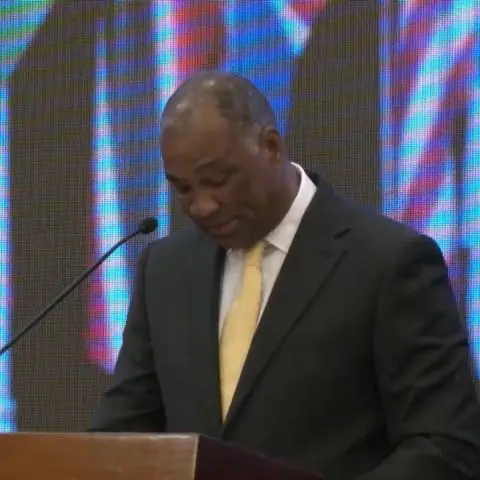
APNU parliamentarian Terrence Campbell has called for an independent review of the Natural Resource Fund’s investment strategy, warning that Guyana risks exhausting its oil wealth without building sufficient assets to sustain future generations.
In a letter titled “Guyana Must Think About How It Invests Its Oil Wealth”, Campbell argued that the country needs both productive domestic development and a professionally managed financial portfolio, rather than treating infrastructure spending as a substitute for investing the fund itself.
There is an important distinction between keeping money safe and investing wealth strategically,” he wrote, calling for an approach which balances protection of the principal, access to funds for foreseeable obligations and sustainable long-term returns.
His intervention follows remarks by Natural Resources Minister Vickram Bharrat that Guyana’s immediate priority remains using petroleum revenues to develop infrastructure, education and healthcare.
Speaking on The Guyana Dialogue programme on October 15, Bharrat said countries such as Norway had already used their resources to develop their economies and were consequently better positioned to invest sovereign wealth fund revenues.
Campbell criticised that position, arguing that a strategy to preserve and grow financial wealth should accompany expenditure on national development.
“Our policymakers need to resist the temptation to confuse national development expenditure with investment of the Fund itself,” he stated.
While roads, hospitals, schools, housing and other infrastructure were important, he said these projects needed to be assessed for value for money, economic returns, maintenance costs and benefits to citizens.
“A country needs both productive domestic investment and a well-managed financial portfolio,” Campbell wrote.
He proposed an independent examination of the NRF’s investment strategy against international best practices, with the findings and recommendations made public. Decisions should be guided by professional expertise and the long-term interests of Guyanese rather than political expediency, he said.
Campbell also called for greater public discussion of the fund’s objectives, the risks being accepted, returns achieved and the benchmarks used to assess performance.
Petroleum resources were finite, he stressed, and extracting them without building durable financial and productive assets could leave future generations with depleted resources and insufficient means to support themselves.
“A well-managed sovereign wealth fund should help convert oil revenues into enduring financial wealth,” he wrote.
The parliamentarian said that the PPP/C government had consistently spent around 90 per cent of oil earnings. His letter did not specify the years or calculations underlying that figure.
The distinction between annual receipts and withdrawals is relevant to that contention. Kiskadee Watch reported in September that the Ministry of Finance’s Mid-Year Report projected petroleum deposits of US$6.498 billion for 2026, against planned withdrawals of US$2.374 billion. The revised revenue forecast was substantially higher than the US$2.744 billion projected at budget time.
The debate also follows changes to the NRF withdrawal formula in February 2024. Stabroek News reported that the amendments increased the amounts available for withdrawal, including raising the first tier from 100 per cent of the first US$500 million deposited in the preceding year to 100 per cent of the first US$1 billion. The opposition criticised the changes as weakening savings for future generations.
Campbell has previously challenged the fund’s governance and the relationship between withdrawals and its investment capacity.
In December 2024, while serving as the opposition representative on the NRF Investment Committee, he told Stabroek News that his efforts to secure justification for withdrawals had met resistance. He also argued that statutory requirements linking safe investments to the fund’s balance and anticipated withdrawals restricted the committee’s scope to consider other investments.
In his latest letter, Campbell urged a national discussion encompassing how much petroleum revenue should be saved, how much should be spent and where retained resources should be invested.
“Guyana’s oil wealth must become more than a temporary source of government revenue. It must become the foundation of lasting national wealth,” he said.











Discussion