The Guyana Trades Union Congress (GTUC) has urged Britain’s King Charles III to use his visit to Guyana to encourage meaningful action on slavery reparations and raise concerns with President Irfaan Ali about democratic rights, workers’ living standards and the independence of constitutional institutions.
In a statement issued yesterday, the union body welcomed the monarch but said the visit should extend beyond ceremonial engagements to include the concerns of workers and citizens seeking accountability.
“The wrongs of history demand redress, and the injustices of the present demand accountability,” the GTUC stated.
It called for a formal commitment to sustained reparations dialogue between the United Kingdom and representatives of affected communities, including trade unions and civil society. Such discussions, it said, should establish practical measures to address slavery’s enduring consequences, including educational and economic inequalities.
The GTUC pointed to Britain’s compensation of former slave owners following emancipation, contrasting this with the absence of comparable compensation for those who had been enslaved.
“The enslavers were compensated. The enslaved received nothing,” it said, arguing that expressions of regret alone could not settle that injustice.
The call comes amid renewed demands for an apology and reparations during the King’s Caribbean tour. Kiskadee Watch yesterday carried a Reuters report on the King’s remarks in The Bahamas acknowledging the suffering and injustices of slavery. Buckingham Palace has indicated that he would address the issue during the tour but would not offer a formal apology, in keeping with British government policy, which also rules out financial reparations.
President Ali has himself argued that an apology should follow the King’s acknowledgement of slavery. In an ITV News programme, Ali rejected suggestions that Britain’s financial difficulties should prevent it from addressing the damage inflicted on the Caribbean, as reported by Kiskadee Watch.
The report also recalled Ali’s position in 2023 that an apology by descendants of British slave owner John Gladstone was a first step towards comprehensive reparations. That apology was delivered at the University of Guyana during commemorations of the 200th anniversary of the Demerara rebellion.
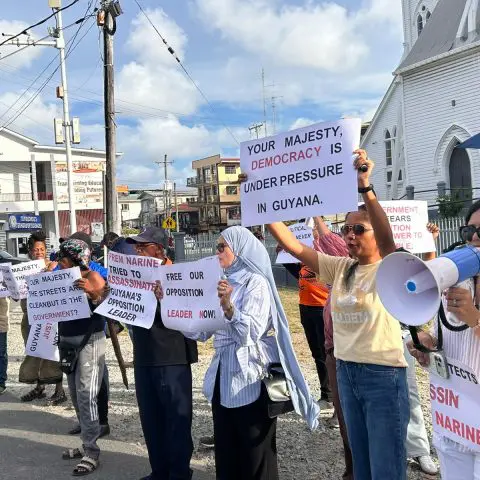
Alongside its reparations demands, the GTUC expressed concern about what it described as political intimidation, the marginalisation of the opposition and the weakening of independent institutions and civil society.
It urged the King to raise these concerns directly with Ali and encourage demonstrable commitments to constitutional governance and the protection of fundamental rights.
The union body said allegations of political interference, intimidation and misuse of state institutions should be subjected to credible, independent scrutiny.
While supporting the requirement that anyone accused of an offence answer through lawful procedures, it maintained that arrest and detention must not be used to intimidate political opponents or silence dissent.
“An accusation is not a conviction. Arrest is not a substitute for justice,” the statement said.
The GTUC also sought protection for freedom of expression, peaceful assembly, association and the right to organise without retaliation. Parliament, it said, must be able to scrutinise the executive, while regional and local democratic bodies must be permitted to discharge their lawful responsibilities.
On the economy, the TUC argued that Guyana’s rapid growth was not adequately reflected in workers’ living standards.
“Economic growth is not shared prosperity when workers cannot afford a decent standard of living,” it stated.
It called for a structured, time-bound process involving government, employers and unions to establish a livable wage reflecting actual living costs. It also sought regular negotiations on wages and working conditions, greater transparency in the management of oil revenues and measurable benefits for workers and vulnerable communities.
The GTUC further urged attention to Indigenous peoples’ rights in the implementation of the Low Carbon Development Strategy and other programmes affecting lands, resources and livelihoods. It called for meaningful consultation, transparent decision-making and effective remedies where rights are violated.
Acknowledging that the King cannot direct Guyana’s domestic policies, the TUC said responsibility remained with the elected authorities. Nevertheless, it argued that the visit provided an opportunity for candid discussion of justice, accountability and human dignity.
“His Majesty should leave Guyana having heard not only official speeches, but also the concerns of workers and citizens demanding accountability,” it said.







Discussion