Some indigenous leaders are calling on the government to resolve longstanding land claims and include them in decisions affecting their territories, saying Guyana’s international conservation ambitions must be accompanied by respect for the people who have protected its forests for generations.
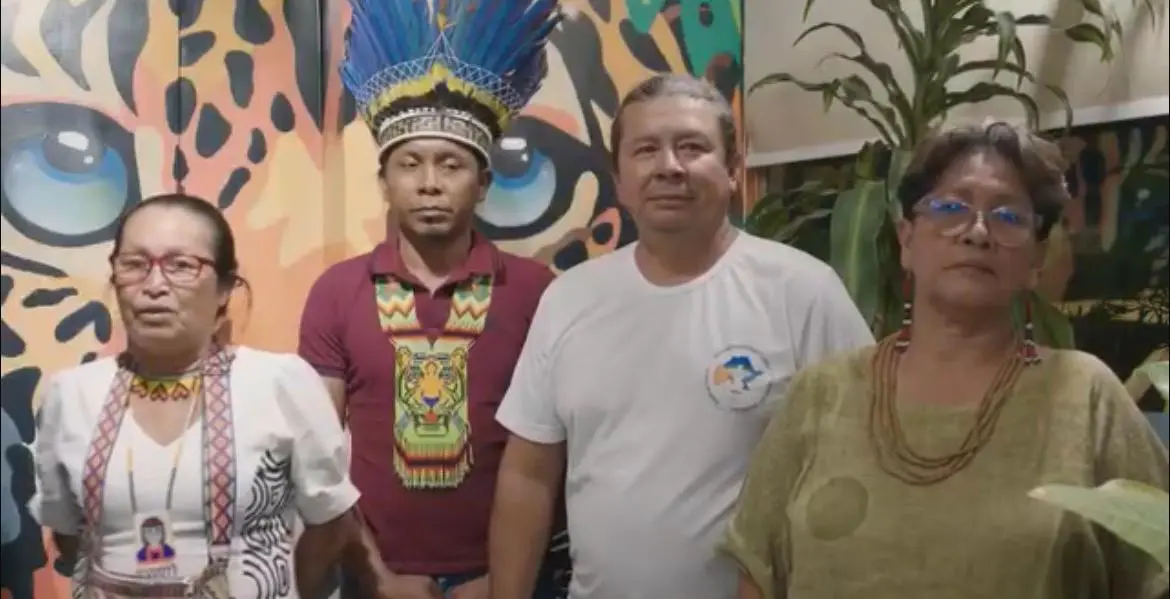
In a video posted on the North Pakaraimas District Council’s Facebook page, village leaders and representatives of the Amerindian Peoples Association (APA) raised concerns about mining concessions, delays in land titling and their participation in biodiversity discussions.
Their statements came against the backdrop of the second Global Biodiversity Alliance Conference and Financing Forum, held on October 30 and 31 at the Arthur Chung Conference Centre.
Alma Marshall, Toshao of Kamarang-Warawatta and chairwoman of the Upper Mazaruni District Council, said Indigenous communities continue to face difficulties over lands being allocated for extractive activities.
She called on the government to consult communities before decisions are taken and ensure that they have a meaningful role in determining what happens within their territories.
“We would like to be a part of the decision-making processes,” Marshall said.
Marshall also referred to a land case which she said had remained unresolved for more than two decades. She appealed to the state for a resolution that would recognise full ownership of the communities’ lands, including subsurface rights.
Turning to the biodiversity conference, she expressed concern that leaders from her district were not present to make their presentations.
“We need to be consulted, we need to be a part of decision-making processes as people, because we’re the ones, the true custodians of the forest, and that is our concern,” she said.
Edward McGarrell, Toshao of Chenapou and chairman of the North Pakaraimas District Council, similarly called for recognition and respect for Indigenous territories.
He contrasted the lengthy wait communities face when seeking land demarcation and extensions with what he described as the speed at which mining interests obtain concessions.
“We’ve been making applications for demarcation and extension, and have to be waiting for years to receive it. Sometimes we do not receive it at all, but people are applying to get mining blocks, concessions, they get it within weeks, within days,” McGarrell said.
“This is something we want to fix as Indigenous people. We are not obstacles of development.”
McGarrell argued that recognition should extend to communities’ traditional territories, rather than only small portions of the lands they have occupied and used for generations.
He described forests as essential to Indigenous livelihoods, providing food, medicine and places for hunting, fishing and other community activities.
“We know that these forests that are on the land are our supermarkets,” he said.
Wapichan representative Kid James also stressed the connection between Indigenous identity and ancestral territory, saying that communities with generations of experience caring for biodiversity-rich ecosystems should help shape conservation decisions.
James said Indigenous peoples were willing to engage with government and conservation organisations and contribute their knowledge to discussions about the country’s future.
“We are very willing to sit at that table, to share, to contribute, to make sure that the future is for the benefit of everybody,” he said.
“Consider us as equal partners,” James urged, calling for space for Indigenous peoples to contribute to ongoing dialogue.
Repeatedly
APA Executive Director Jean La Rose said the organisation had repeatedly raised concerns about respect for Indigenous land and territorial rights.
She urged the government to ensure that its commitment to conserve 30 per cent of Guyana’s lands and waters by 2030 respects those rights.
“Increasingly, however, we see our lands are being given away to mining companies,” La Rose said.
She also questioned the disparity between the pace at which concessions are granted and the time taken to rectify Indigenous land titles or issue new ones.
La Rose identified poor demarcation, inadequate land descriptions and overlaps with conservation activities among the problems affecting communities.
“And we want all of these addressed. We want them to be addressed by the communities, with the communities, in consultation with the communities, through decision-making by the communities and their leadership,” she said.
She called on the government to work with Indigenous peoples to improve legislation and policies governing their lands and territories.
The concerns place community participation and territorial rights alongside the financing proposals advanced at the biodiversity conference.
Kiskadee Watch previously reported that President Irfaan Ali used the opening of the conference to propose common fiscal incentives and regulations to attract biodiversity investment. He also challenged participating countries to prepare at least one project for financing before their next gathering.
Ali said the proposed conservation of the Acarai–Rupununi Corridor would respect community interests, with further engagement, management planning and biodiversity monitoring guiding the process towards permanent protection, according to that report.
In separate coverage, Kiskadee Watch reported that the Bezos Earth Fund, Andes Amazon Fund, Nia Tero and Rainforest Trust pledged an initial US$12.5 million for conservation in Guyana. Support for the proposed corridor, covering more than one million hectares, is conditional on permanent legal protection against mining, industrial logging and other incompatible activities, as well as safeguards for Indigenous rights, including free, prior and informed consent.
Rainforest Trust Chief Executive Officer Dr James Deutsch also emphasised that Indigenous peoples and local communities must be meaningfully involved in conservation planning, governance and management, Kiskadee Watch reported.








Discussion