
Retired Assistant Commissioner of Police Paul Slowe says Senior Superintendent Prem Narine’s shooting at the car carrying Opposition Leader Azruddin Mohamed could not be justified under the force’s rules of engagement, arguing that the official account failed to establish grounds for opening fire.
In an interview with Kiskadee Watch, Slowe, a former firearms instructor, challenged both the shooting outside Narine’s Barr Street, Kitty residence on October 12 and the alleged subsequent discharge of rounds when the vehicle was intercepted at Sandy Babb Street and Vlissengen Road.
“None of those two shootings could be justified,” he said, citing Police Standing Order No. 18, which he said sets out the circumstances in which ranks may fire.
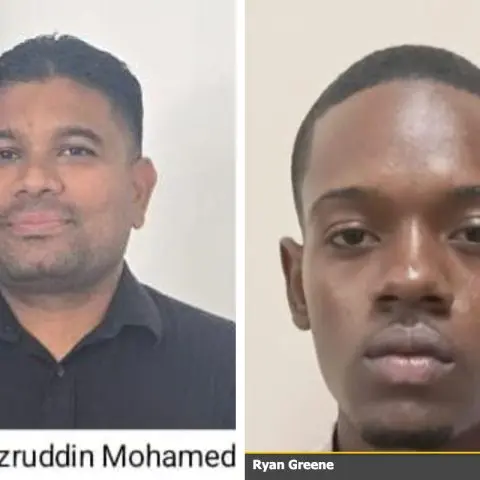
The incident occurred at about 11.45 pm while Mohamed was travelling in a black Toyota Allion with his driver, Eugene Thorne, and videographer, Mario Mohamed. According to the police account, Narine observed the vehicle passing his home slowly before returning. Police said he heard what “appeared to be a gunshot”, took cover and discharged several rounds from his service firearm towards the vehicle. Mohamed has denied that anyone in the car fired at Narine.
Slowe questioned how hearing a suspected gunshot, without clearly identifying its source or a target, could justify firing at the car.
“Why he fired? What he fired at? That is the first question. What are you firing at?” he asked.
He described the actions outlined in the account as “recklessness to the extreme”, maintaining that a rank must clearly identify a target before discharging a firearm.
Slowe also argued that the location of bullet damage on the side of the car raised questions about the reported sequence of events.
If Narine took cover before firing, he reasoned, the moving vehicle would have travelled farther along the street, exposing its rear rather than the area near the driver’s and passenger’s positions.
“If you hear what appeared to be a gunshot, you take cover and then you return fire,” he said, arguing that even a short interval would have changed the vehicle’s position.
Slowe said the alleged shooting during the subsequent interception was also unjustified on the circumstances described to him.
Explaining the rules he said he taught police ranks, Slowe stated that being attacked and apprehending serious danger to one’s person were not the only conditions governing the use of a firearm. A rank must also be unable to defend himself or herself by other means.
“Not only that you’re attacked and you apprehend serious danger to your person,” he said, emphasising the further requirement that the officer be “unable to defend yourself by any other means”.
He said the standing order also addressed attacks on police stations, attempts to free prisoners in lawful custody and intervention in certain serious offences. He stressed the requirements concerning warnings and whether persons could be deterred or arrested by other means.
“The rules of engagement are very, very strict,” he said.
Slowe also questioned the authorities’ failure to publicly release footage supporting Narine’s account. He argued that recordings corroborating that version would have been released promptly and alleged that there was an effort to protect the senior officer.
Mohamed released surveillance recordings at an October 26 press conference, maintaining that they supported his allegation that Narine fired at him. He said he had been examining what he considered the misuse of police resources outside Narine’s home. The Government has defended the officer’s actions as a response to gunfire and cited his role as a witness in the extradition proceedings involving Mohamed and his father, Nazar Mohamed, in raising concerns about witness safety.
The Opposition Leader’s office subsequently called for an independent investigation, the preservation of evidence and a forensic examination of Narine’s telephone and communication records. It also disputed police allegations that a constable received $800,000 to supply the recordings, maintaining that confidential sources should be protected.
Police reported recovering a .32 Taurus pistol without a serial number and three live rounds following the interception. Mohamed has disputed the recovery and alleged that the weapon was planted. His attorney told the court that an initial search found nothing and that the firearm was discovered after police took control of the vehicle. The prosecution maintained that the defence’s challenges would have to be tested during the proceedings.
On October 16, Mohamed, Thorne and Mario Mohamed pleaded not guilty to firearm, ammunition and attempting to obstruct the course of justice charges. Each was granted $750,000 bail, with conditions including restrictions on approaching Narine’s home. The matter was adjourned to November 6.
Slowe maintained that his criticism reflected the firearms instruction he had delivered during his police career.
“These are things that were taught to policemen and women,” he said. “These things are contained in the police force standing order number 18.”









Discussion