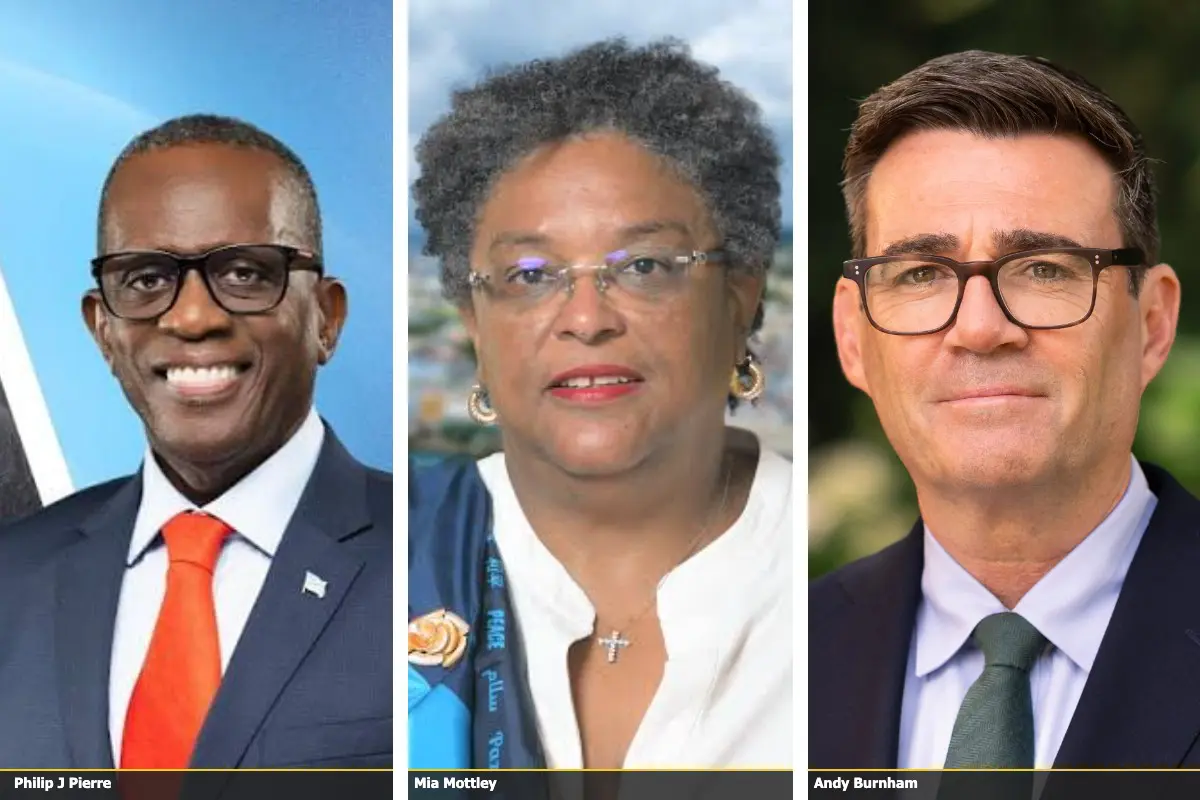
—Mottley welcomes talks, says differences should not prevent progress
CARICOM has rejected British Prime Minister Andy Burnham’s position that financial reparations are not the answer to Britain’s role in slavery, while welcoming his willingness to discuss a formal apology and open structured dialogue with affected countries.
In a statement issued on October 31, CARICOM Chairman and Saint Lucia Prime Minister Philip J. Pierre said the region was ready to engage, but insisted that Britain’s responsibility could not be dismissed because its present-day citizens had played no personal part in enslavement.
Barbados Prime Minister Mia Amor Mottley, in a statement posted on her Facebook page, also welcomed the proposed dialogue while making clear that differences over reparations remained. She said Barbados would participate in good faith as a member of CARICOM.
The responses followed an article by Burnham published in The Guardian on October 30, ahead of the Commonwealth Heads of Government Meeting in Antigua and Barbuda. He signalled willingness to discuss a state apology, but excluded financial compensation.
According to Sky News, Burnham expressed sorrow and regret for the suffering of millions subjected to the transatlantic slave trade and acknowledged its continuing effects.
“We are offering a structured dialogue with those affected by the transatlantic slave trade,” he wrote, adding that listening to calls for a formal apology on behalf of the British state would be an important part of that process.
However, he argued that British people today should not be held liable for historical wrongs committed in another age under different laws and in which they had played no personal part. His remarks offered the prospect of discussions about an apology rather than a formal apology itself.
Pierre welcomed the opening, but said reparatory justice concerned the continuing responsibility of states and institutions. He pointed to Britain’s role in legislating for, protecting and profiting from slavery, and its subsequent compensation of enslavers while the formerly enslaved received none.
“But an apology without repair is incomplete,” he stated.
CARICOM wants every element of its Ten-Point Plan for Reparatory Justice included in the discussions. The statement identified health, education, cultural restitution, technology, debt cancellation and monetary compensation among the measures sought.
Pierre also welcomed consideration of a British debt-restructuring initiative involving former prime minister Gordon Brown, but warned that Caribbean states were often excluded from concessional assistance because of their income classifications despite their vulnerability to economic and climate shocks. Debt relief, he maintained, could not substitute for reparatory justice.
He said CARICOM’s prime ministerial reparations subcommittee, led by Mottley, and its Reparations Commission, chaired by Sir Hilary Beckles, were ready to discuss the terms, agenda and timetable for engagement.
Mottley’s statement emphasised both the historical basis of the region’s claim and opportunities for agreement.
“Dialogue matters because we are not yet on the same page on every element. On reparations in particular, our views differ, and we will say so plainly and respectfully,” she said.
“Honest disagreement on some questions should not hold back progress on the many others where we can readily agree.”
She recalled that in 1661, under English colonial authority, Barbados adopted what she described as the first comprehensive slave code in the English-speaking world. It defined African men, women and children as non-human property and became a model for codes elsewhere.
“That system was built by law and enforced by the State,” Mottley stated.
She identified an apology, addressing anti-Black prejudice, investment in health and education, tackling systemic poverty and institutionalised inequality, and fairer debt arrangements for vulnerable states under the Bridgetown Initiative as areas where agreement could be reached.
The CARICOM Ten-Point Plan, she said, remained a clear guide for the discussions.
“We should build on that common ground while we continue to talk through our differences – CARICOM, the AU and the United Kingdom.”
Mottley also acknowledged former British prime minister Sir Keir Starmer’s participation in the 2024 Commonwealth meeting in Samoa, where leaders agreed on the need for a meaningful conversation on reparatory justice. That decision, she said, opened the door to the current process.
She thanked Burnham and Foreign Secretary Ed Miliband for advancing engagement on the issue.
“We all know that we cannot reach our destination if we do not start the journey,” she said.










Discussion