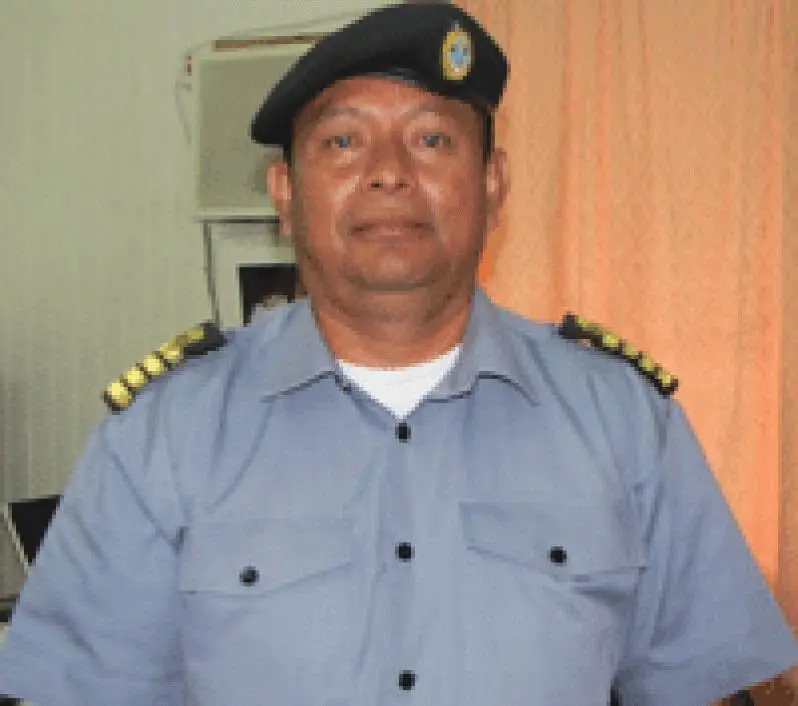
Retired Coast Guard captain John Flores has volunteered to train the crews of government ferries in emergency response following the sinking of the MV Barima on July 18. After more than 35 years in maritime operations and training, he believes regular drills can make a critical difference when a vessel is in trouble.
Flores, now the Coordinator of Emergency Operations at the Maritime Administration Department (MARAD), told Kiskadee Watch in a recent interview that he offered his services because he saw a need to strengthen training in navigation, seamanship and safety.
“I volunteered my services to train those in the maritime industry in navigation and seamanship because I have the knowledge and experience and I saw the need,” he said. His substantive government job, he explained, is to respond to emergencies.
Flores is conducting drills with crews of government ferries on how to manage fires, abandon ship, rescue people who fall overboard and respond to collisions and other emergencies.
“There are all kinds of drills that could be practised regularly in the event of emergencies, like what happened on MV Barima,” he said. “At least crews should have a working knowledge of what to do in quick time.”
Asked whether the Barima crew could have done more to rescue passengers, Flores said he did not know enough about what occurred aboard the vessel to make that judgement. Nor could he say what training its crew had received before the tragedy.
“I don’t know the extent of what transpired on that day. I cannot say if the crew had the relevant training and experience in how to respond to emergencies because the sinking of the vessel has not reached the inquiry stage yet,” he said.
He nevertheless believes the tragedy has exposed a wider need for practical safety training. A crew that knows its drills, he said, can begin responding within minutes.
“If you know how to respond you can save a lot of lives once you do the drills and you know how to do them properly.”
For Flores, the sinking was particularly painful as a seaman. “It was a very sad thing to have occurred,” he said. “I understand the limitations we have. It just shows we lack training not only for the MV Barima captain and mate, but I think it is a general deficiency in the maritime industry among ships that bear the Guyana flag.”
He said Guyana has too few people with the experience to provide specialised instruction in navigation and seamanship. Flores has trained captains and mates in the Guyana Defence Force (GDF) and privately over several years, but had not previously conducted such training for the government’s ferry crews.
“Adequate training is not available. I think the industry needs to focus on trying to improve the standard of training, especially safety-type training for navigational vessels across the country,” he said. “There is a strong need to improve it. That is a national issue.”
He sees safety training as a concern beyond the maritime sector. Flores said that drivers, too, should know how to respond to an accident, provide first aid and help with a rescue while emergency services are on their way.
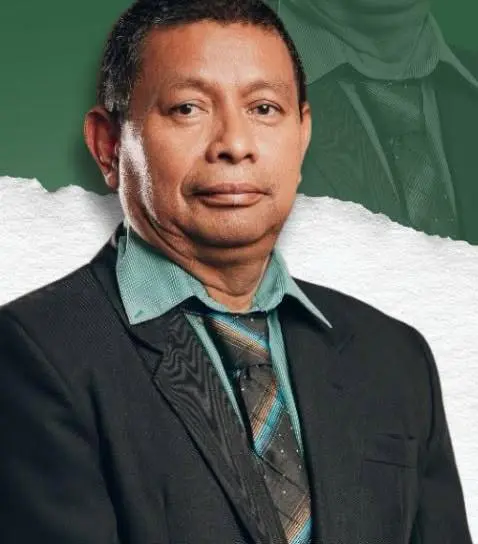
“I personally think the tragedy had to do with a lack of access to safety training,” he said of the Barima. “I think if the crew had the necessary training and followed basic drills, the loss of lives would not have been so bad.” His assessment is his view; the circumstances of the sinking remain the subject of an inquiry.
Naval training
Flores joined the GDF as an officer cadet in 1981 and completed the Standard Officers’ Course in August 1982. Later that year, he was selected for a three-year naval training programme at the Royal Naval College in England.
He said the force needed naval officers at the time, while the training also required a background in science and mathematics.
“There weren’t a lot of people at that time with that sort of background, so they plucked me out and selected me to go to naval college,” he recalled.
On returning to Guyana, he began serving in the Coast Guard as a midshipman. In 1987, he attended a watchkeeping navigation course at the Canadian Coast Guard College in Nova Scotia. He said he topped the class and was subsequently assigned to train other officers.
“My whole career has not been only in operations but also in training, which I like,” he said. “One of my passions is passing on my knowledge and skills.”
His naval career lasted 35 years. He commanded several patrol boats and held appointments in training and operations before retiring in 2016 with the rank of captain. During his final seven years in the military, he worked in administration and quartering at Defence Headquarters.
Flores recalled the difficulties of patrolling Guyana’s rivers and borders during the economic hardships of the late 1980s and early 1990s. The Coast Guard had too few purpose-built patrol vessels and sometimes relied on converted trawlers.
“We had a shortage of patrol boats and in those days, we converted mostly trawlers to patrol boats,” he said. “At the time the GDF had one proper patrol boat, which was the one I served on.”
The GDF acquired smaller patrol boats from the United States in 2001. That same year, Flores and a crew brought the GDF *Essequibo*, a larger patrol vessel, from England to Guyana. The journey took 21 days, with stops for fuel before they crossed the Atlantic.
“I piloted it down to Guyana. That served us for a few years as the main offshore patrol vessel for the Coast Guard,” he said. “I was on board the vessel for five years until I handed it over to another officer.”
The voyage remains one of his strongest memories.
“It was exciting because we hadn’t had such a big boat for quite a while. It was a good experience for the crew. We had to undergo some training in the care and management of the vessel before we brought it down,” he said. “That was something I always remember, bringing the vessel down with the crew.”
Under his command, the GDF Essequibo intercepted vessels engaged in illegal fishing in Guyana’s waters, participated in joint exercises, including Tradewinds, and undertook humanitarian missions. Those included the deployment of soldiers to Grenada to assist with rebuilding after Hurricane Ivan in 2004. Flores also trained hundreds of sailors and junior officers aboard the vessel.
Of Lokono ancestry, he was the first Indigenous officer to command the Coast Guard. He served two terms in that post, from 2003 to 2005 and again from 2008 until his retirement in 2016. He was awarded the Military Service Medal.
From Moruca to Queen’s College
Flores was born in Santa Rosa, Moruca, on September 7, 1961. He spent a brief period at Matthews Ridge during the manganese-mining years and most of his formative years in Mabaruma, which he still calls home and visits regularly.
He attended St Joseph Roman Catholic School in Mabaruma, where he formed friendships that have lasted throughout his life. After sitting the Common Entrance examination, he won a hinterland scholarship to Queen’s College in 1972.
His route into the military was unexpected. When he left Queen’s College, Flores wanted to become a civil engineer. Drawn by a sense of adventure, he first went to the Rupununi and taught for a year in Karasabai while awaiting a response to his application for a Public Service Ministry scholarship.
On his return to Georgetown, he learnt that he had been granted the scholarship, but would first have to complete a period of national service. He said he spent about three months at the Guyana National Service office on Broad Street waiting to be assigned to a quarry.
“No one was telling me anything. One day I just got fed up with not being assigned to where I should have been and I just walked out of the office,” he recalled.
The GDF was recruiting for an officer cadet course, so he applied.
“That was the end of my engineering dreams and the beginning of a fulfilling naval career in the Guyana Defence Force,” he said. “I never regretted that move.”
Flores said the military gave him opportunities to study and to serve both in Guyana and overseas. He graduated from the University of Guyana in 2009 with a bachelor’s degree with distinction in public management, and obtained a master’s degree in Global Studies from the University of the West Indies in 2011.
“The army is a great training place,” he said to young people considering a military career. “You can join the army and become whatever you want to be, a pilot, a doctor, an engineer or have a naval career like me.”
He said discipline and diligence were essential, but so was a willingness to seize opportunities. He has found satisfaction in the military’s work at Guyana’s borders and at sea, as well as in its response to floods and other disasters.
Helping others advance
Flores urged students from hinterland communities not to let their circumstances limit their ambitions.
“The sky is the limit. You could come from the humblest and poorest background, but once you have your head on and the ability to study nothing can prevent you from doing what you want to do in life to improve your situation,” he said.
There will be sacrifices of time and money, he said, but young people now have more opportunities for schooling and online training than were available when he was growing up.
“Whether you come from Hosororo or Lethem or wherever in the country you can achieve great things,” he said. “Grab it with both hands and look at the options available.”
Success, for Flores, also carries an obligation to help others. “It is also not about making it big but also helping to educate people along the way to uplift themselves. That is something that pleases my heart,” he said.
He plans eventually to retire in Lethem, where he is building a home. His wife, Andrea, is from the town, and Flores said he has grown fond of its mountains, savannahs and rivers. His early working years in the Rupununi have also given him a lasting connection to the area.
“Actually, she likes Mabaruma more than me, but I also like Lethem,” he said of Andrea. “It is scenic. I like the mountains and the savannahs and the rivers running down the mountains. It has been welcoming to me.”
Sport has been another constant in his life. At Queen’s College, Flores played football, volleyball and badminton, among other games. He continued playing football and volleyball after joining the GDF and served on the executive of the Georgetown Football Association.
He later concentrated on volleyball, first as a player and then as an administrator. He is a national volleyball referee and currently serves as president of the Guyana Volleyball Federation. Over the years, he said, work sometimes required him to step aside and let a deputy lead the organisation.
“I have been in volleyball for as many years as I have been in the army,” he said.
For now, Flores’s attention remains on the ferry crews taking part in his drills. He wants them to practise often enough that, if an emergency occurs, they can respond immediately and give passengers the best possible chance of survival.








Discussion