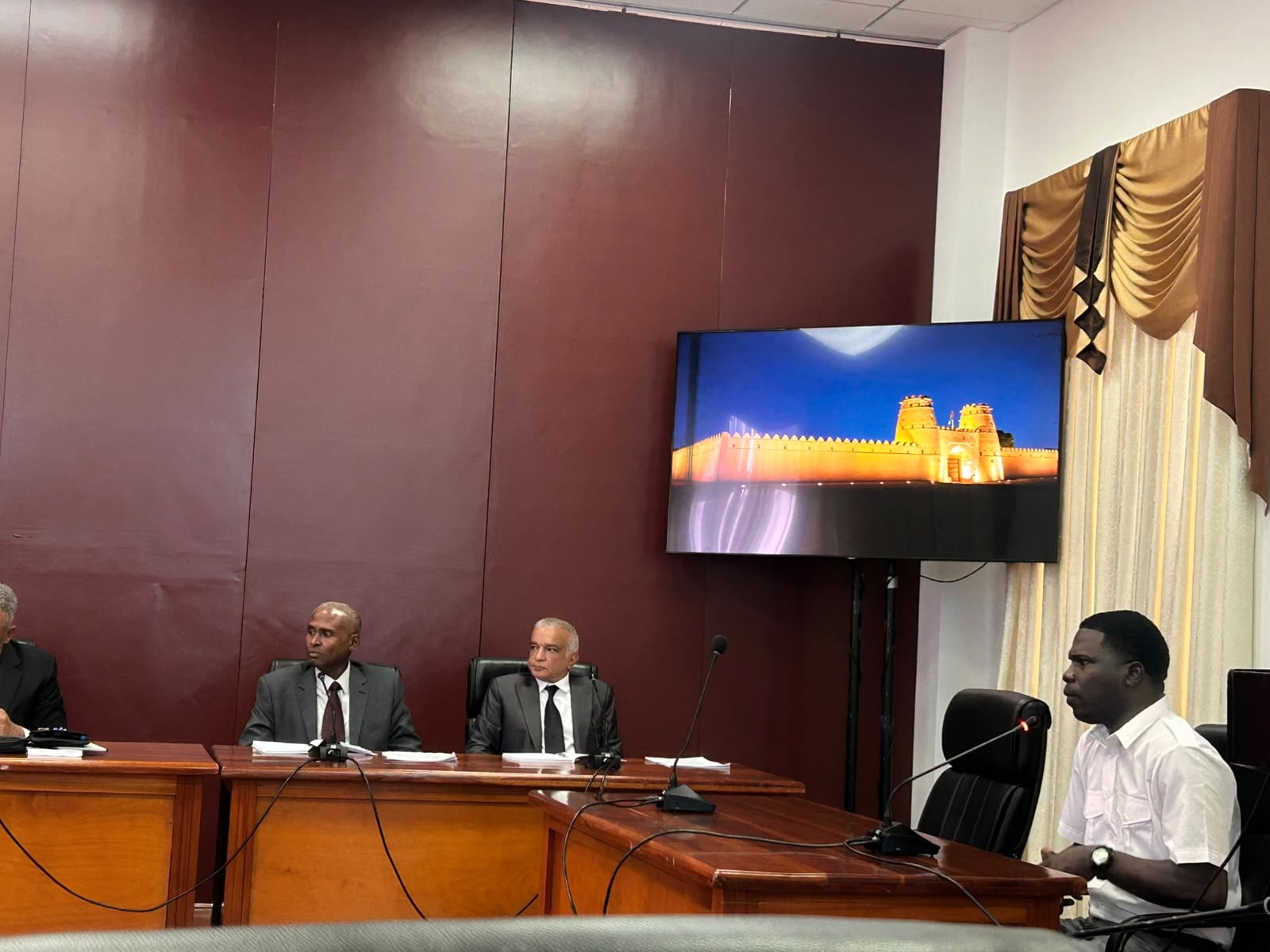
The MV Barima Commission of Inquiry yesterday heard that the absence of runway lighting affected initial plans for an overnight flight during the rescue operation, while Chief Engineer Christopher Clark acknowledged that he held no formal maritime licence or certification for his position.
The sitting at the Arthur Chung Conference Centre also examined the absence of formal maintenance systems and safety drills aboard the vessel, gaps in casualty records and the recovery of its emergency beacon.
Major Loyden Layne of the Guyana Defence Force (GDF) Air Corps testified that shortly after 1 am on July 19, he received an urgent call from his Commanding Officer, Lieutenant Colonel Jocelyn Hosanah, requesting a flight from Ogle to Anna Regina or Hampton Court.
Layne said he advised that landing before first light would not be advisable unless runway lights were activated.
The assignment was subsequently changed to offshore reconnaissance using a GDF Islander aircraft.
He and his co-pilot flew at approximately 500 feet in darkness and spent between 20 and 25 minutes circling a steady red light offshore. The location was approximately 49.5 nautical miles from Ogle and 14 nautical miles from Hampton Court.
The aircraft had no specialised searchlights, limiting observations to what the crew could see with the naked eye. Layne said coordinates were recorded using the aircraft’s GPS and relayed to GDF headquarters.
His witness statement and accompanying map were admitted as Exhibits LL1 and LL2.
The commission also questioned Clark about his qualifications and the vessel’s maintenance arrangements.
Clark said he relied on an internal promotion letter issued by management rather than a formal maritime licence or certification. Much of his approximately two decades in the department had involved shore-based plumbing and electrical repairs rather than engineering work at sea, he acknowledged.
He said he had not worked on or maintained the MV Barima for nearly 18 years and could not recall some structural details, including the location of its water tanks.
Clark further testified that the vessel had no formal Planned Maintenance System or standard operating procedure manuals. Maintenance was reportedly undertaken on an ad hoc basis, with servicing at 500-engine-hour intervals.
He also acknowledged that mandatory safety drills were not being conducted.
Media releases
Meanwhile, Rickford Samaroo, Director of Air Navigation Services at the Guyana Civil Aviation Authority (GCAA), was questioned about casualty figures recorded during the emergency response.
He acknowledged that figures showing 67 people rescued and 66 missing had been obtained from media releases.
“Well, that’s what we had from the media releases,” he said.
Asked whether subsequent updates had been incorporated into the authority’s records, Samaroo said the media had published revised figures but these were not reflected in its log.
“No, not in our log,” he told the commission.
Samaroo presented records concerning the activation of the Rescue Coordination Centre, aircraft movements and communications between controllers and search crews.
The documents indicated that the centre was activated at 1.10 am on July 19, with L. Fernandez designated Search and Rescue Mission Coordinator for aerial operations.
At 1.08 am, the Aeronautical Information Services unit had queried the Cospas-Sarsat beacon alert and confirmed receipt of a message associated with the vessel.
Roraima Airways flight ROR 401 departed at 1.39 am, followed by a GDF helicopter at 2.04 am. Seven aircraft were subsequently recorded as mobilised during the search.
An air traffic control transcript recorded the ROR 401 pilot reporting a flare and a strong emergency locator transmitter signal over the search area.
Samaroo also outlined the national search-and-rescue framework, involving the GDF Air Corps and Coast Guard, Maritime Administration Department (MARAD), Civil Defence Commission and Guyana Police Force.
The commissioners requested records of evaluations of previous communication exercises and full-scale search-and-rescue operations.
In separate testimony, MARAD Marine Superintendent and Surveyor of Ships Christopher Bailey said he recovered the vessel’s emergency position-indicating radio beacon (EPIRB) between 3.30 am and 4 am on July 19.
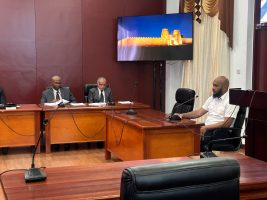
He spotted a faint light and approached it, finding the beacon floating freely, unattached to debris, the vessel or a life raft.
“When I brought it on board, it immediately deactivated,” he testified, saying he had neither activated nor deactivated it himself.
The beacon’s first distress alert had been received at the Timehri Control Tower at approximately 10.43 pm on July 18. Coordinates were subsequently relayed to the Coast Guard and MARAD.
Bailey said that during a November 17, 2025 inspection of the Barima, he had observed a beacon in a white, waterproof, float-free casing on the starboard side near the wheelhouse.
He explained that the housing was designed to release the beacon when submerged, allowing it to float to the surface and transmit a distress signal.
Commissioner Dr Andrzej Jasionowski questioned whether the initial alert indicated that the device had become submerged as the vessel began sinking. Bailey said this was possible but could not confirm the timing.
Bailey also found three fully inflated life rafts during the search, none containing survivors or bodies. He later helped transfer approximately 50 survivors to another pilot vessel for transportation to the Coast Guard base for medical attention.
On July 20, his team encountered approximately 15 to 20 bodies floating off the Pomeroon Beach area. He recorded their coordinates using his personal GPS and passed the information to the Maritime Rescue Coordination Centre.
Bailey is expected to return to give further evidence about his inspections of the Barima and its condition before the July 18 sinking.









Discussion