
The social consequences of Guyana’s rapid economic development, including questions about inequality, migration and changing community relationships, were among the issues examined at the sixth annual Caribbean Sociological Association (CASA) conference hosted by the University of Guyana last week.
Held from September 23 to 25 under the theme “Sociology of Societies in Transition: Exploring the Tensions Between Stability and Change,” the conference brought together researchers, scholars, practitioners and students from the Caribbean and its diaspora, according to a UG release issued on Wednesday.
Approximately 40 presentations addressed social, economic, political, environmental and technological changes across the Caribbean and the Americas.
Dean of UG’s Faculty of Social Sciences, Dr Diana Da Silva-Glasgow, said the expansion of Guyana’s petroleum sector presented significant opportunities while raising questions about inequality, migration, labour markets, family structures, community relationships and the ability of institutions to adapt.
She noted that Caribbean societies had historically experienced transitions arising from colonialism, independence, globalisation and migration, and were now confronting further changes linked to technology, geopolitical tensions and climate change. She called for continued collaboration across disciplines and national boundaries.
During a panel discussion, Minister of Human Services and Social Security Dr Vindhya Persaud said development must remain focused on people’s quality of life.
“It is imperative that there be people-centric development, and this is where the social services remain pivotal on the Government of Guyana’s radar,” Persaud said.
According to the release, she pointed to migration from rural and remote communities to urban areas, as well as rising life expectancy, as factors requiring continued assessment of resource allocation and national priorities.
Chairman of UG’s transitional management body, Professor Stafford Griffith, urged researchers to make their findings accessible beyond academic journals, particularly to policymakers, administrators, professionals and the public.
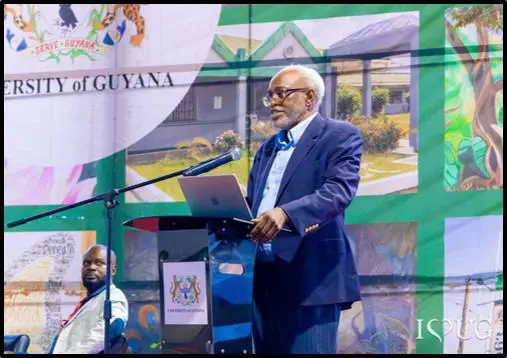
He said the pace of development in Guyana was bringing socio-economic challenges that required deeper understanding and that Caribbean researchers were well placed to examine the region’s experiences.
“Research that is socially and developmentally relevant to the needs of the Caribbean should be a critical responsibility of scholars in the Caribbean,” Griffith said, quoting from an article to which he contributed in 2024.
Delivering the keynote address, former UG Vice-Chancellor Professor Paloma Mohamed Martin examined the role of fear in societies undergoing rapid change.
“Fear, I would argue tonight, is the most salient effect of tensions arising between stability and change. Fear is what a society feels when it stands at the hinge between the stability it knows and the change it cannot fully comprehend,” she said.
Drawing on her research into Guyanese society, Mohamed Martin said fear could inhibit participation in public, social and professional life and erode trust.
She also addressed technology and artificial intelligence, arguing that technology amplified existing influences rather than independently determining the outcomes of change.
“Technology is an amplifier, not an author,” she said, while urging scholars and policymakers to examine whose interests and assumptions were being incorporated into the technologies societies adopted.
Mohamed Martin said resilience should involve developing the capacity to emerge from disruption better equipped to respond to future challenges.
“Resilience, properly understood, is not bouncing back. It is bouncing forward, emerging from disruption, reorganized, wiser, more capable than when we first entered it,” she said.
CASA President Dr Duane Edwards said Guyana’s ongoing transformation made it a particularly relevant setting for the conference.
“The conference being held in Guyana promises to bring participants from across the Caribbean and the diaspora to discuss countries experiencing various kinds of transitions and change. There is perhaps no better place to hold this conference than in Guyana,” Edwards said.
Participants came from Guyana, Jamaica, Barbados, Trinidad and Tobago, Suriname and the wider Caribbean diaspora. Presentations covered racial, class and gender inequality, domestic violence, social welfare, resource extraction, environmental impacts, demography, governance, democracy and sustainable development.
CASA is a regional body that promotes the study of Caribbean societies through sociological research, collaboration and advocacy.










Discussion