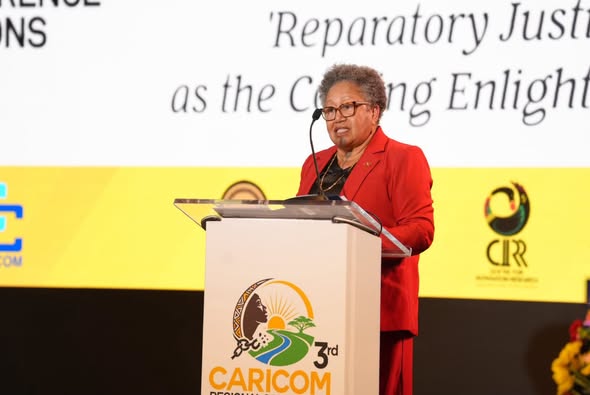
CARICOM Secretary-General Dr Carla Barnett has said that the region’s reparations campaign must go beyond recognition of the atrocities committed against African and Indigenous peoples and deliver meaningful improvements in health, education and economic conditions.
Speaking at the opening of the Third CARICOM Regional Conference on Reparations in Barbados, Barnett said the Caribbean’s pursuit of reparatory justice was fundamentally about recognition, accountability and transformation.
She said the campaign concerned crimes against humanity committed in Africa, the Caribbean and the wider African diaspora, including the genocide and dispossession of Indigenous peoples, the trafficking of enslaved Africans and racialised chattel enslavement in the Caribbean and the Americas.
“Reparations is fundamentally about justice. It is about recognition, accountability and transformation, and also about building a just and equitable future,” Barnett told the gathering.
The Secretary-General said the CARICOM 10-Point Plan for Reparatory Justice and the recently revised ‘Manifesto for Reparatory Justice’ provided a comprehensive framework for advancing the campaign.
She said the framework placed the present-day needs of affected communities at its centre, including public health, education, psychological rehabilitation, cultural development, support for Indigenous communities, gender justice, debt cancellation and monetary compensation.
“It reminds us that reparations must be meaningful and transformative, addressing both the historical wrongs and the resulting contemporary consequences,” Barnett said.
She noted that CARICOM heads had approved the revised plan at their meeting in July and said it reflected the progress made by the global reparations movement over the past 13 years. The updated document, she added, brought renewed direction to the campaign for justice.
CARICOM established its Reparations Commission in 2013, supported by a Prime Ministerial Subcommittee on Reparations. Barnett said the creation of the commission demonstrated the importance regional leaders attached to the matter and its connection to the dignity and development of Caribbean people.
She praised the commission’s chairman, Professor Sir Hilary Beckles, and its members for what she described as their sustained advocacy and intellectual leadership.
Barnett said they had shown courage by engaging in difficult conversations and had helped move the regional campaign to a new level of global consciousness.
According to the Secretary-General, 12 CARICOM member states have since established national reparations commissions or committees. She said this demonstrated the region’s commitment to pursuing reparatory justice through coordinated national and regional action.
Barnett also pointed to the expanding partnership between CARICOM and the African Union, saying this had significantly strengthened the campaign.
She cited the Addis Ababa Declaration on Transcontinental Partnership in Pursuit of Reparatory Justice for Africans and People of African Descent, adopted at the second Africa-CARICOM summit in Ethiopia in September 2025, as an important framework for continued collaboration.
That cooperation, she said, helped to build momentum for the United Nations General Assembly’s adoption on March 25 of a resolution declaring the trafficking of enslaved Africans and racialised chattel enslavement to be the gravest crime against humanity.
Barnett also credited the leadership of Ghanaian President John Dramani Mahama, the African Union’s champion for reparatory justice, with helping to advance the campaign.
She said CARICOM heads were expected to make further statements on reparatory justice during the upcoming 81st session of the UN General Assembly and to participate in high-level activities commemorating the 25th anniversary of the Durban Declaration and Programme of Action.
The Secretary-General stressed that civil society remained central to the movement, noting that activists, community leaders, artists, faith-based organisations, young people and ordinary citizens had kept the demand for justice alive across generations.
She also welcomed the participation of representatives of Indigenous peoples, Garifuna communities, Kalinago people and Maroons, saying their histories and voices must be included in the deliberations.
Barnett placed particular emphasis on the involvement of young people, whom she said would carry the campaign forward and inherit the results of the present effort.
The conference has brought together policymakers, academics, activists, Indigenous representatives and members of the African diaspora to assess the progress of the reparations movement and determine its future direction.








Discussion