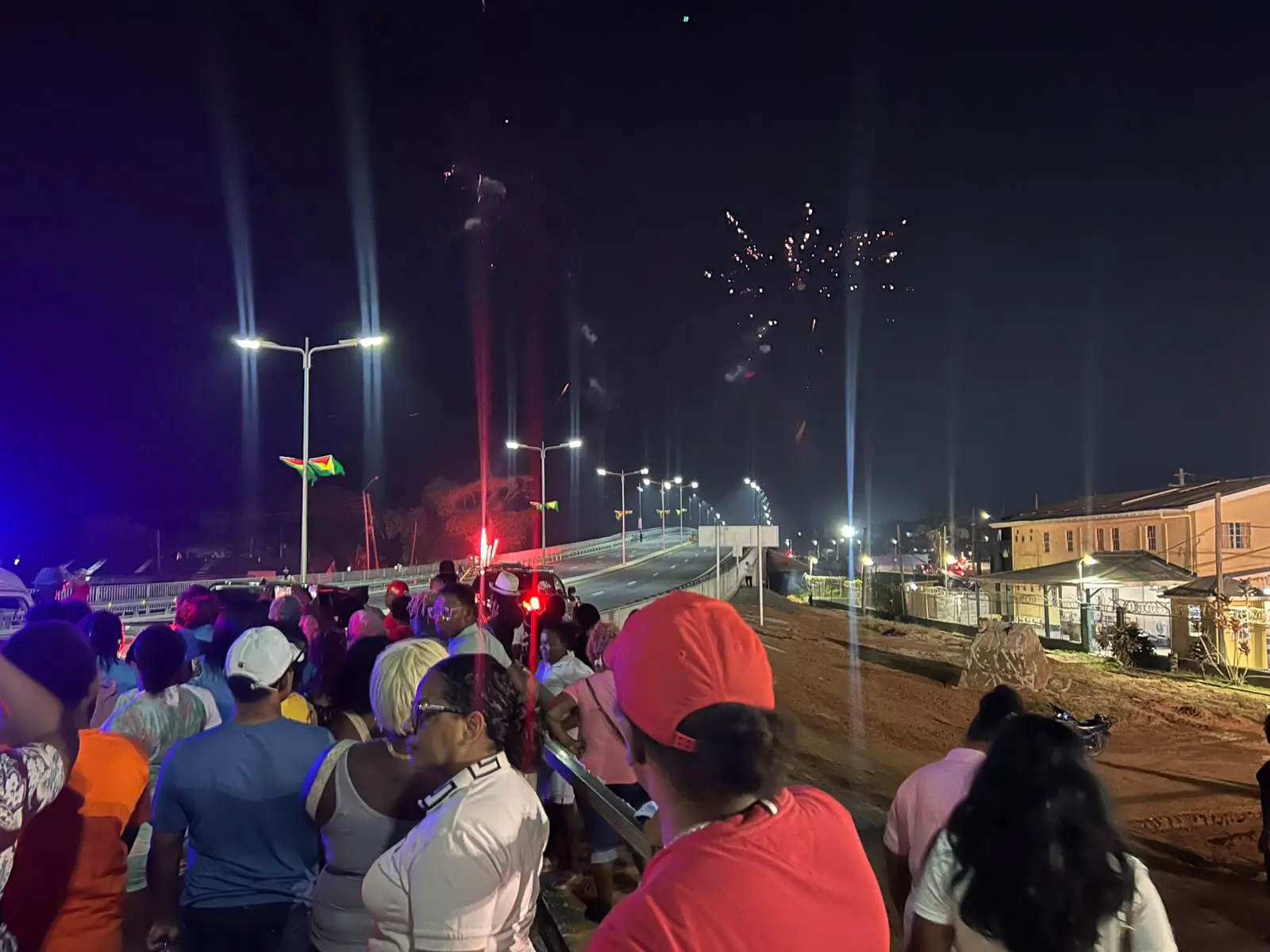
After nearly six decades of motorists having to take turns crossing the Demerara River, the days of lengthy queues at the Mackenzie-Wismar Bridge are expected to become a thing of the past, following the commissioning of a new US$35 million crossing featuring four traffic lanes, dedicated pedestrian walkways, modern lighting and an expanded road network.
The modern structure, officially opened by President Irfaan Ali yesterday, represents a major upgrade to Linden’s transportation infrastructure, replacing the single-lane bridge commissioned in 1967.
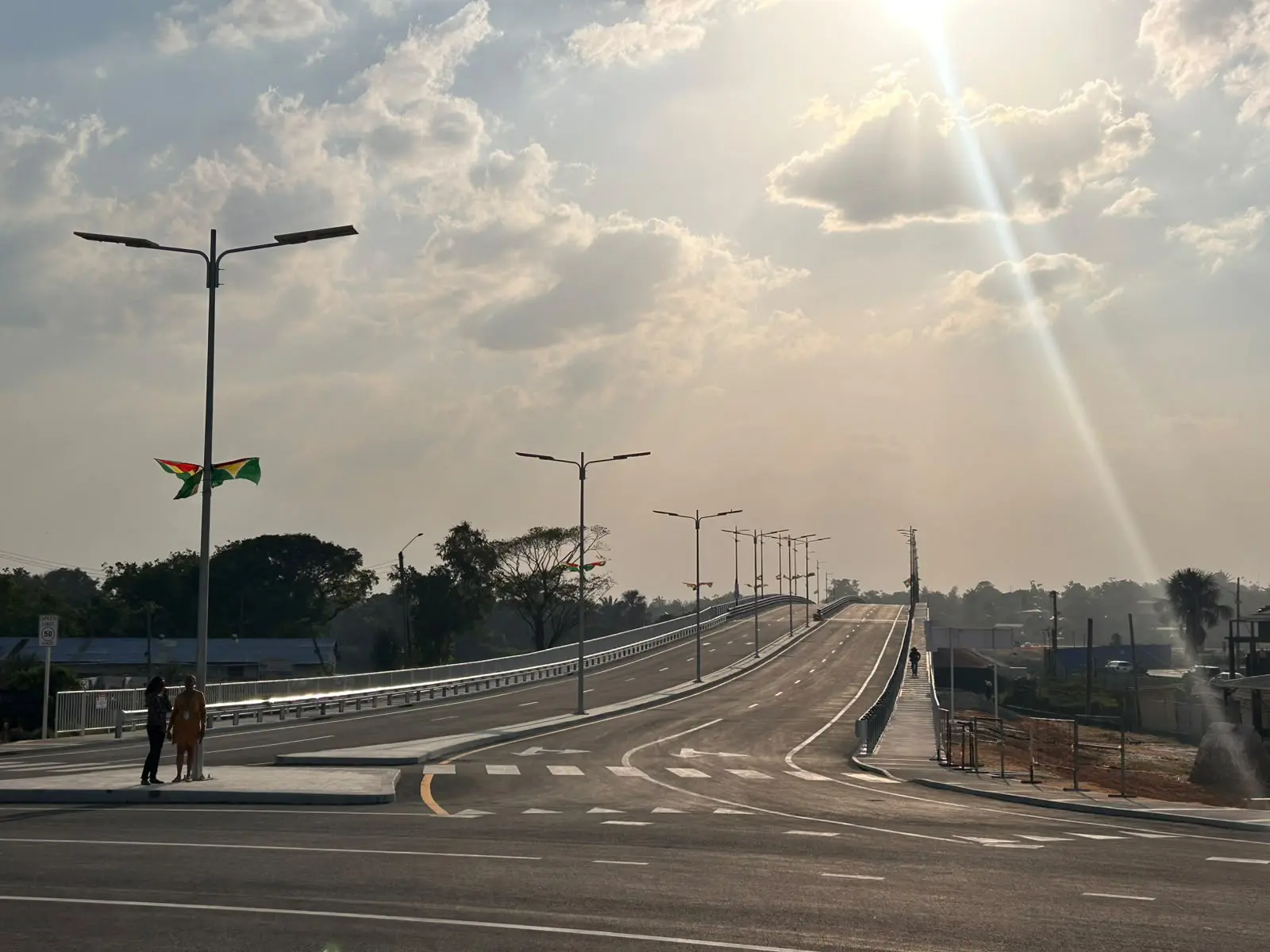
Spanning approximately 233 metres, the new high-span bridge accommodates two lanes of traffic in each direction, allowing vehicles to travel simultaneously between Mackenzie and Wismar without having to wait for traffic approaching from the opposite side.
For decades, the old bridge operated under a single-lane arrangement that frequently resulted in delays for commuters, commercial vehicles, truck operators and other road users.
During yesterday’s commissioning ceremony, Minister of Public Works Juan Edghill said the new structure was designed to permanently address those limitations while accommodating Linden’s growing transportation demands.
“For decades, crossing this river meant waiting your turn, waiting to get to work, waiting to take your goods to the market, waiting to get home to the people who really matter the most,” Edghill said.

“Generations of Lindeners have known that routine. One side moves while the other side waits. Today, we change that experience permanently.”
The minister explained that the bridge’s four-lane design would increase traffic capacity and improve the movement of workers, students, businesses and commercial operators who rely on the crossing daily.
Unlike the previous structure, the new bridge also incorporates dedicated pedestrian walkways on both sides, separated from vehicular traffic by protective barriers.
The design is intended to provide safer passage for pedestrians, reducing the need for persons on foot to share space with moving vehicles.
Modern lighting has also been installed to improve visibility, particularly for motorists and pedestrians travelling after dark.
“More capacity means an end to taking turns to cross. Dedicated pedestrian space means greater protection for those on foot. Better lighting means improved visibility when the working days end and the journey home begins,” Edghill stated.
However, the project extends beyond the bridge itself.
According to the minister, the government also constructed approximately 4.5 kilometres of connecting roads on the eastern and western approaches, complete with drainage and lighting infrastructure.
These new road connections were designed to provide smoother access to the bridge while linking the crossing with surrounding communities and major transportation corridors.
The connecting infrastructure also incorporates roundabouts intended to facilitate the movement of vehicles approaching and leaving the bridge.
Edghill explained that the design was developed with future expansion and increasing traffic volumes in mind, particularly as Linden continues to serve as a gateway to Guyana’s hinterland.
The crossing forms part of the wider transportation network connecting the Georgetown-Linden corridor to the Linden-Mabura Hill Road and eventually Lethem and neighbouring Brazil.
It is expected to accommodate increased movement of trucks, mining equipment, agricultural produce and other commercial goods travelling through Region Ten.
President Ali, delivering the feature address, said the new bridge represents a significant expansion in the capacity of a crossing that has long been critical to Linden’s development.
“For too long, motorists and commuters had to come to a bridge that permitted only one lane of traffic at a time,” Ali said.
He explained that the previous bridge was originally constructed to support the bauxite industry, particularly the movement of ore between the two sides of the Demerara River.
However, as Linden’s population, economic activities and transportation requirements expanded, the limitations of the old structure became increasingly evident.
“Today, we move from that single-lane arrangement to a modern four-lane high-span bridge with two lanes in each direction, dedicated pedestrian facilities,” the President said.
According to Ali, the upgraded crossing will reduce congestion, improve travel efficiency and create opportunities for businesses and transport operators.
“It means that vehicles, people, goods and services can move with greater ease and reliability. It means that business can plan with greater confidence, transport operators can work more efficiently, and families can spend less time negotiating bottlenecks and more time pursuing their daily lives,” he added.
Construction of the bridge and its eastern approach road was undertaken by China Railway Construction Caribbean Company Limited, while GuyAmerica Construction Inc. was responsible for the western approach.
The Ministry of Public Works also recognised the contributions of its engineers, project managers, technical personnel and supervisory consultants involved in delivering the project.
Edghill urged motorists to exercise caution when using the new crossing, particularly when approaching the roundabouts, observing traffic signs and travelling near pedestrian areas.
“A wider road still requires careful driving,” the minister cautioned, reminding road users that the structure’s safety would depend on responsible use and proper maintenance.
Meanwhile, the commissioning ceremony also saw President Ali announce that the structure would officially be named the Samuel Hinds River Bridge, in honour of the former Prime Minister and President of Guyana, who spent decades working in Linden’s bauxite industry before entering political office.
The Mackenzie-side access road will be named after the late former Deputy Prime Minister and Opposition Leader Robert Herman Orlando Corbin, while the Wismar-side approach will honour current Prime Minister Brigadier (Ret’d) Mark Phillips.
The President further announced plans for two “Roundabouts of Heroes,” which will feature a Harpy Eagle monument bearing the names of individuals who have made significant contributions to Linden, Region Ten and Guyana.
As part of the commissioning ceremony, President Ali joined officials and members of the public for a ceremonial walk across the new structure following the ribbon-cutting.
With the new crossing officially commissioned, the bridge is expected to transform the daily travel experience for Linden residents while strengthening the movement of people and goods through one of Guyana’s most important inland transportation corridors.











Discussion