`We are behind schedule. We don’t want to go to any litigation or anything here. We want this project to continue to its end and deliver on the promise to the people’
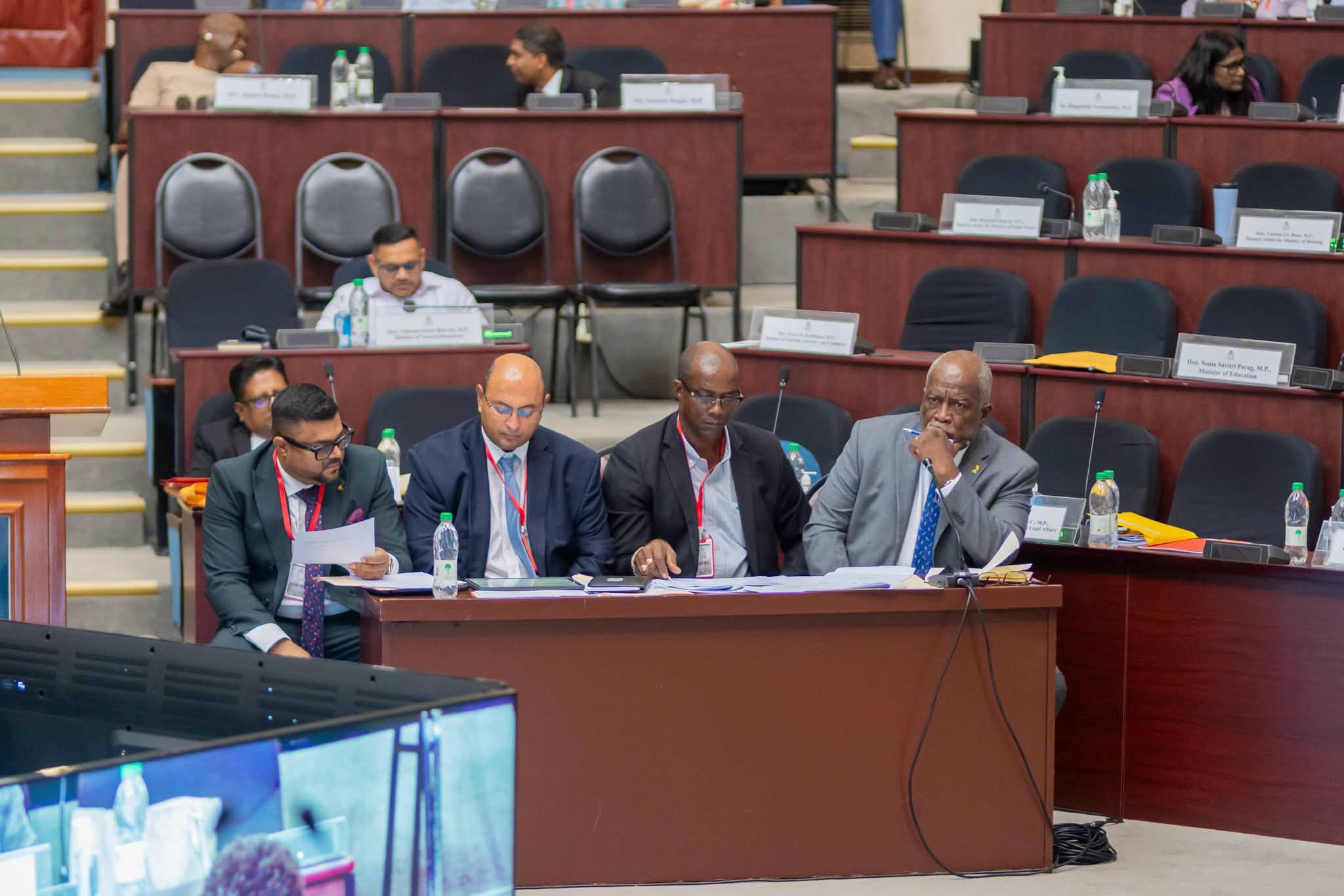
The Government was yesterday pressed in parliament to explain an additional $25 billion to advance the Gas-to-Energy project, pushing its overall cost to US$956 million, with Prime Minister Mark Phillips acknowledging that the venture has encountered delays and cost overruns but insisting that further funding is necessary to bring it to completion.
The request, which comes on top of an initial $10 billion allocation and a previous supplementary provision of $19 billion, was challenged yesterday by Opposition Members of Parliament (MPs) during consideration of the estimates in the National Assembly, with questions raised about the escalating cost, procurement for the project’s second phase and the Government’s ability to guarantee that no further funding will be required.
APNU MP Terrence Campbell questioned the Government’s decision to return to Parliament for another $25 billion, arguing that the successive requests raised concerns about the project’s budgeting and financial management. “This is not budgeting,” Campbell said, while asking Phillips to explain what had necessitated the latest request.
In response, the Prime Minister shared several components accounting for the additional expenditure, including $12.1 billion for the Lindsayca EPC integrated natural gas liquids (NGL) plant and 300-megawatt power plant, $4.25 billion for Siemens Energy Phase Two gas turbines, and $866.3 million for transmission and substations.
Other allocations include $360.8 million for transmission lines and substations under the KPL EPC contract, $210.5 million for substation commissioning, and $315 million for an access road upgrade and the Goedverwagting substation. Phillips also identified $3.364 billion for operations and maintenance, $2.988 billion for NGL downstream activities, including storage, pipelines and mobilisation, and $378.57 million for outstanding land acquisition payments.
A further $430.2 million was identified for project management, supervision, legal and advisory services, while $35.3 million was earmarked for US Export-Import Bank (EXIM Bank) lender monitoring requirements. The Prime Minister put the total expenditure at $24.688 billion.
Campbell then questioned whether the Government had already started making payments towards Phase Two of the project, particularly the $4.25 billion identified for Siemens Energy gas turbines, and Phillips confirmed that payments were being made towards the procurement of turbines for the second phase, explaining that the Government had decided to secure the equipment early because of extended manufacturing lead times and increasing global demand.
He said the turbines had to be manufactured and could not simply be purchased and delivered immediately, adding that there was only one set of manufacturers producing the equipment.
To maintain the project’s anticipated 2030 schedule for Phase Two, Phillips said the Government was pursuing long-lead procurement, which requires an upfront payment to secure the supplier’s commitment, with the balance to be paid later.
However, when Campbell asked whether any other component of Phase Two had been sole-sourced and whether Lindsayca had received advance payments for that phase, Phillips responded in the negative.
Campbell also sought a breakdown of the $12.1 billion allocated for Lindsayca, initially referring to the sum as money already paid to the contractor. Phillips corrected him, clarifying that the money had not yet been paid and that the Government was seeking Parliament’s approval before commencing the payment process.
MP Tabitha Sarabo-Halley asked at what stage the Government recognised that the additional funding was necessary, noting that project management and other related expenses should ordinarily have been identified during the initial budgeting process. Phillips acknowledged that money had been allocated for the project earlier in the year but said it had already been utilised.
He attributed the additional request to cost overruns and discussions with the project directors and contractor, saying the Government had decided to provide additional funding rather than risk further interruptions to the project. “We are behind schedule. We don’t want to go to any litigation or anything here. We want this project to continue to its end and deliver on the promise to the people,” Phillips said. He maintained that the Government remained committed to delivering an additional 300 megawatts of electricity at half the current cost.
Pressed further by Sarabo-Halley on whether the entire original allocation had been exhausted, Phillips confirmed that the money had been fully utilised. He also disclosed that the Government had entered into Amendment Five with the contractor and was in the process of finalising Amendment Six to facilitate the continuation of the works.
The Prime Minister said the additional funding was necessary to avoid further stalling or delays, noting that the Government had a responsibility to complete the project.
Meanwhile, APNU MP Vinceroy Jordan sought the revised overall cost of the project, the specific milestones that had not been achieved, the reasons for the delays and a firm completion date.
Phillips disclosed that the revised cost was US$956 million, up from the previously stated US$759 million. He also said the four turbines were expected to be operational by the end of the first quarter of 2027.
On the question of the contractor’s additional financial demands, APNU MP Sherod Duncan asked Phillips to clarify reports that Lindsayca had requested an additional US$170 million.
The Prime Minister said the contractor had actually requested US$200 million, of which the Government had agreed to pay that amount, with US$130 million already paid and another US$70 million outstanding.
He said the additional amount would take the project cost from US$759 million to US$956 million.
Campbell subsequently questioned whether the Government had entered into an agreement that capped the additional expenditure and provided for penalties if the contractor failed to meet deadlines. Phillips responded that Amendment Five had been signed by both parties, while Amendment Six was awaiting finalisation. He explained that the amendments established financial limits and penalties for delays, adding that payments would be made in an open-book arrangement based on the work to be completed.
However, when Campbell asked whether the Prime Minister could assure the House that there would be no further amendments or requests for additional funding, Phillips was less definitive. “I’m not clairvoyant, but I’m confident that the amendments entered into and the other ones soon to be signed will see us to the end of this project,” he said.
The financing arrangements also came under scrutiny, with Duncan asking how much of the expenditure would initially be funded by Guyana and subsequently reimbursed by the US EXIM Bank, and how much would have to be financed directly by taxpayers. Phillips declined to provide details, saying he would rather not answer questions linked to the EXIM Bank. He later acknowledged that reimbursement was an ongoing exercise handled through the Ministry of Finance but declined to elaborate.
Duncan also questioned the handling of shipping costs, referring to correspondence submitted to the National Assembly which reportedly listed two freight charges of US$25 million and US$5.8 million. He asked who had paid those amounts and how much had been claimed for reimbursement under the financing arrangement. Phillips responded that the question should be directed to the person or agency that had submitted the relevant documents to the House.
He also addressed concerns raised by MP Amanza Walton-Desir about whether the latest request represented an expansion of the original scope of works or additional expenditure arising from cost overruns. Phillips explained that the request covered both additional costs associated with completing Phase One and advance payments to secure turbines for Phase Two. He said the early procurement decision was necessary because of the lead time required to manufacture and supply the equipment.
Walton-Desir had also questioned whether the turbines and their associated procurement costs were known when the 2026 Budget was presented, given that Phase Two had already been identified as part of the Government’s plans. Phillips maintained that the turbine procurement decision was made later in the year following discussions with the manufacturer and a determination that early payment was necessary to avoid missing deadlines.
On the legal expenditure, MP Dexter Todd sought clarification on the amount specifically allocated for legal services. Phillips identified the Joseph Hage Aaronson & Bremen as the legal consultants and disclosed that $11.154 million was earmarked for legal advice on the Siemens operations and maintenance contracts and Phase Two gas turbine supply contracts.
The supplementary provision was eventually approved by the National Assembly.









Discussion