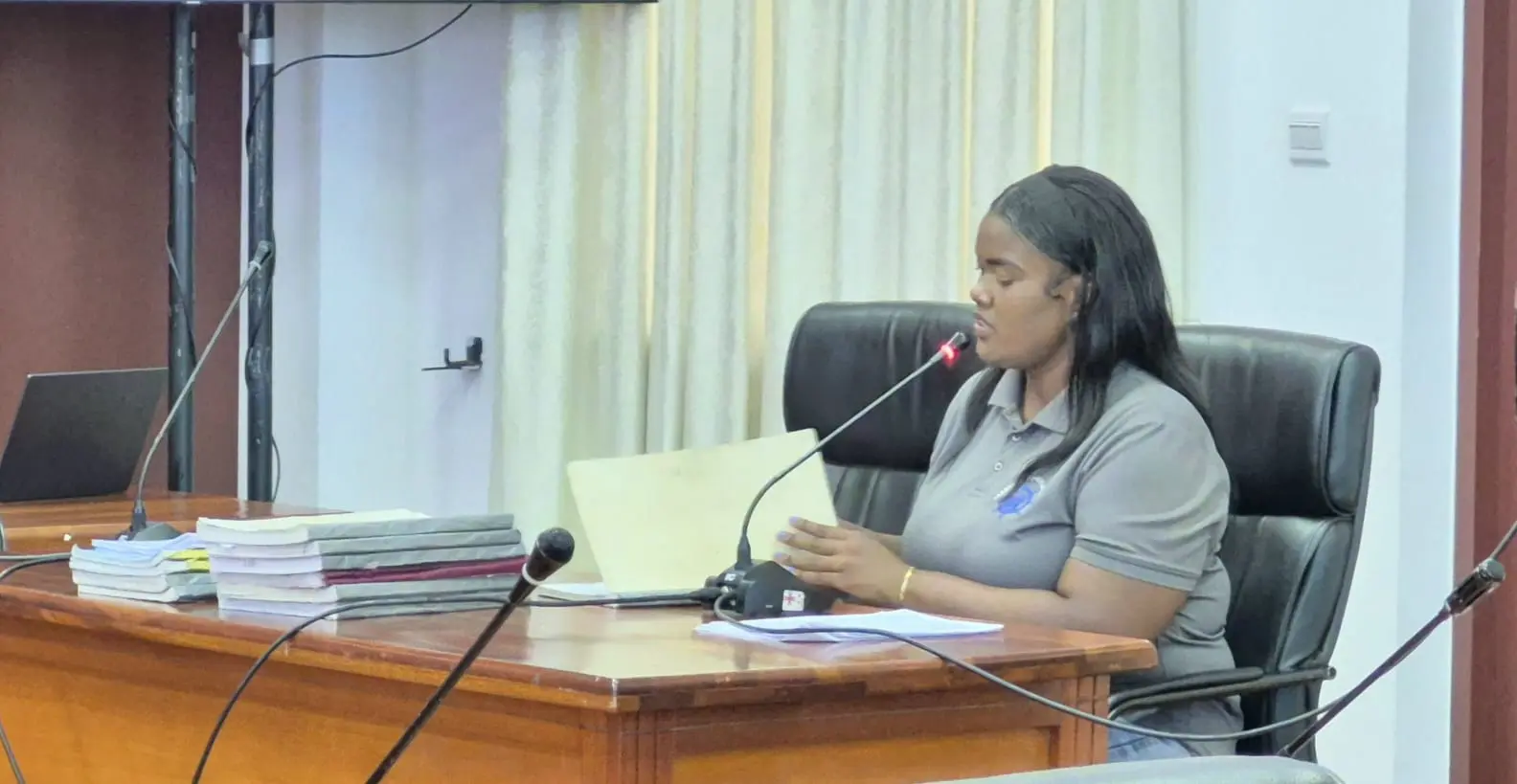
– warned about confusing testimony
Cargo checker Kessa Case struggled to explain a series of discrepancies in the Transport and Harbours Department’s (THD) cargo accounting records, including a missing page from her ledger, inconsistent numbering of entries and the absence of a to-pay list for the MV Barima’s July 18 trip, leaving several commissioners questioning how the system was being managed.
During her testimony before the Commission of Inquiry (CoI) yesterday into the sinking of the vessel and the loss of over 100 lives, Case repeatedly told commissioners she could not remember or explain how certain records were maintained, moving them to remind her of her responsibility to tell the truth and assist the inquiry in establishing what happened.
At one point, Chairman Godfrey Smith reminded Case that she had taken an oath to tell the truth and warned that there could be consequences for providing false information to the Commission.
He intervened during Commissioner Hayden Pritchard’s questioning when Case responded “no comment” after she was asked whether she found it unusual that no to-pay list had been prepared for the July 18 trip. Smith reminded her that the Commission had been appointed by the Government of Guyana to investigate the tragedy and recommend measures to prevent a recurrence. He urged her to explain whether there was a reasonable justification for the missing document, warning that the commissioners could draw inferences from her refusal to assist them.
Case subsequently explained that July 18 had passed very quickly and that the checkers had not managed to prepare the list before the tragedy occurred. She said the staff were distracted by the events that followed and could not offer much more of an explanation.
However, Pritchard questioned why the tragedy, which occurred hours after the vessel departed, would have prevented the checkers from preparing a document that was supposed to be handed to the cashier after the completion of cargo operations. Case agreed with his understanding of the procedure but could not provide a further explanation.
She confirmed that the to-pay list was normally prepared by the checkers using the cargo manifest to identify customers whose goods had been checked but for which payment had not been received. The information was handwritten on loose sheets of paper, shared among the checkers and eventually handed to the cashier. However, she acknowledged that she did not retain copies of the lists and was unsure whether the cashier made copies.
The lists were also not maintained in a dedicated register or numbered book, raising concerns about how the department ensured that the records were preserved and could be audited.
Case said the checkers sometimes prepared the lists collectively, with each person signing beside the items they had checked. She confirmed that no such collective exercise took place for the July 18 voyage. She also acknowledged that some customers were allowed to transport cargo without paying in Georgetown, with the expectation that they would settle the outstanding freight at Port Kaituma.
Missing ledger
Commissioner Andrzej Jasionowski raised questions about Case’s checker’s ledger after discovering that one page immediately preceding the July 14, 2026 entries had been removed.
Case confirmed that she had removed the page but could not remember when she did so or explain why, other than describing it as an extra carbon copy.
The missing page became particularly significant because Case had initially testified that she began checking cargo on July 13. However, after examining her ledger, she changed her account, saying she had made a mistake and had actually started on July 14.
Jasionowski questioned whether the missing page could have contained entries for July 13, pointing out that it was the only page removed from the book. Case maintained that it was a carbon copy but could not remember the date recorded on it or retrieve the missing document.
She explained that carbon copies were normally removed from the checkers’ books, although the checkers sometimes forgot to take them out.
Commissioner Nyree Dawn Alphonso examined the ledger and found further inconsistencies, noting that some pages contained only original entries, others appeared to contain only carbon copies, while some had both. Despite confirming that she personally made the entries, Case said she had no explanation for the different recording arrangements and acknowledged that there was no particular system governing how the information was recorded.
Jasionowski also questioned the numbering system, while Pritchard later described the ledger as disorganised and suggested that consecutively numbering every page would provide a more secure and transparent system.
Pritchard said the numbering arrangement was difficult to follow, particularly when entries stopped at one number and restarted at one, with gaps in the dates and sequences that Case struggled to explain.
Customers identified only by initials
Alphonso also questioned the practice of recording customers using incomplete names or initials, highlighting entries for persons identified only as RS, RC and TDE.
Case explained that TDE referred to a regular customer known as Tony, while she could not recall the full name of RS. She also acknowledged that she knew a customer identified as Sue but could not remember her surname.
Asked how THD would recover outstanding payments from persons identified only by initials, Case said she would attempt to retrieve their contact information and contact them.
However, she acknowledged that some telephone numbers were not recorded in her ledger and explained that she sometimes relied on colleagues to help retrieve customers’ contact details.
Jasionowski pressed her on whether there was a central directory containing customers’ full names, addresses and telephone numbers and Case said there was no such list that she knew of. She ultimately acknowledged that she had no way of confirming whether the outstanding payments were eventually collected.
Further discrepancies
After being asked to return with additional documents, Case produced several checkers’ ledgers, slip books, an items-remaining-in-bond ledger and to-pay lists. However, she was unable to identify the checker responsible for some of the ledgers, including one covering December 16, 2025, to June 23, 2026.
The Commission also identified pages that appeared to have been torn out of some of the books. The additional records included two slip books, which Case explained were used for different categories of cargo. She clarified that the checkers shared a fine-goods slip book, while separate books were used for bags, gas and perishables such as eggs, fruits and vegetables.
This prompted further questioning from Alphonso, who noted that Case had earlier described the arrangement as one shared slip book, without initially explaining that different books were used for different categories of goods.
The commissioner also questioned why receipt numbers did not follow a clear sequence, despite the books containing pre-printed official numbers. Case explained that the books were shared among checkers and that the sequence could be interrupted depending on which checker was using the book and when customers arrived.
Pritchard described the arrangement as a “recipe for chaos,” saying the department needed a more orderly system.
Jasionowski also examined a February 27 to-pay list containing entries marked both “paid” and “did not pay,” including consignments of rice.
When asked what happened to cargo for which payment was never made, Case said customers were generally required to pay at the destination before collecting their goods. However, she could not explain the particular entries marked “did not pay.”
The commissioners had also requested an electronic copy of the WhatsApp communications through which the checkers shared to-pay lists. However, Case said she could not retrieve the messages because she had changed phones and the information was not available on her current device.
Pritchard questioned the apparent gaps in the records, suggesting that either substantial amounts of cargo were not being paid for, payments were being made but not documented, or there were serious problems with the storage and security of accounting records.
Case said she could not say which of those circumstances applied.










Discussion