
-cites `inhumane’ solitary confinement
Less than 24 hours after Magistrate Abigail Gibbs refused to grant him bail, Opposition Leader Azruddin Mohamed has moved to the High Court seeking his release and declarations that his continued detention and conditions of solitary confinement at the Lusignan Prison violate his constitutional rights.
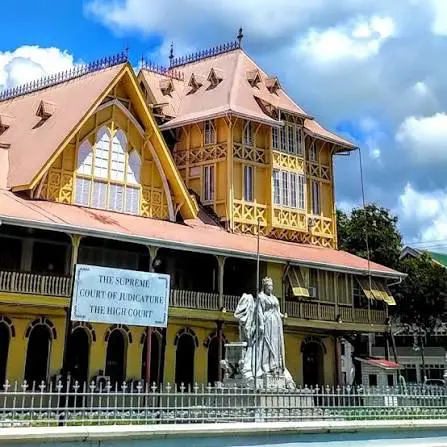
The urgent constitutional motion, filed yesterday, names the Attorney General and the Director of Prisons as respondents and seeks relief under Articles 139, 141, 144 and 153 of the Constitution of Guyana.
Through his attorneys, Senior Counsel Roysdale Forde, Siand Dhurjon and Damien Da Silva, Mohamed is asking the High Court to grant him reasonable bail pending the determination of the criminal charges against him.
He is also seeking declarations that his continued detention violates his constitutional right to personal liberty, the presumption of innocence and the protection against inhuman or degrading punishment or treatment.
The application follows Tuesday’s proceedings before Magistrate Gibbs, during which Mohamed was refused bail in relation to charges arising from his alleged receipt of electronic footage connected to the October 12 shooting incident involving Senior Superintendent Prem Narine.
In his supporting affidavit, Mohamed maintains that the allegations against him do not justify his continued incarceration and argues that the prosecution has failed to establish substantial grounds for refusing bail.
His attorneys contend that the prosecution’s case is weak and that there is no sufficient evidence to suggest he would interfere with witnesses, obstruct justice, commit further offences or abscond if released.
The constitutional challenge also raises allegations concerning Mohamed’s treatment at the Lusignan Prison, where he has been detained since October 30.
In the affidavit, Mohamed said that he has been confined to a cell on a floor where he is the only prisoner, with virtually no meaningful interaction with other inmates.
He alleges that he is permitted to leave his cell for approximately ten minutes each day, primarily to shower, and has limited access to natural sunlight.
Mohamed further describes his cell as windowless, poorly ventilated and constantly illuminated by a bright light that remains switched on throughout the day and night.
He said the continuous lighting has made sleeping difficult and that requests to have the light turned off have been refused.
The Opposition Leader also alleges that smoke and fumes from a nearby burning dumpsite regularly enter the prison, contributing to headaches, nausea and breathing difficulties.
One of the more serious allegations outlined in the affidavit concerns an incident on November 19, when Mohamed claims he experienced what he described as a panic or respiratory attack.
According to his account, he began screaming for assistance after experiencing difficulty breathing and requested permission to move temporarily to a nearby area where he could obtain fresh air.
He alleges that the request was refused and that the only medical attention subsequently provided was a blood-pressure check conducted through a small opening in his cell door.
Mohamed maintains that the cumulative effects of his confinement have caused significant physical and psychological distress.
His attorneys argue that these conditions go beyond what is reasonably necessary for safe custody and amount to cruel, inhuman or degrading treatment prohibited under Article 141 of the Constitution.
The application also challenges the justification for Mohamed’s continued isolation, stating that he has been classified as a high-risk prisoner despite having no previous convictions.
Mohamed contends that he was never given an opportunity to be heard before the classification was imposed.
He further argues that the restrictions should be examined against international standards governing the treatment of prisoners, including the United Nations Nelson Mandela Rules concerning prolonged solitary confinement.
Meanwhile, the constitutional motion also challenges the prosecution’s reliance on separate firearm, ammunition and obstruction of justice charges in opposing bail.
Undermine
Mohamed’s attorneys contend that video footage and witness statements disclosed during those proceedings undermine the prosecution’s account of the October 12 shooting incident.
They argue that the material raises questions about the allegations against Mohamed and the justification for treating him as a continuing threat to public safety.
The defence also challenges the charge under the Cybercrime Act, maintaining that the receipt of footage relating to an incident involving a police officer does not, without more, establish criminal conduct.
According to the application, the footage concerned a shooting incident in which Mohamed maintains he was a victim rather than an offender.
The attorneys further argue that the prosecution has not established that Mohamed unlawfully obtained electronic data or that the information constituted material relating to Guyana’s national security.
The affidavit also refers to the position of Police Constable Ryan Greene, who was jointly charged with Mohamed but subsequently granted bail.
Mohamed contends that the prosecution’s treatment of Greene raises additional questions about the basis for maintaining his own detention.
He alleges that prosecutors indicated Greene had been cooperating with investigators and that the possibility of Greene giving evidence against him was discussed during the proceedings.
The Opposition Leader has denied paying for the footage or participating in any unlawful arrangement to obtain it.
In advancing his application for bail, Mohamed also points to his previous compliance with court-imposed conditions in other proceedings, including the ongoing extradition matter involving himself and his father, Nazar Mohamed.
He maintains that he has consistently attended court, complied with reporting requirements and respected restrictions imposed on him.
Mohamed also cites his responsibilities as Leader of the Opposition, his family ties and his established residence in Guyana as reasons supporting his release.
He argues that his continued imprisonment has prevented him from fully carrying out his parliamentary duties, including participating in sittings of the National Assembly.
The motion asks the High Court to consider these circumstances alongside the presumption of innocence and his constitutional right to liberty.
The proceedings come against the backdrop of multiple criminal matters involving Mohamed following the October 12 shooting incident in Kitty, Georgetown.
During Tuesday’s hearing, Magistrate Gibbs refused the renewed bail application after hearing submissions from both the prosecution and defence.
The defence maintains that continued reliance on allegations arising from the shooting incident is unjustified in light of the evidence it says has since been disclosed.











Discussion