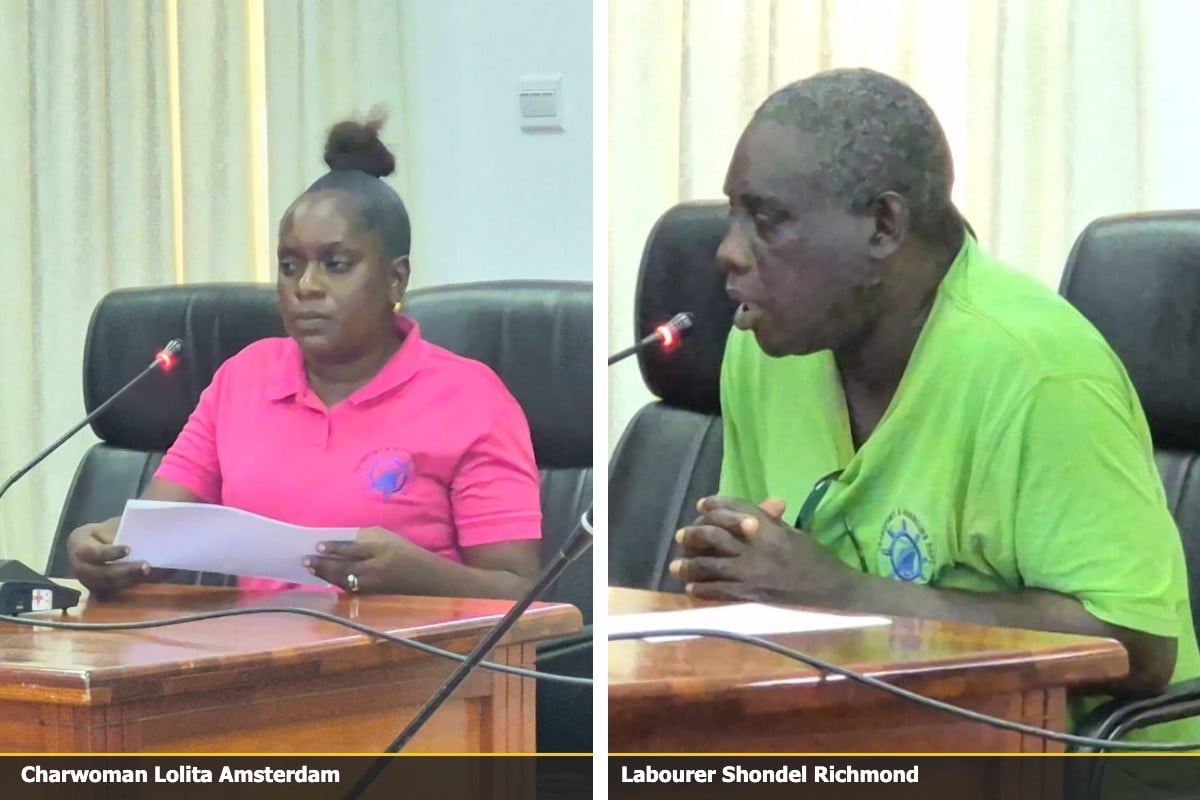
Transport and Harbours Department (T&HD) workers took advantage of moments when supervisors were not watching to allow people aboard the MV Barima without going through the proper procedures, a longtime employee testified at the Commission of Inquiry into the July 2026 tragedy.
Charwoman Lolita Amsterdam told the Commission yesterday that while there were strict systems in place for boarding the vessel, some ordinary employees would disregard those procedures when supervisors were not looking.
“When the supervisor’s back is turned, they would be doing their own things,” Amsterdam said, when questioned about how people could get aboard the vessel without passing through the established system.
Asked to explain what she meant, Amsterdam said some staff members would facilitate people getting onto the vessel without following the required procedures. However, she declined to identify those employees, saying she feared the consequences of naming colleagues. “I have to walk home. I don’t want nobody knock me down,” she told the commissioners.
Amsterdam, who has worked with the department for 17 years, including nine years at the Goods Wharf, said she was not accusing supervisors or superintendents of being involved in the alleged practices. Rather, she pointed to ordinary staff members.
When asked specifically whether supervisors and superintendents were involved, she said they were not, adding that the conduct involved ordinary employees.
The commissioners also questioned her about how cargo could be taken aboard the vessel without being recorded in the official books. Amsterdam, however, said she could not explain how that was done, insisting that cargo handling was not part of her duties.
Her testimony came as the commissioners sought to understand how people and cargo could get aboard the MV Barima without passing through the department’s established checks.
The commissioners pressed Amsterdam about who was responsible for overseeing operations at the wharf that morning, particularly in light of questions about how people could have boarded without tickets.
At one point, the Commission referred to reports that approximately 45 people had passed through the system without tickets and sought to establish who might have facilitated this. Amsterdam did not identify any individual.
The commissioners then read out several staff members’ names and asked whether they had been involved.
Earlier in her testimony, Amsterdam said she had observed bags of potatoes, onions, garlic and other goods occupying the passenger seating area when she boarded the MV Barima at around 9 a.m. on July 18 to purchase food from the canteen.
She said some of the goods were on passenger benches and others were on the floor, prompting her to question where passengers would sit. Amsterdam said she reported the matter to Goods Superintendent Delon Granderson, who told her he would address it immediately.
When she returned to the vessel around midday, she noticed that a significant amount of the cargo had been moved onto the arch cover at the front of the vessel. She said it was the first time in her nine years at the Goods Wharf that she had seen goods stored in that manner in the passenger accommodation.
Weighing started recently
Meanwhile, also testifying yesterday was Shondel Richmond, a T&HD labourer who told the Commission that while he assisted with packing perishable goods aboard the MV Barima on Friday, July 17, 2026, he had no knowledge of the actual loading of the vessel’s hatch.
Richmond, whose duties included cleaning the wharf compound and assisting with the movement of goods, said he was asked by the acting floor supervisor to help pack goods on a pallet for transfer to the vessel.
Richmond said that at the time he assisted with the packing, the goods were not being weighed. He indicated that weighing had only started recently, suggesting that there had previously been no weighing process at that stage of the operation.
He also explained that one of his responsibilities was taking water and ice to workers involved in loading the vessel. He would transport these supplies by bicycle to an area where they could be collected by the workers. However, Richmond said he could not describe how the workers loaded the hatch, as he simply left the water and ice for them before returning to his duties on the compound.
He confirmed that he did not board the MV Barima on Saturday, July 18, the day of its final voyage, and therefore could not speak to what took place aboard the vessel that day.








Discussion