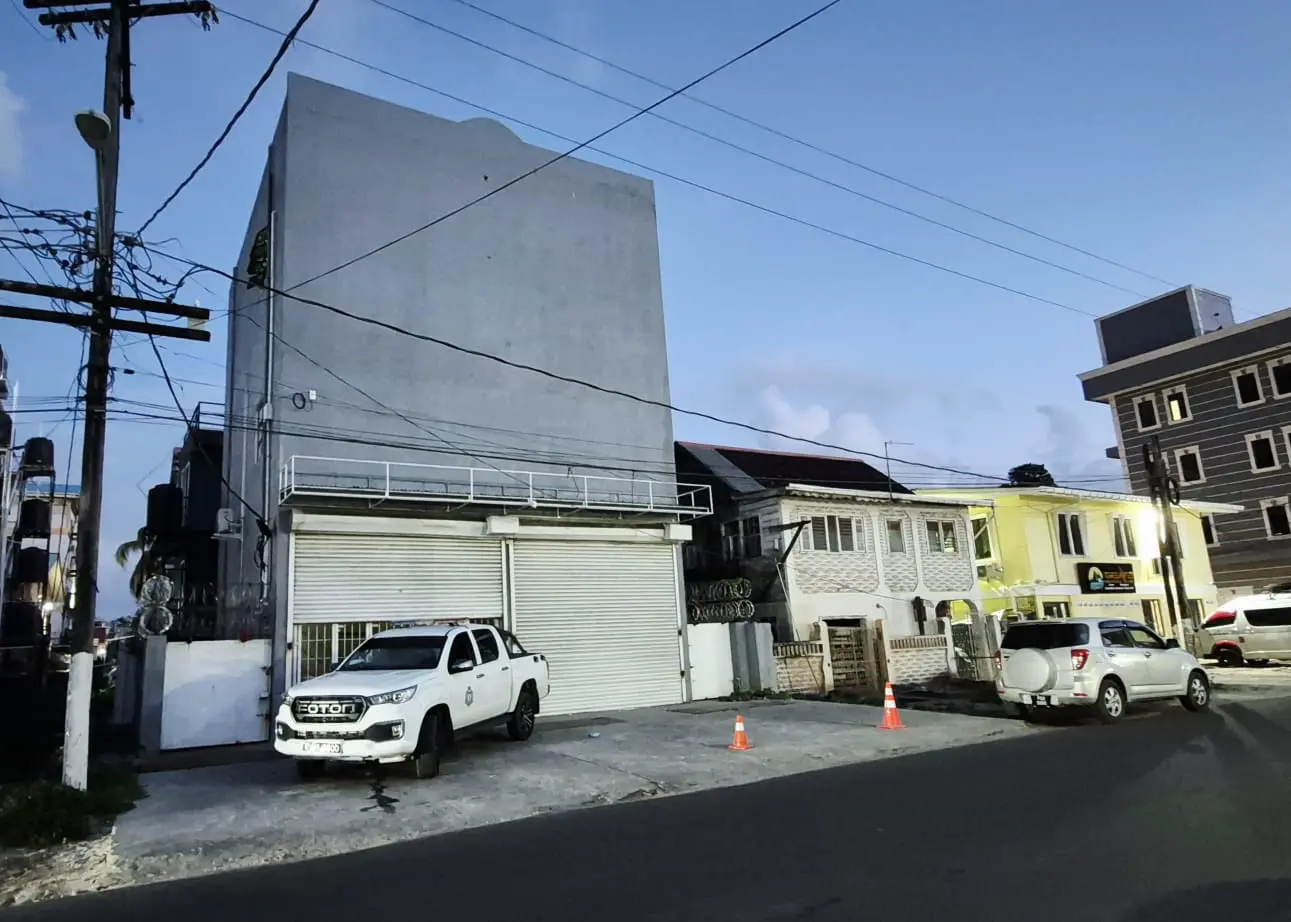
A suspected gold refinery operating inside a three-storey building in central Georgetown has brought attention to vulnerabilities in Guyana’s gold trade, with a new international investigation warning of widespread under-declaration, cross-border smuggling and weaknesses in the monitoring of the sector.
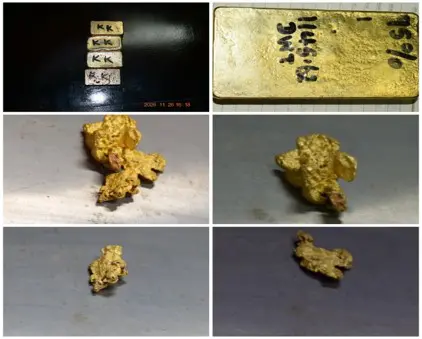
The discovery at Lot 179 Albert Street was made during a coordinated operation by the Special Organised Crime Unit (SOCU) and the Guyana Geology and Mines Commission (GGMC) last Thursday. Officers seized more than 106 ounces of suspected gold, valued at approximately $75.2 million, along with local and foreign currencies and equipment used in gold testing and processing.
The discovery comes against the findings of a November 2026 report, Following Guyanese Gold: Illicit Gold and Financial Flows in Guyana, which describes a gold sector vulnerable to illicit activity because of weak oversight, limited transparency and inadequate checks along the supply chain.
The report was a joint effort involving the Global Initiative Against Transnational Organized Crime (GI-TOC) and SWISSAID, which contributed to its research, analysis, drafting and review. It draws on more than 18 months of desk research, five weeks of fieldwork, more than 90 interviews with people directly involved in or with first-hand knowledge of Guyana’s gold sector, and a review of hundreds of documents.
No individual authors are identified as the report’s acknowledgements explain that the identities of confidential sources, local informants, journalists and civil society partners were withheld because of the sensitivity of the subject and the potential for reprisals.
Among its key findings, the report states that Guyana’s declared gold production fell by 32 per cent, from 19.7 tonnes in 2019 to 13.5 tonnes in 2024, despite record international gold prices and reports of increasing numbers of miners.
While the Bank of Guyana attributed the decline partly to weather conditions and labour shortages, the researchers said under-declaration appeared to play a much larger role. More than 30 interviewees reportedly said official declarations were significantly lower than actual production, with some estimating that declarations represented about half of real output.
The report identified smuggling by traders and dealers as the main driver of the decline in official figures. It also highlighted a significant discrepancy in international trade records: between 2018 and 2024, the United Arab Emirates reported importing 12.6 tonnes more Guyanese gold than Guyana declared as exports to that country.
The researchers said this suggested parallel, unofficial flows of gold. The report also traced alleged movements of Guyanese gold through Brazil and, in some cases, onwards to Venezuela, identifying the Brazilian city of Boa Vista as an important logistics and processing hub.
The investigation further raised concerns about the way gold is traded within Guyana, noting that transactions are often cash-based or conducted through informal payment arrangements. It said unlicensed traders can attract miners by offering better rates and immediate payment, while inadequate supply-chain and customer checks leave opportunities for illicitly mined gold to enter formal channels.
The report also points to the difficulty of establishing the origin of gold once it has been melted or mixed with other supplies. It says illicit and legally produced gold can be combined along supply chains, particularly at trading hubs, making its original source harder to determine.
The discovery of a suspected refinery in central Georgetown raises questions about the source of the gold being processed there and the extent to which authorities can trace gold moving through private trading and refining operations. However, SOCU has not indicated that the refinery is connected to any of the specific smuggling routes or trade discrepancies identified in the report.
SOCU operation
In its statement, SOCU said the operation was conducted between noon and 3:30 p.m. on November 26, with searches carried out at Hotel-Sofia, Lot 166 Charlotte Street, and the three-storey building at Lot 179 Albert Street.
The unit identified Venezuelan national Andres Antonio Fernandez Sota, a tenant at Hotel-Sofia, as the alleged mastermind of the suspected operation.
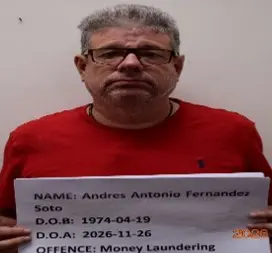
SOCU alleged that Fernandez Sota, together with other Venezuelan and Brazilian nationals, operated an illicit gold-trading business from an office on the lower flat of the hotel, while the refinery and jewellery-making operation were housed at the Albert Street premises.
One Guyanese, three Brazilians and five Venezuelans were detained in connection with the investigation.

In addition to the 106 ounces, 13 pennyweights and three grains of suspected gold, officers seized US$4,811, G$2,655,010, five euros, 50 pesos, 56 Brazilian reais and an unspecified amount of Indian rupees.
Several electronic devices, financial records and travel documents were also taken.
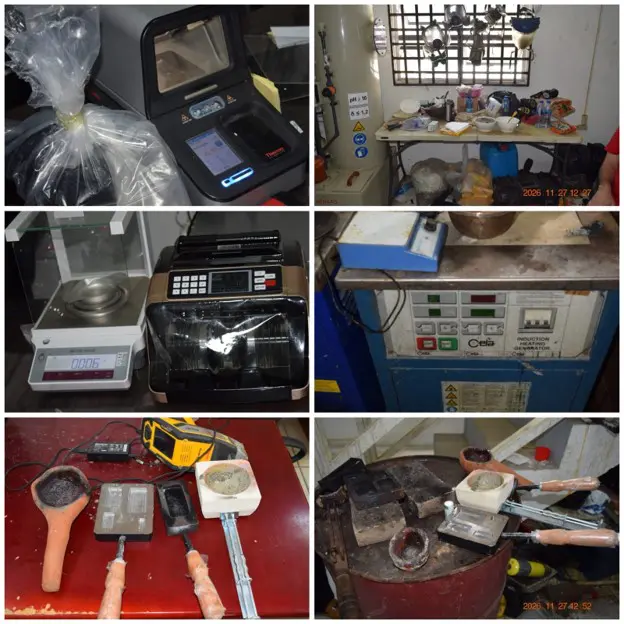
SOCU said officers found gold-testing equipment, a smelting furnace, a gas torch, containers of chemicals, a fume-extraction system, a slag skimmer, digital weighing scales, a graphite ingot mould and other equipment at the Albert Street building.
The building and its contents were photographed and secured, while the refinery was shut down. When Kiskadee Watch visited the Albert Street premises yesterday, police ranks were stationed outside the three-storey building, maintaining a visible presence at the location following the discovery of the suspected illegal gold refinery.
An officer on duty, while declining to provide further details about the ongoing investigation, told this publication that the police presence was necessary to monitor activities at the building. The officer did not indicate how long the security detail would remain in place or whether any further searches were expected to be conducted.
Fernandez Sota and the eight other persons were questioned and remained in custody assisting with investigations. SOCU said the recovered materials were tested, secured and lodged, and that investigations were continuing to establish the circumstances surrounding the gold and cash seized.
The unit described the operation as part of a national strategy to dismantle criminal networks involved in gold smuggling and organised crime, and said it remained committed to investigating and prosecuting those involved in the unlawful movement of precious minerals and money laundering.
Home Affairs Minister Oneidge Walrond declined to comment on the issue when contacted by this publication yesterday.
Meanwhile, the report recommends stronger mining-sector governance, improved transparency in licensing and ownership records, more effective supply-chain checks and tighter financial controls on gold-related transactions. It also calls for greater international cooperation to address illicit gold flows.
The SOCU investigation remains ongoing, and the authorities have not publicly established the origin of the gold seized at the suspected refinery.
The gold trade has also become entangled in mainstream politics here with Opposition Leader Azruddin Mohamed and his father Nazar Mohamed the subjects of extradition proceedings by the United States to answer a series of charges connected to the shipping of gold.
US authorities seized a US$5.3m consignment of gold bars shipped from Guyana by Mohamed’s Enterprise on June 11, 2024, the same day that sanctions were applied by the US Department of the Treasury against Nazar Mohamed and his son Azruddin Mohamed.
The indictment said that from approximately 2017 to approximately 2024, the two men caused shipments through Miami with at least ten thousand kilograms of gold to be exported without payment of Guyanese taxes and royalties, causing a loss to the Guyanese authorities of approximately US$50 million. The two men have denied wrongdoing.
In December last year, Azruddin Mohamed alleged that illicit dealings in gold were continuing and that one major player was being paid in a cryptocurrency which is not traceable.
He alleged that a major dealer based in Essequibo was continuing to smuggle gold and was being paid via the cryptocurrency USDT which he said is not traceable. He said that Chinese interests then purchase this cryptocurrency.
The backdoor gold trading, Mohamed said, means that US dollars are not coming into the economy in the quantities that they should.













Discussion