
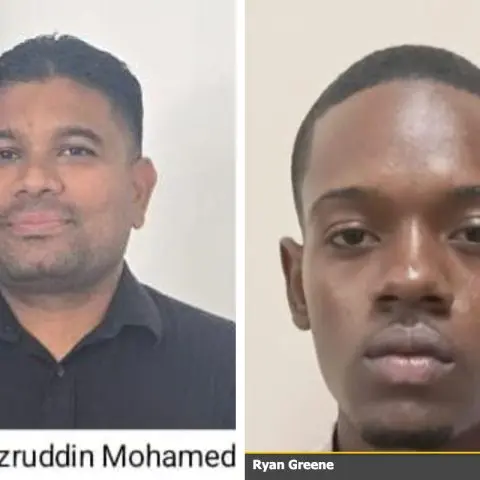
Opposition Leader Azruddin Mohamed yesterday called for Caribbean Court of Justice (CCJ) President, Justice Winston Anderson to be excluded from a proposed review of allegations concerning the administration of the regional court.
The Regional Judicial and Legal Services Commission (RJLSC) announced on Monday that it would undertake a “transparent and independent review” of allegations concerning the administration of the CCJ and the independence of its judges.
However, Mohamed’s office pointed out that Justice Anderson is also chairman of the RJLSC, the body proposing the review.
“Justice Anderson must therefore be completely recused from every aspect of this process,” the Office of the Leader of the Opposition said in a statement.
It said Justice Anderson must play no direct or indirect role in selecting the investigators, setting the terms of reference, deciding what evidence would be examined or influencing the findings and consequences.
“Independence cannot simply be announced. It must be demonstrated,” the statement declared.
On Monday the RJLSC said it recognised the seriousness of the allegations and the importance of addressing them in a way that protects public trust in the court and the wider administration of justice in the Caribbean.
Kiskadee Watch earlier noted that Anderson’s position as chairman raises questions about how the promised independent review will be conducted. It said he would be expected to recuse himself from the commission’s deliberations and that a temporary chairman would have to be appointed.
The RJLSC, which was established in 2003 under the agreement creating the CCJ, is responsible for appointing the court’s judges and overseeing other administrative matters. It describes itself as an independent and non-political body comprising legal professionals, public service officials and civil society representatives from across the Caribbean.
The controversy erupted after the Sunday Express in Trinidad published extracts from internal correspondence in which five of the CCJ’s six sitting judges raised concerns about Justice Anderson’s leadership. The allegations include unilateral decision-making, interference with the composition of judicial panels and attempts to influence the handling of cases.
Mohamed’s office said the reported correspondence was of particular importance to Guyana because three judges had allegedly raised concerns touching on extradition proceedings involving him and his father, Nazar Mohamed.
The statement cited reports that Justice Peter Jamadar had described the working environment at the court as increasingly “toxic” and alleged an attempt to influence colleagues during deliberations in the Mohamed matter.
It also referred to reported comments by Justice Chile Eboe-Osuji describing the court’s administration as a “dictatorship” and alleging that Justice Anderson intended to announce a decision in the Mohamed case at a time and in a manner opposed by a majority of the judges.
Justice Arif Bulkan was quoted in the correspondence as stating: “If a President could overrule a majority there is no need for a panel.”
According to the opposition statement, Justice Bulkan also warned in relation to the proposed procedure in the Mohamed appeal: “If we were to continue along this anti-democratic path, the very survival of this institution will be threatened.”
The opposition leader’s office acknowledged that the allegations had not been proven and said their existence did not by itself establish that the eventual decision in the Mohamed appeal was wrong.
“That is precisely why a genuinely independent investigation is indispensable,” it said.
It called on the RJLSC to disclose who would conduct the review, its terms of reference and timetable, whether the judges would be interviewed and whether its findings would be published. It also sought an assurance that all emails, communications and records relating to the controversy, particularly the Mohamed proceedings, would be preserved and examined.
“The Office does not demand a predetermined conclusion. It only demands the truth,” the statement said.
Mohamed’s office also criticised Attorney General Anil Nandlall SC and the Bar Council of the Bar Association of Guyana over their responses to the controversy.
The Bar Council had condemned the disclosure of the confidential judicial correspondence while declining to address its contents. Mohamed’s office acknowledged the importance of confidentiality but asked: “Do Guyanese litigants have rights?”
“For Azruddin and Nazar Mohamed, this is not an academic discussion about judicial administration. Their liberty and future are directly engaged by extradition proceedings,” it said.
Meanwhile, Jamaica’s Senate President Tom Tavares-Finson KC has said the current controversy makes it reckless for Jamaica to adopt the CCJ as its final appellate court.
According to Nationwide Radio Jamaica, Tavares-Finson said the reported allegation of manipulation in the selection of judicial panels was the most troubling of the claims and must be treated seriously.
He called for a public inquiry, saying nothing less would be adequate to address the issues now confronting the court.
Tavares-Finson also challenged Jamaica’s opposition People’s National Party to say whether it still maintained that the country’s transition to a republic must be accompanied by the adoption of the CCJ as its final appellate court.
Jamaica currently retains the United Kingdom-based Judicial Committee of the Privy Council as its final court. Guyana abolished appeals to the Privy Council in 1970 and in 2005 adopted the CCJ as its final appellate court.










Discussion