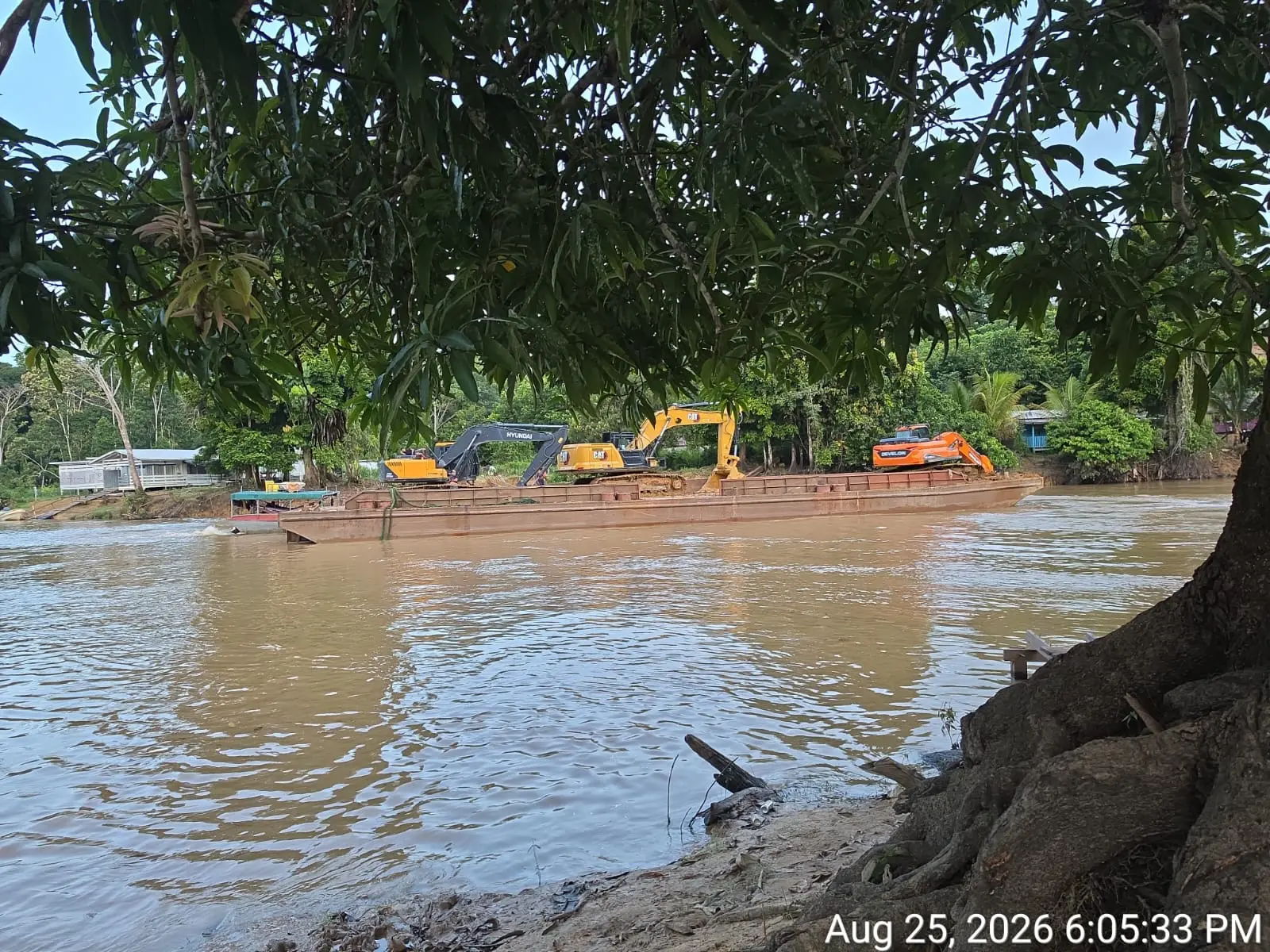
-Vieira maintains mining rights allow access
Former Chinese Landing–Tassawini Toshao Orin Fernandes says businessman Wayne Vieira cannot simply move mining equipment through the Indigenous community to access his mining properties without first seeking permission from the Village Council, as residents continue to block equipment from entering the area.
Fernandes, speaking in the context of the ongoing dispute in the village, told Kiskadee Watch on Thursday that the community has no objection to finding a way forward with Vieira but believes the businessman must engage the village and respect its authority over access through its lands.
“He’s not coming to a mutual conclusion where villagers and him can work together. We would never have been here today. He is doing according to what he feels like,” Fernandes expressed, acknowledging that even as Vieira has mining rights, this does not give him unrestricted access through the village.
“He is saying the Act doesn’t apply to his concession. He has a right to take the equipment there, but he was supposed to seek permission from the Village Council,” Fernandes said, adding, “You can’t just walk in someone’s yard. He has to pass through our land to get to his location.
The former Toshao said the community has experienced bullying over the years and wants greater accountability from persons conducting activities in the area. “From time to time we have been bullied. Eye pass nah do,” Fernandes said, adding that residents do not want persons operating in the community without proper accountability.
Fernandes also questioned the fairness of the 1998 agreement between Vieira and village representatives. “Vieira is not being fair to the village. Even this 1998 agreement signed by the Toshao, it was not fair because the people couldn’t read and write properly. It’s really sad,” he said.
Upheld
Vieira, however, maintains that the mining rights were lawfully acquired and that his position has already been upheld by the courts.
In a response on the matter, Vieira said he acquired the Tassawini mining rights for US$100,000 at public auction in 1995 and subsequently entered into a written agreement with representatives of Chinese Landing in 1998.
According to him, the agreement provided for employment, assistance with a school and medical services and a 1% royalty or tribute to the community. In return, he said, he was granted sole and exclusive possession for mining purposes for the life of the mine, along with authority to enter the property and bring in mining equipment.
Vieira is further arguing that his mining rights predated the Amerindian Act 2006 and therefore were not subject to the provisions of Section 48 of that legislation in the manner claimed by the Guyana Geology and Mines Commission (GGMC).
He said the dispute reached the Caribbean Court of Justice (CCJ) after the GGMC issued a Cease Work Order in 2010, and that in 2017 the CCJ allowed his appeal and restored a High Court decision quashing the order. The courts, he said, established that the Amerindian Act could not retrospectively extinguish his pre-existing vested mining rights or replace the 1998 agreement.
Fernandes, meanwhile, said on Thursday that the GGMC bears significant responsibility for the present dispute. He recalled that the mining blocks had been offered through a lottery process and that Vieira secured them by submitting the highest bid. He also pointed to the community’s land titles obtained in 1976 and its absolute grant issued in 1991.
Fernandes said the village has sought to negotiate a new agreement rather than continue operating under the 1998 arrangement. “The two parties can have a mutual understanding and way forward. The government and agencies have to be involved,” he said.
“We drafted a new agreement rather than accepting that old one. We used the Amerindian Act in this one,” Fernandes explained.
Under the proposed arrangement, the community is seeking an increase in the royalty from the existing 1% to 10%, with 7% described as the minimum, while also addressing access and entry protocols for mining operations.
Vieira, though, is saying that between 2004 and 2010, foreign investors invested approximately US$24 million in exploration and development, establishing an estimated gold resource of more than 500,000 ounces. He argues that the resource was developed through private investment and not by the Village Council.
Vieira also rejects the suggestion that he is seeking to exclude Chinese Landing residents from economic participation. He said that in 2026, arrangements were proposed under which 20 residents could participate directly in lawful mining operations under conditions acceptable to the GGMC. Ten residents accepted, he said, and he purchased dredging equipment for their use.
The businessman also maintains that four excavators and a bulldozer registered with the GGMC were brought into the area for mining and rehabilitation works, including roads and the Tassawini airstrip, but were obstructed from proceeding into Tassawini.
Vieira argues that the dispute should not be framed solely as a clash between Indigenous rights and mining rights, insisting that both must be respected.
Fernandes similarly called for government intervention and a negotiated solution.










Discussion