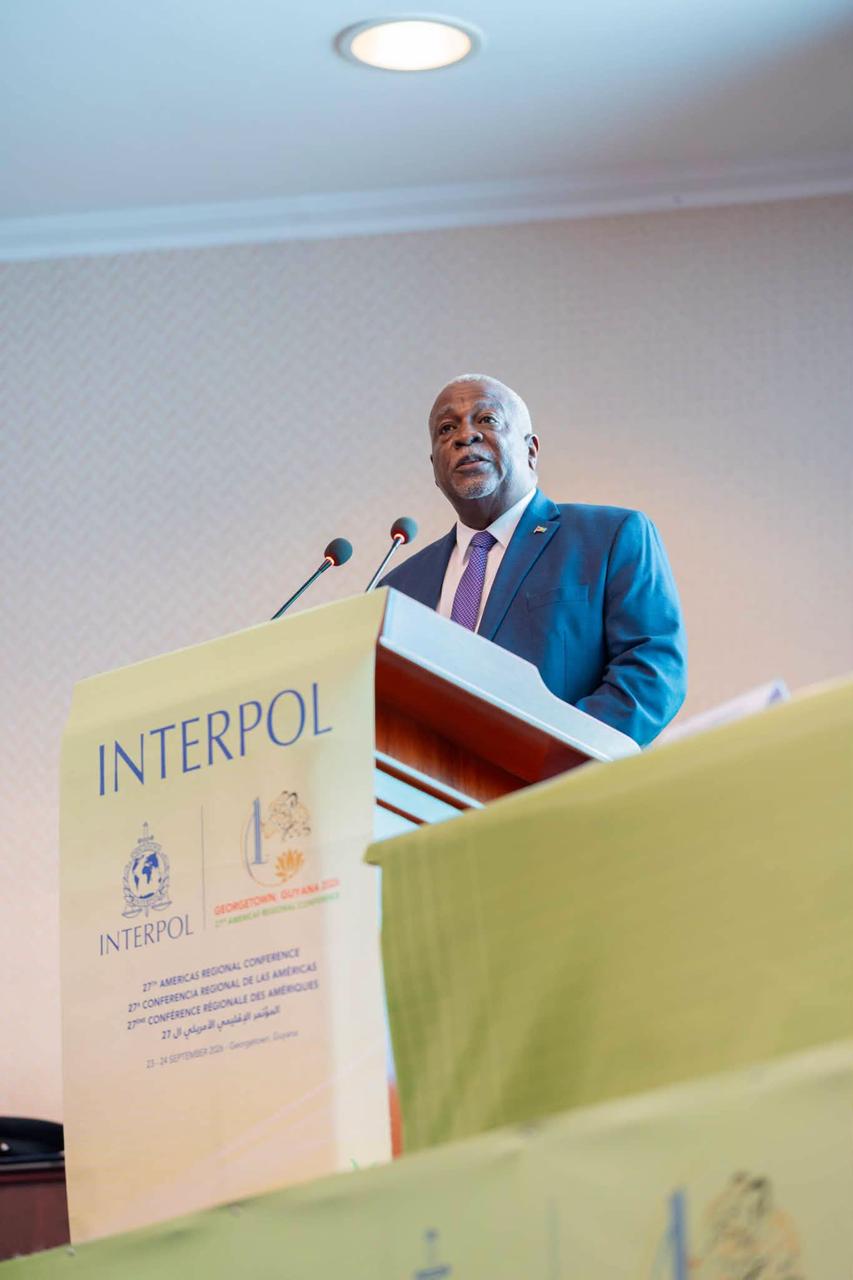
Information gathered through international police cooperation must reach the officers who can act on it in time to make a difference, Prime Minister Mark Phillips told the INTERPOL Americas Regional Conference on Wednesday.
Opening the two-day meeting at the Arthur Chung Convention Centre, Lilendaal, Phillips warned that criminal organisations could move people, money and illicit goods across several jurisdictions before investigators established the connections between their cases.
“Once an investigation crosses a national boundary, any delay can shift the advantage to the offender and place justice further out of reach,” he said.
He said INTERPOL’s secure communications network, notices and diffusions could help an officer checking a person at a border or police station discover a connection to an investigation elsewhere. Such systems would be effective only if the information was accurate, available when needed and used in accordance with the law, he added.
“Intelligence cannot protect the public when it fails to reach the official required to act upon it,” Phillips said.
He cited December’s Operation Guyana Shield as an example of coordinated action. Authorities in Guyana, Brazil, French Guiana and Suriname conducted more than 24,500 checks and made 198 arrests during the operation against illegal gold mining and related crime, according to INTERPOL. Phillips said its importance lay not only in those results but in showing that authorities could pursue criminal activity spanning several territories when they worked together.
Phillips also referred to Guyana’s extradition of Harry Narine Rajkumar to Canada in February 2025. Rajkumar had been arrested following an INTERPOL Red Notice, and the extradition allowed him to face criminal charges there.
Those examples did not remove weaknesses in the system, Phillips said. Intelligence could be delayed by poor coordination or uncertainty about which agency had authority to act. He called for clearer channels among the police, immigration authorities, the Customs Anti-Narcotic Unit and their overseas counterparts.
He placed particular emphasis on safeguards. Information shared by another country had to be protected and used lawfully if partners were to trust one another, he said. Governments had to respond to organised crime while remaining accountable for the powers they exercised.
Phillips asked delegates to use the meeting to identify obstacles to cooperation and settle how an officer handling an urgent case could obtain help from another jurisdiction. A conference agreement, he said, would have value only if it led to a faster response when a real investigation crossed a border.









Discussion