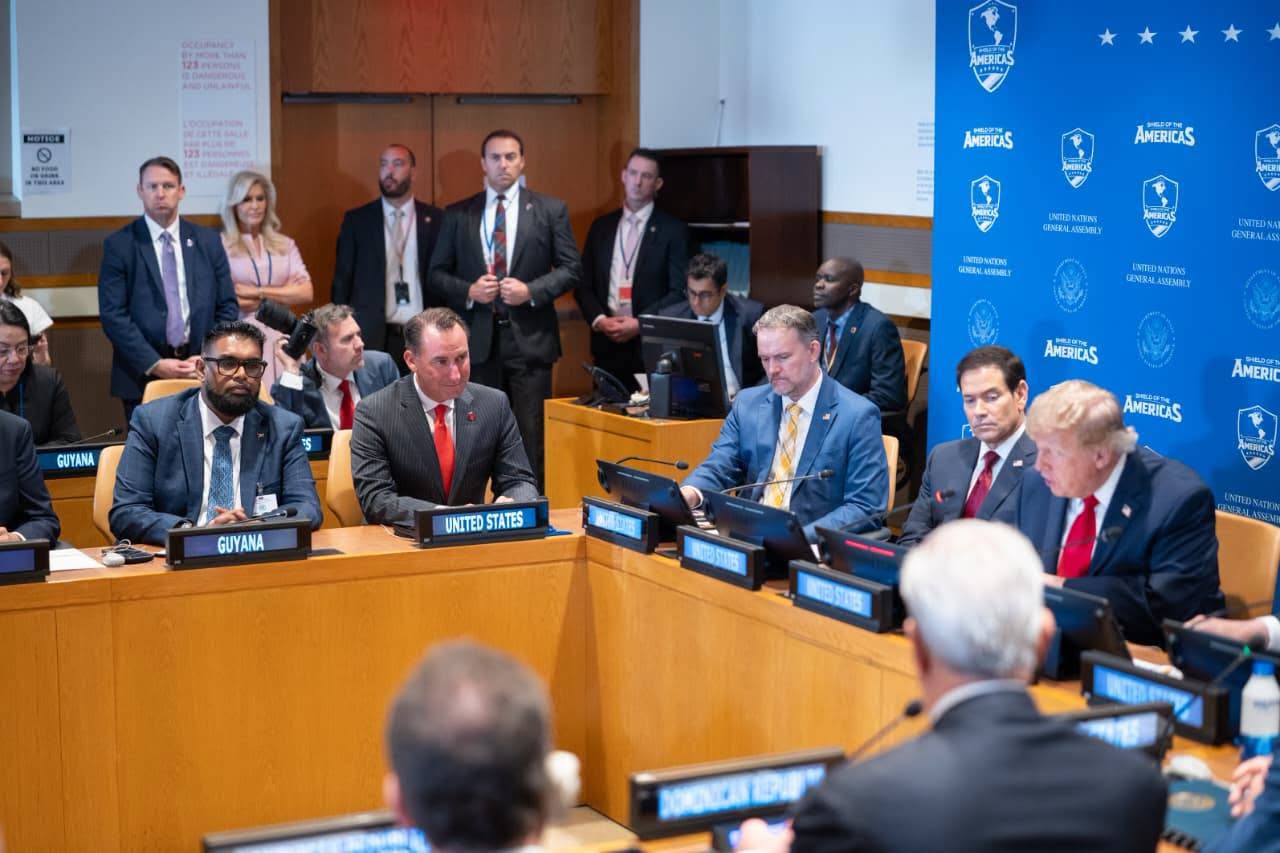
-as part of US-led Shield of the Americas
Guyana has joined the United States and 13 other countries in declaring their intention to impose asset freezes and immigration and visa restrictions against members and supporters of 24 organisations labelled as “narco-terrorist” groups, according to a joint statement issued yesterday.
The statement, titled Joint Statement on Defending Hemispheric Sovereignty, was issued following a meeting of the US-led Shield of the Americas on the sidelines of the United Nations General Assembly in New York.
Apart from Guyana and the US, the statement was issued in the names of Argentina, Bolivia, Chile, Colombia, Costa Rica, the Dominican Republic, Ecuador, El Salvador, Honduras, Panama, Paraguay, Peru and Trinidad and Tobago.
President Irfaan Ali attended the meeting with US President Donald Trump, Secretary of State Marco Rubio and other participating leaders.
Ali had disclosed on his Facebook page that the meeting adopted a communiqué based on three pillars—economic, security and multilateral coordination—but provided no details of the proposed sanctions or collective action.
The statement, subsequently published by the US Department of State, said the participating governments intended to take individual and collective action against transnational criminal organisations.
The proposed measures include asset freezes and immigration and visa restrictions targeting members, associates and supporters of the listed organisations. The governments also declared their intention to impose criminal liability on persons who knowingly provide material or logistical support to those groups.
The statement repeatedly qualifies the commitments as being subject to the international and domestic legal obligations of the participating countries. It is therefore unclear what additional legislative or administrative steps Guyana may have to take to implement the measures.
The 24 organisations – mainly based in Mexico, Venezuela, Colombia, Peru and El Salvador – include Mara Salvatrucha, commonly known as MS-13; Tren de Aragua; the Sinaloa Cartel; the Jalisco New Generation Cartel; the Gulf Cartel; Cartel de los Soles; Clan del Golfo; Colombia’s National Liberation Army; FARC dissident groups; Primeiro Comando da Capital; Comando Vermelho; and Shining Path.
Gangs operating in Haiti and Ecuador, including Gran Grif, Viv Ansanm, Los Lobos, Los Choneros, Chone Killers and Los Tiguerones, are also on the list.
Under the security pillar, the participating countries intend to coordinate sanctions, terrorist designations and other financial action while expanding civilian law-enforcement cooperation.
They have also agreed to strengthen intelligence sharing, facilitate access to security technologies and capabilities, increase training and exchange best practices.
The governments propose asking the Permanent Council of the Organization of American States to convene a meeting to consider establishing an Organ of Consultation under Articles 6 and 13 of the Inter-American Treaty on Reciprocal Assistance, also known as the Rio Treaty.
If convened, participating countries intend to meet at the ministerial level to consider a resolution promoting collective action against the listed organisations.
Countries participating in the Shield which are not parties to the Rio Treaty have nevertheless declared their support for the initiative and said they would contribute within the limits of their domestic and international legal obligations.
The economic component of the statement extends beyond drug trafficking and law enforcement.
Mineral supply
The countries intend to explore mechanisms for screening investments, safeguard critical mineral supply chains through diversified sourcing and promote “trusted supplier” regulations for digital infrastructure.
The statement does not identify any country or company against which these investment-screening or supplier provisions are directed. It said the regulations should be applied on a non-discriminatory basis.
The governments also declared that capital entering their countries should be “transparent and verifiable”.
The multilateral pillar provides for closer consultation and coordination of common positions in regional and international bodies. It also speaks of pursuing reforms to multilateral organisations and coordinating international enforcement action against transnational criminal groups.
The Shield of the Americas was launched by Trump at a summit in Florida in March. Ali and Trinidad and Tobago Prime Minister Kamla Persad-Bissessar were the only CARICOM leaders at that meeting.
Stabroek News reported that Trump told the gathering that the initiative’s central commitment involved the use of military force against cartels and terrorist networks.
Since the March summit, security cooperation between Georgetown and Washington has deepened.
Kiskadee Watch reported last month that Guyana and the US signed an enhanced memorandum of understanding covering narcotics trafficking, human trafficking, money laundering and other forms of smuggling.






Discussion