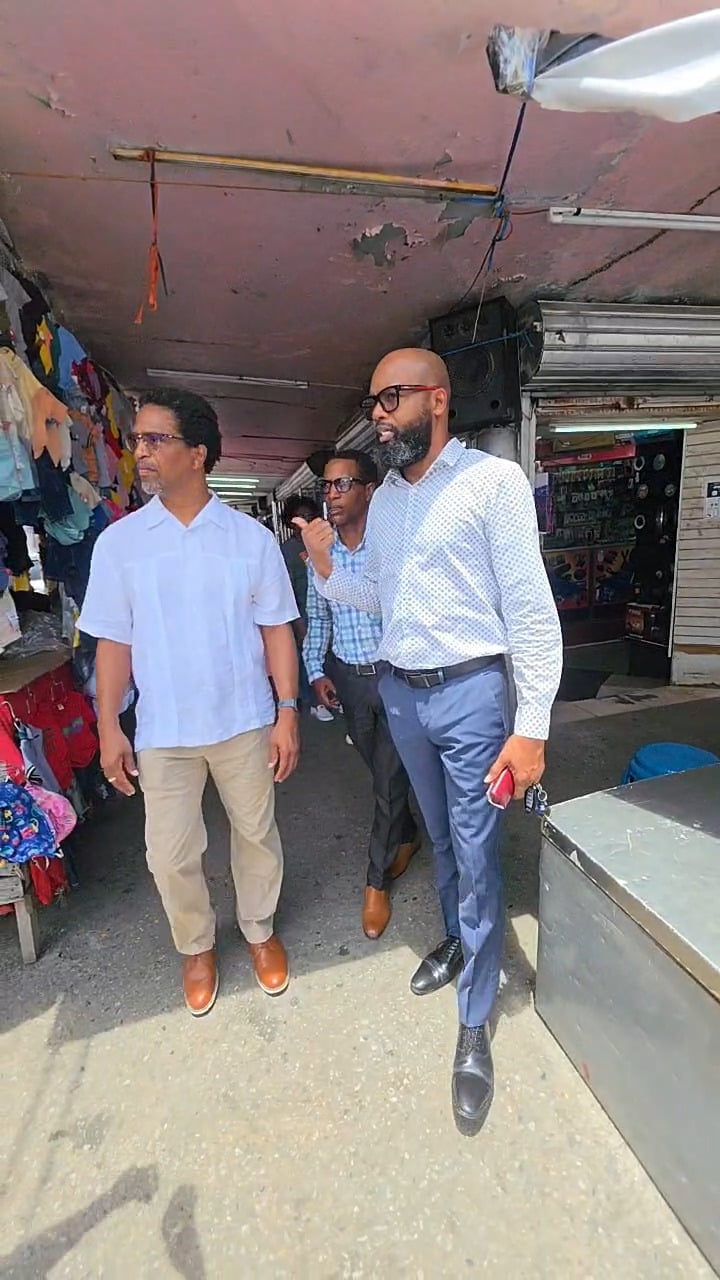
Vendors and small business operators along Regent Street and at the Bourda Market complained of sluggish sales and rising costs during an almost three-hour walkabout led by APNU parliamentary leader Dr Terrence Campbell and MP Saiku Andrews.
The engagement, broadcast live on Campbell’s Facebook page on Monday, formed part of what the APNU representatives said would be a countrywide exercise to hear directly from citizens and businesses about the cost of living and other economic pressures.
At the start of the broadcast, Campbell said the opposition wanted to engage citizens about the cost of living, which he described as the country’s biggest challenge. He said particular attention would be paid to small business operators and entrepreneurs struggling to earn a living amid rising prices.
Andrews said it was important for the opposition to engage directly with citizens and referred to what he saw as a sense of exclusion among people who were not benefiting from the country’s economic growth. He said women and small business operators would be among the groups approached during the exercise.
Campbell said the initiative would not be confined to Georgetown and that the APNU representatives intended to visit communities across the coastland and hinterland, where residents faced their own far-reaching problems.
“We will walk the entire country and listen to your concerns,” he said. “Because the only way we can develop proper solutions to the real challenges facing the people of this country is by engaging with you directly.”
During the walkabout, Campbell said almost every vendor when asked to compare business this year with the corresponding period last year reported that sales had declined. He said the only exception was a beverage vendor, who offered an explanation for why his trade was performing differently.
“To get 100% of the people that we were meeting saying that things are slow is troubling,” Campbell said.
The exchanges were informal and no sales records or other evidence were presented to support the vendors’ assessments. However, Campbell said the responses pointed to a disconnect between Guyana’s rapid economic expansion and the experiences of ordinary citizens.
The 2026 Mid-Year Report estimated that the economy grew by 33.3% during the first six months of the year, primarily on account of oil and gas, while non-oil growth was recorded at 10.1%.
Campbell said those headline growth figures were not reflected in what vendors and shoppers told the APNU team.
“There is a disconnect,” he said, arguing that while official figures showed a rapidly expanding economy, people on the ground felt that conditions were worsening.
Several of the interactions in the live broadcast were difficult to hear because of street noise, but vendors referred to reduced customer spending and the rising cost of operating their businesses. Campbell also noted the expenses faced by households at the beginning of a new school year, including uniforms, footwear, textbooks and, in some cases, private-school fees.
Foreign currency
Campbell also spoke about difficulties obtaining United States currency through commercial banks. He said that, for the first time, he might have to purchase US dollars outside the banking system for an overseas trip because he could not obtain what he needed from his bank.

He said having to repeatedly ask a bank for foreign currency made customers feel as though they were begging. Campbell questioned how such a shortage could persist in one of the world’s fastest-growing economies and in a country earning billions of US dollars from oil exports.
During the walkabout, the duo stopped at the Commerce House Cambio on Regent Street which had its cambio rates displayed and the MP argued that businesses and travellers were being forced to pay considerably more than the official rate. He described the widening disparity as evidence that the Guyana dollar was depreciating despite the country’s increased foreign-currency earnings.
The APNU representatives also interacted with Cuban nationals during the exercise. Campbell criticised the manner in which Cubans were being treated in Guyana and said their country’s historical support for Guyana and liberation movements elsewhere should not be forgotten.
Campbell and Andrews said the exercise was intended particularly to reach women, entrepreneurs and small business owners struggling to cope with higher costs. They said the concerns gathered during the outreaches would help shape the opposition’s policy proposals.







Discussion