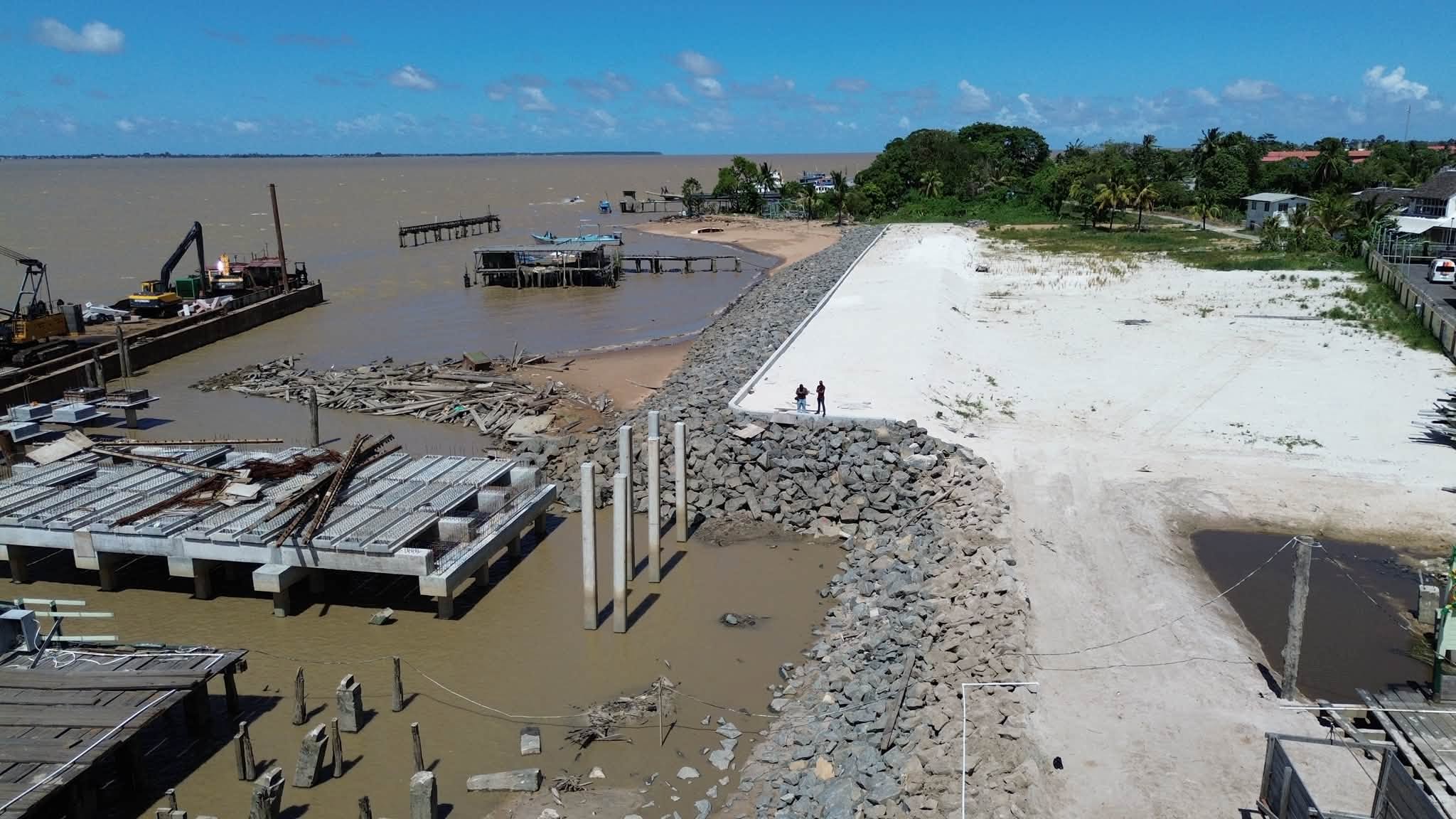
Construction of the new Parika Ferry Stelling is approximately 15% complete, while a diversion route has been completed to allow cargo exceeding 20 tonnes to again pass through the facility, Minister within the Ministry of Public Works Madanlall Ramraj has reported.
In a Facebook post following an inspection, Ramraj said river defence work had advanced significantly and the area had been sealed to protect against flooding. Pile cap work was underway ahead of the installation of precast beams. He was accompanied on the visit by Minister within the Ministry of Agriculture Vickash Ramkissoon.
The completion of the diversion follows restrictions on heavy vehicles using the Parika–Supenaam ferry service, which drew protests from truck operators in August.
Kiskadee Watch reported on August 8 that the Transport and Harbours Department (T&HD) had imposed a maximum gross vehicle weight of 20 tonnes on July 9, before further reducing it to 15 tonnes. The restrictions were linked to a damaged drawbridge at Supenaam and construction at Parika, where several beams had shifted from concrete-encased piles during piling works.
Truckers complained that the lower limit, which included both vehicle and cargo weight, made their operations unprofitable. Ramraj subsequently met truckers and businessmen and reprimanded T&HD over the lack of consultation. His latest post did not specify the maximum gross vehicle weight now permitted on the service.
Stabroek News had reported in July 2025 that the first phase of the new Parika port facility and waterfront development was valued at $5 billion. The announced work included land reclamation and sea defence north and south of the existing stelling, together with construction of the main concrete stelling. Gaico Construction, Toolsie Persaud and A&S General Contractors were identified as the contractors.
The 2026 budget allocated $2.2 billion to advance the stelling and waterfront project, with completion slated for 2028. The government’s stated plan is to develop the facility into an international port of entry and a regional hub for tourism, agriculture and shipping.







Discussion