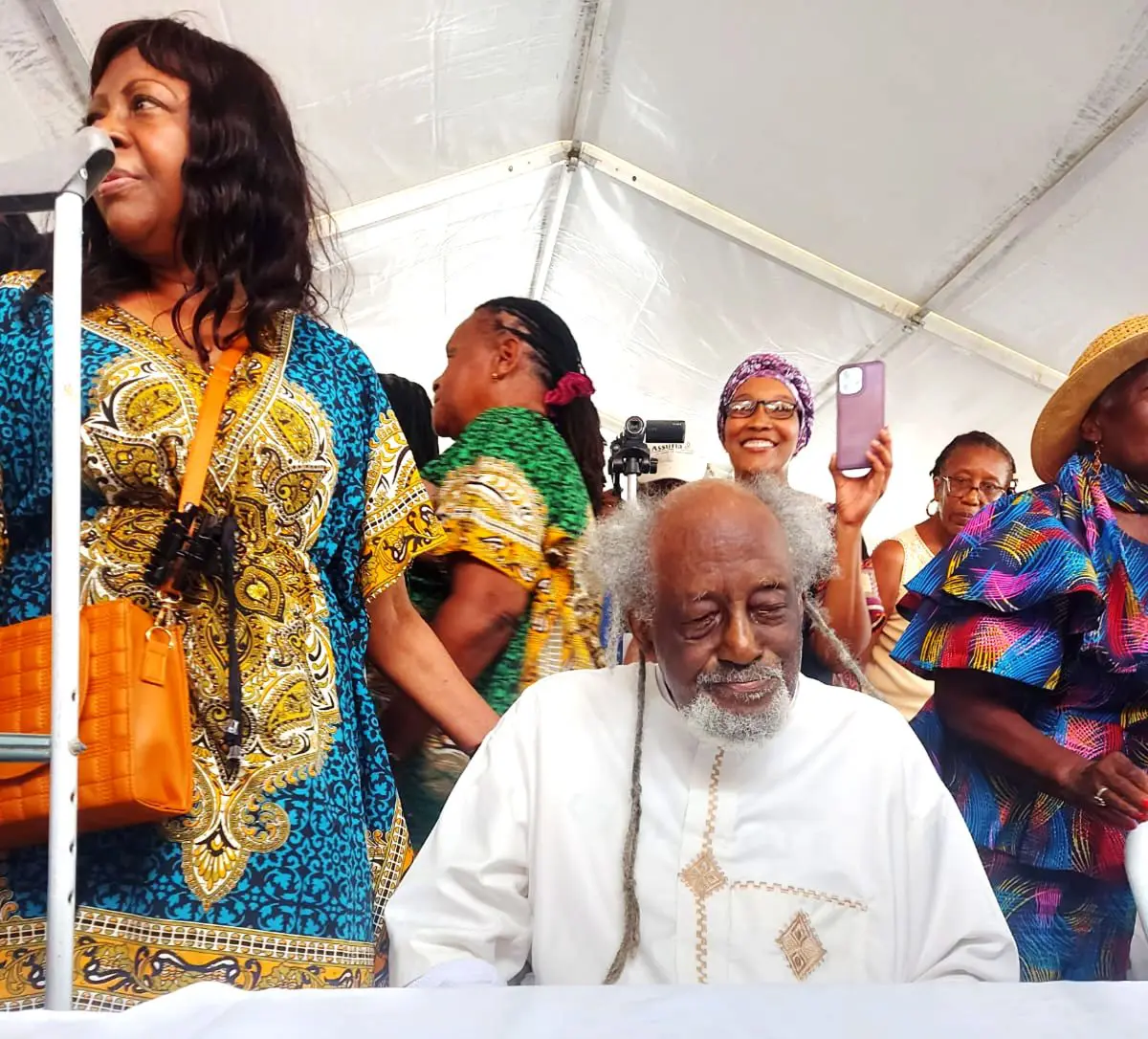
WPA: this ‘rare and special spirit walked among us with a deliberate purpose that touched the core of Guyana’
After more than eight decades in public activism during which social justice was at the centre of his work, Eusi Kwayana passed away yesterday at the age of 101, one of the last witnesses to the struggle for independence and the post-colonial period in Guyana.
Kwayana, who celebrated his 100th birthday last year in the village of Buxton with a typical call for a one-day fast for justice, has been hailed as a political leader of peerless integrity who was part of the PPP during the heady days of the 1950s before moving to the PNC following the split between Cheddi Jagan and Forbes Burnham before becoming a major figure in the Working People’s Alliance (WPA) where he was one of its premier leaders – particularly in the aftermath of the assassination of Dr Walter Rodney in 1980 – and serving it in Parliament.
A Pan-Africanist who came to be affectionately known as the `Sage of Buxton’, Kwayana was hailed for his Gandhian qualities and the equanimity with which he approached his life as politician having originally been a teacher, a vocation that never left him. Soft-spoken, Kwayana invested his time in taking up causes for those who had no access to the corridors of power.
The WPA paid a glowing tribute to him yesterday and implored the public “not to mourn Bro Eusi’s passing, but to celebrate his life and lived journey”.
In a statement, the WPA said: “Our elder, teacher, mentor, leader and inspiration has left us to go back to his ancestors. The Sage of Buxton has left this side of the river to return to the source of his spirit. His earthly duty is over. To the very end he kept the faith, cradled the civilization, protected the vulnerable, and empowered the powerless. His loss leaves an empty chair in the gallery of our Guyanese humanity.
“It is with deep sadness that the WPA joins with the Kwayana family in announcing the death of Brother Eusi Kwayana. Although we know death is inevitable and that Bro Eusi would eventually leave us, we thought this day would never come. But it is finally here. We give thanks for his life, his wisdom, his guidance and above all, his example. Guyana has lost the last of its original independence visionaries—one of Guyana’s priceless gifts to itself”.
The party said that or 101 years and six months this “rare and special spirit walked among us with a deliberate purpose that touched the core of Guyana”. Along with others and sometimes alone, the party said that he lived the Guyanese decolonization and independence narrative of freedom.
“WPA declares with certainty that our Eusi was a Founder-Pioneer of our post-colonial order. In him shone the light of the full flowering of the Guyanese, Caribbean and African fusion”, it said.
The WPA noted that in 1974 Kwayana co-founded the party and remained a committed member until his death. Within the WPA he functioned as Executive member, Member of Parliament and de facto editor of the party’s organs, Open Word and Dayclean.
“We remember Eusi as an excellent party organizer and mobilizer. Whenever the party was low on morale, we turned to him for confidence. We also remember him as a loyal party member who never compromised his integrity and independent praxis. It is for that reason that we label him the modern pioneer of the Independent Radical strand in modern Guyanese politics”, the WPA said.
While he gave 52 years of service to the party, the WPA noted that he also laboured in the valley for the original PPP and the PNC in which he served as Assistant General Secretary and General Secretary respectively. He served as a Member of Parliament and Cabinet Member in the 1953 PPP government. In addition to being General Secretary, he served as editor of the PNC’s newspaper, New Nation.
During the period 1964-71, the party said that Kwayana served as head of the National Land Settlement Committee; chairman of the Guyana Marketing Corporation (GMC); chairman of the Cooperative Insurance Committee; and chairman of a committee charged with converting the Guyana Cooperative Credit Society into a Cooperative Bank.
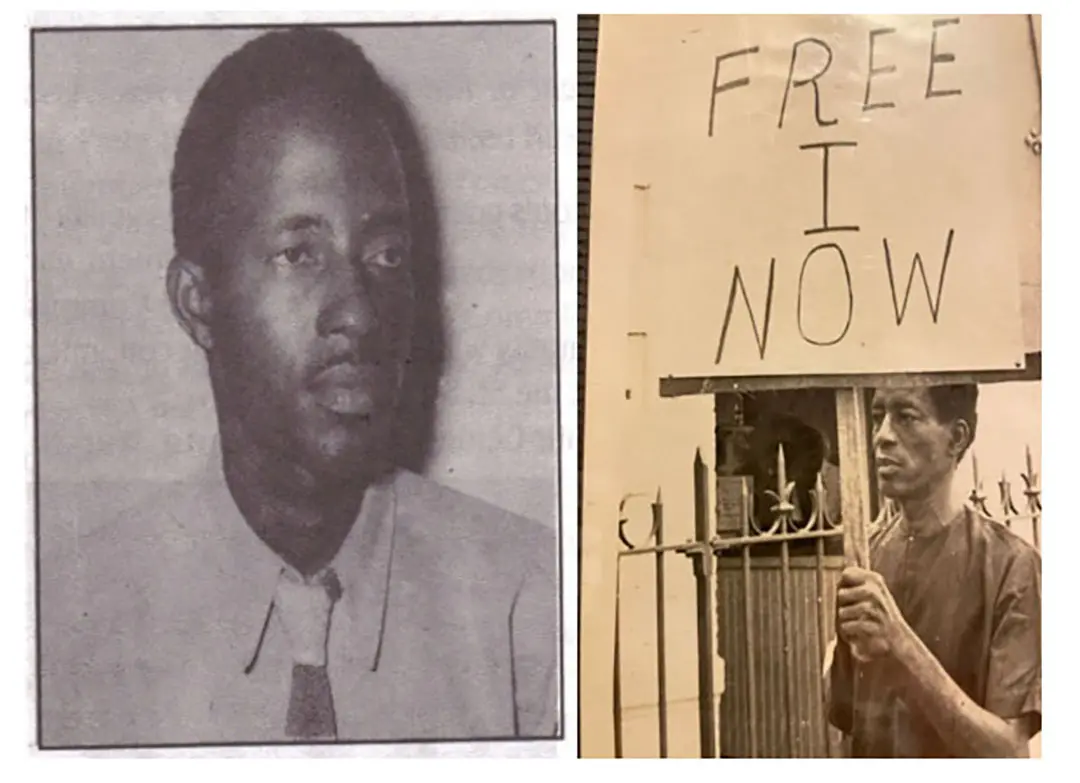
As an Africanist leader he co-founded in 1961 the African Society for Racial Equality (ASRE), which was dedicated primarily to raising cultural consciousness among African Guyanese. In 1964, the party said that he also co-founded the African Society for Cultural Relations with Independent Africa (ASCRIA), which, like ASRE, committed itself to the promotion of African pride, dignity, and culture among African Guyanese. He served as Coordinating Elder of ASCRIA and changed his name from Sydney King to Eusi Kwayana, which, in Swahili, means Black Man of Guyana.
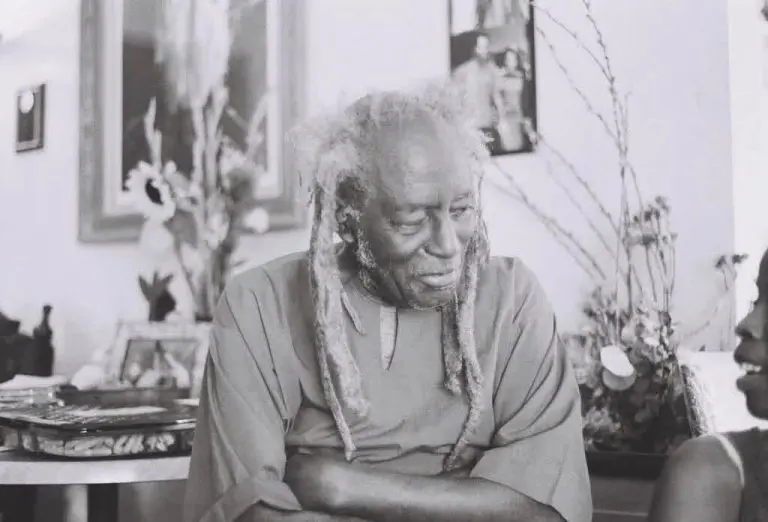
African star
“He gave everything to his country and his people. Farewell African star, Guyanese treasure and Caribbean wise man. We end this initial statement by calling on Guyanese not to mourn Bro Eusi’s passing, but to celebrate his life and lived journey”, the WPA said.
Speaking at his 100th birthday celebration last April, Stabroek News reported Kwayana as saying: “As you know, in my political activity, I have gone on hunger strikes; fasting, for various causes and reasons. Right in the Caribbean we used that weapon to draw attention and public conscience to abuses of public life.
“… Tonight, after long deep consideration I must challenge people in Guyana, who listen and are concerned about themselves and the future, I challenge them now about naming a piece of activity that they can do or join me, as I can do it and what I am talking about is … a short one day fast; a hunger strike for a maximum time of one day”.
Kwayana said then that he kept himself abreast of current affairs by listening to local news and felt that the fast was needed.
“We can’t go on doing what we do all the time… I hope that we take on the responsibility. I thought about some activity in which I can appeal to you members of the human planet … This includes freedom of action …asking you to consider taking on responsibility, in Guyana, for change for the better of Guyana. I am talking about deep change that comes from a deep place bigger than politics,” the centenarian said.
Having gone on his first hunger strike in 1953, he said, he believed that this medium of protest helped to highlight his cause. However, he told his audience that they do not have to announce they are fasting like him, but do so in earnest and from a point where they ask their divine to bless this country”, Stabroek News reported.
In an April 7, 2025 tribute in the In the Diaspora column of Stabroek News, Moses Bhagwan and Nigel Westmaas wrote that one of Kwayana’s earliest politically self-conscious memories dated back to Lusignan around 1929, when he was about four or five years old.
“He vividly recalled a woman, perhaps aged between 60 and 65, sitting in a doorway on a bench in a range yard, enjoying the warmth of the sun with her legs crossed and smoking a clay pipe. Addressing him directly, she said, `Pickney, Congo ah high nation, Congo ah high nation.’ Her words, clearly affirming African pride and heritage, emphasized that the horrors of slavery could never erase the fact that Africans originated from great and dignified civilizations. Kwayana never forgot it. Kwayana and the poet Martin Carter often rode their bicycles to and from Georgetown. On one such occasion, Carter stopped at Le Ressouvenir—a site associated with the 1823 Demerara revolt—and, in a gesture echoed in the title of one of his later poems, physically listened to the land”, they related.
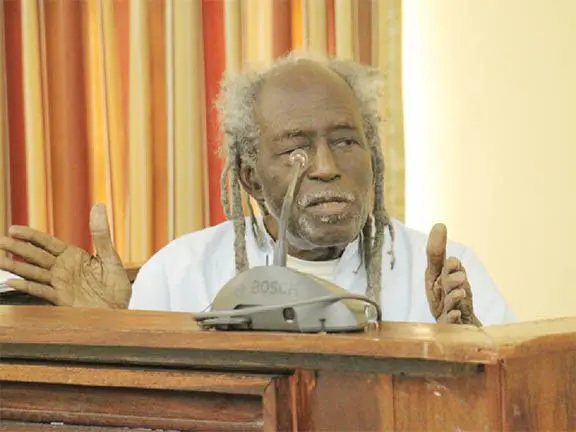
They wrote that Kwayana held the unique distinction of having composed the official songs for three major political parties in Guyana: the PPP (“O Fighting Men”), the PNC (“Battle Song”), and the WPA (“People’s Power”).
Bhagwan and Westmaas wrote that Kwayana produced hundreds of works across multiple genres—poems, critical reviews, short stories, letters to newspapers, opinion pieces, song lyrics, obituaries, court motions, parliamentary interventions (motions and speeches), editorials, political statements, essays, press releases, and plays for both theatre and grassroots events.
“His literary span stretches from The Prodigal Daughter (his first play, written in the early 1940s) to the book The Legend: Post-Emancipation Villages in Guyana, Making World History (2016), co-authored with David Hinds.
“One of his most remarkable works, Buxton-Friendship in Print and Memory, exemplifies his method—a deeply democratic respect for people from all walks of life. Published by Red Thread Women’s Press (1999), this village history illuminates the minutiae of everyday life while reinforcing Kwayana’s reverence for both the printed word and the oral tradition, the latter long marginalized in formal scholarship but deeply embedded in the cultural traditions of Guyana and the Caribbean. Kwayana also wrote several plays, including Christus the Messiah, Proclamation (on the 1823 Demerara Revolt), The King and I, and the prize-winning Promised Land (1965). During the same period, he wrote theatre reviews under the alias Kiskadee Cloud”, they wrote.
Kwayana was a prolific letter writer to Stabroek News and authored a missive to Kiskadee Watch on August 31st this year on the upholding of Donald Rodney’s appeal against his 1982 conviction.
Despite his contributions, Bhagwan and Westmaas said that Kwayana remained one of the most misunderstood figures in Guyanese political history. And no political proposal dogged him more than the call for ‘partition’ in 1961. The plan primarily advocated ‘joint and equal Prime Ministerships,’ with partition identified as a last resort. At the time, they said that Kwayana felt that it would bring equality of rights and power for Indians and Africans and attempt to end racial antagonism.
They said that Kwayana’s philosophy of multiracialism—tailored to Guyana’s unique socio-political landscape—is best captured in his celebrated 1978 speech, Racial Insecurity and the Political System. This speech, they said, laid the foundation for a self-critical assessment of racial divisions in Guyana and became integral to the WPA’s broader philosophy of multiracialism—a legacy that continues to inform contemporary debates on race and politics, even if unacknowledged. He later expanded upon this in two major analyses of the cultural contributions of Indians and Africans at the Genesis of a Nation conference held at the Pegasus Hotel in 1988.
Because of the limitations of the 5th parliament (1986-1992) and his own preferred mode of representation, Bhagwan and Westmaas said that Kwayana made the WPA office and his frequent visits to villages and the rural areas “centres of representation,” turning Parliament into a “living forum.”
“He reopened the use of citizen petitions to the National Assembly as a means of expressing grievances. Outside of Parliament, the WPA MP, helped by other WPA activists, assisted senior citizens; mothers due for social impact amelioration payments; farmers with water problems; and persons denied the reasonably prompt issue of passports. He visited the Georgetown hospital on several occasions, taking extensive notes of its deficiencies and speaking with patients. These were only a few of the representations he made”, they said.
In August 1987, Kwayana stood with protesting crowds as the kero and gas crisis unfolded.
“So long as suffering of this kind is encouraged and maintained by the government my pen will not sleep in my hand, nor will my tongue cleave to the roof of my mouth”, Bhagwan and Westmaas reported him as saying.
He was also credited with an immaculate understanding of parliamentary procedure.
“What were the origins of Kwayana’s skill in the Parliament? A likely possibility was his generation’s experience from the 1940s to the 1960s, with its ingrained knowledge of the ‘system’ when fighting British control of the legislature and colony. Cheddi Jagan, Forbes Burnham, HJM Hubbard, Janet Jagan, Winifred Gaskin, WOR Kendall, Boysie Ramkarran and others all exhibited a range of parliamentary prowess during their own shifts in the Chamber. These parliamentarians were forced to be creative and knowledgeable of the system out of sheer necessity to ensure their survival against the British constitutional and colonial system”, Bhagwan and Westmaas wrote.
Yesterday, the PNCR mourned Kwayana.
“Brother Eusi entered the political arena as a youth, dedicating his life to the struggles and aspirations of the Guyanese people. He served the People’s National Congress under the leadership of its founder, Linden Forbes Sampson Burnham, contributing his intellect, energy, and convictions to the building of our Party and the advancement of an independent Guyana.
“In the years that followed, he continued to serve the nation through the Working People’s Alliance, remaining a fearless and principled voice on matters of governance, justice, and national development. As a historian, he dedicated himself to recording and preserving our country’s story, ensuring that future generations would know the journey of our people and the sacrifices made along the way.
“Eusi Kwayana was more than a politician; he was a teacher, a chronicler, and a conscience for our nation. His life spanned generations of our political evolution, and his counsel, integrity, and unwavering commitment to principle earned him the respect of friend and adversary alike”, the party said.










Discussion