President Irfaan Ali has said an apology is the next step after King Charles III’s acknowledgement of the horrors of slavery, as Guyanese interviewed by Britain’s ITV News called for the monarch to confront the lasting consequences of Britain’s colonial rule.
Speaking with correspondent Robert Moore ahead of the King’s visit to Guyana, Ali rejected arguments that Britain’s financial difficulties should prevent it from addressing the damage inflicted on the Caribbean.
“I think he has rightfully recognized slavery as the darkest days in human history, and that recognition is the first step. Now, moving to the apology is the next step,” the President said.
The report featured reparations advocate Eric Phillips, Joan Cambridge, elderly former sugar worker Rudolph Edwards and other Guyanese discussing the legacy of enslavement and their expectations of the royal visit.
Campaigners called for an unequivocal apology, arguing that expressions of sorrow and regret did not amount to accepting responsibility. ITV reported that Charles would not apologise during the visit.
Asked what form reparations should take, Ali questioned whether the suffering and enduring consequences of slavery could adequately be assigned a monetary value.
“Some would say it is through a valuation system, but in my humble opinion you cannot evaluate the type of injustice that took place,” he said.
He also challenged the argument that Britain could not afford reparations because of competing demands on its public finances.
“You, who benefited tremendously from the darkest days of human history, benefited materially and financially, are now telling me that you don’t have enough financing to match your needs,” Ali said.
“You exploited the region. You destroyed lives. You created underdevelopment. So imagine what the region faces, the damage that slavery would have created for generations.”
Phillips said he looked forward to an apology from Charles and argued that an informed British public would be willing to support efforts to address the past.
“I believe that there is decency in the British public, that if they know the truth, not the propaganda, not the misinformation, if they know the truth, they’ll be willing to find a solution,” he said.
He stressed that reparations were not simply a demand for Britain to make a payment and end its relationship with the region.
“We’re not saying Britain give us money and go away. We have British heritage because of the long years Britain was here. Let us find solutions.”
The report presented investment in Caribbean education and healthcare as possible forms of reparative action.
Cambridge, who recalled being among the crowds during Queen Elizabeth II’s visit shortly before independence in 1966, said Charles should offer more than an apology. She linked the circumstances of African Guyanese today to the consequences of enslavement and called on the monarch to demonstrate leadership.
The report also showed commemorative prayers and rituals by the Atlantic Ocean at the seawall, with participants reflecting on the Africans forcibly brought across the Atlantic and the efforts to preserve identities that enslavement sought to erase.
One participant spoke of the trauma carried across generations, while others insisted that the legacy remained part of their daily lives.
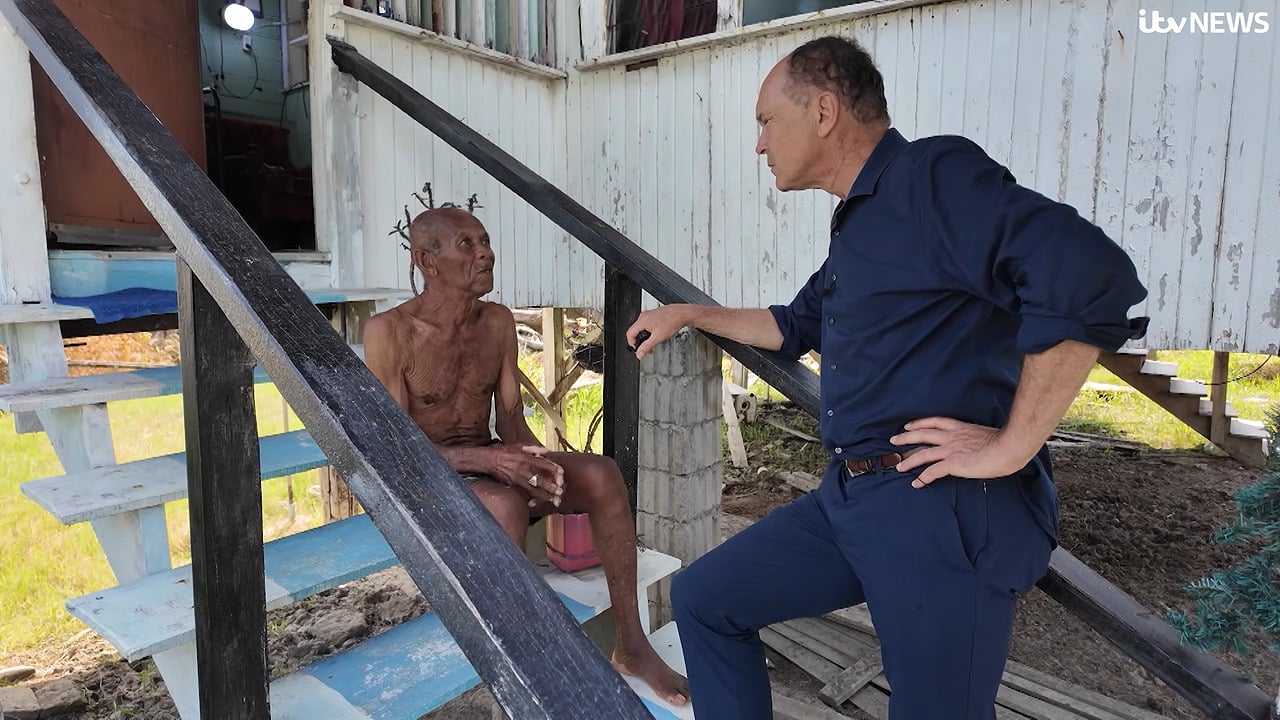
Moore also interviewed 94-year-old Rudolph Edwards, who recalled working long hours cutting cane, sometimes through the night, on sugar plantations under British rule.
Asked whether he had cut cane both day and night, Edwards confirmed that he had. He said his grandparents had been enslaved, but expressed no hostility towards the British or the King.
The report visited Georgetown locations associated with slavery, including the old Parade Ground, recalling the executions that followed the suppression of the 1823 Demerara rebellion.
Ali was particularly critical of British political arguments that the country should feel no guilt over its colonial past.
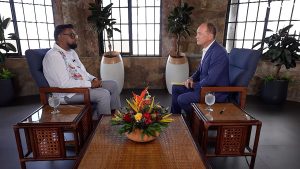
President Irfaan Ali during his interview with ITV News.
“Something is seriously wrong with them. Something is seriously wrong with that mentality,” he said, pointing to the deaths of Africans aboard slave ships and the brutality inflicted on those forced to work on plantations.
The President has previously argued that an apology must open the way to reparative justice. Stabroek News reported in August 2023 that he described an apology from descendants of British slave owner John Gladstone as a first step towards comprehensive reparations, stressing that slavery’s legacy extended beyond historical memory.
The Gladstone descendants delivered their apology at the University of Guyana during a visit coinciding with the commemoration of the 200th anniversary of the Demerara rebellion. Stabroek News reported that John Gladstone was among the largest beneficiaries of Britain’s compensation scheme for slave owners following abolition.
The wider CARICOM reparations campaign includes demands for a full and formal apology, education programmes, debt cancellation and monetary compensation. A Caribbean delegation visiting Britain in November 2025 pressed for meaningful engagement on the lasting economic and social consequences of slavery and colonialism.
Charles has previously expressed deep sorrow over slavery, while Britain has resisted demands for reparations. Stabroek News reported in June 2025 that Jamaica intended to ask the King to seek legal advice from the Judicial Committee of the Privy Council on the issue.







Discussion